













Suzuki–Miyaura catalyst-transfer polycondensation of triolborate-type fluorene monomer: toward rapid access to polyfluorene-containing block and graft copolymers from various macroinitiators
Literature Information
Publication Date
2020-10-09
DOI
10.1039/D0PY01127D
Impact Factor
5.582
Authors
Saburo Kobayashi, Kaiyu Fujiwara, Takuya Yamamoto, Kenji Tajima, Yasunori Yamamoto, Takuya Isono, Toshifumi Satoh
View Original
Abstract
In this study, we demonstrated that the Suzuki–Miyaura catalyst transfer polycondensation (SCTP) of the triolborate-type fluorene monomer, viz. potassium 2-(7-bromo-9,9-dihexyl-9H-fluorene-2-yl)triolborate, can be an efficient and versatile approach to the precise synthesis of poly[2,7-(9,9-dihexylfluorene)]s (PFs) and PF-containing block and graft copolymers. SCTP of the triolborate-type monomer proceeded rapidly in a THF/H2O mixed solvent at −10 °C using an iodobenzene derivative/Pd2(dba)3·CHCl3/t-Bu3P initiating system. Kinetic and post-polymerization experiments revealed that SCTP proceeded via the chain-growth and living polymerization mechanisms. The most important feature of the present polymerization system is that only a small amount of base and water can sufficiently promote the reaction. The well-controlled nature of this polymerization system enabled the synthesis of high-molecular-weight PFs (Mn = 5–69 kg mol−1) with narrow dispersity (ĐM = 1.14–1.38) and α-end-functionalized PFs. Most importantly, PF-containing block and graft copolymers were successfully synthesized, beginning with various iodobenzene-functionalized macroinitiators; this was difficult to achieve by the conventional SCTP of pinacolboronate-type fluorene monomer. One of the key factors for the successful block and graft copolymer syntheses is the reduced water content in the polymerization medium, which suppressed the potential precipitation/aggregation of the macroinitiators.
Related Literature
Applicability of some mass spectrometric criteria for the confirmation of pesticide residues
Eugenia Soboleva, Karam Ahad, Árpád Ambrus
2004-08-13
Paper
DOI: 10.1039/B405024J
A SIFT-MS study of positive and negative ion chemistry of the ortho-, meta- and para-isomers of cymene, cresol, and ethylphenol
Stefan J Swift, Nikola Sixtová, Patrik Španěl
2023-06-20
Paper
DOI: 10.1039/D3CP02123H
Alkaline earth metal ion doping to enhance the light emission from Er3+:SnO2 nanocrystal Co-doped silica films
Enze Qu, Lixiang Wang, Jiaming Chen, Jingjie Zhao, Jun Xu, Kunji Chen
2023-06-15
Paper
DOI: 10.1039/D3CP00337J
Correction: Structure and bonding of molecular stirrers with formula B7M2− and B8M2 (M = Zn, Cd, Hg)
Rui Yu, Jorge Barroso, Meng-hui Wang, Wei-yan Liang, Chen Chen, Ximena Zarate, Mesías Orozco-Ic, Gabriel Merino
2023-07-25
Correction
DOI: 10.1039/D3CP90156D
Measurement of nitric oxide by 4,5-diaminofluorescein without interferences
Xiaoying Ye, Won-Suk Kim, Stanislav S. Rubakhin, Jonathan V. Sweedler
2004-11-09
Paper
DOI: 10.1039/B409394A
Strain-induced giant enhancement of anisotropic dielectric constant in layered nitrides SrHfN2 and SrZrN2
Yuanyun Zhang, Jianmin Ban, Junjie Hou, Bowen Zhang, Junwei Liu, Xiaojun Kuang
2023-06-23
Paper
DOI: 10.1039/D3CP01907A
A new class of cationic surfactants inspired by N-alkyl-N-methyl pyrrolidinium ionic liquids
Gary A. Baker, Siddharth Pandey, Shubha Pandey, Sheila N. Baker
2004-08-25
Communication
DOI: 10.1039/B410301G
Comparative quantification of nucleic acids using single-molecule detection and molecular beacons
Chun-Yang Zhang, Shu-Yi Chao, Tza-Huei Wang
2005-02-09
Paper
DOI: 10.1039/B415758C
Quantitative analysis of serum and serum ultrafiltrate by means of Raman spectroscopy
Wolfgang Kiefer, Wolfgang Petrich
2004-08-10
Paper
DOI: 10.1039/B408927H
You might also like
Compound Q&A
What are the main uses of 1H-Indazole-6-carbonitrile (CAS: 141290-59-7)?
1H-Indazole-6-carbonitrile finds applications in pharmaceuticals, where it serve...
141290-59-71H-Indazole-6-carbon...
Compound Q&A
How should waste containing Dioctyl (2E)-2-butenedioate (CAS: 2997-85-5) be handled?
Waste containing Dioctyl (2E)-2-butenedioate (CAS: 2997-85-5) should be collecte...
2997-85-5Dioctyl (2E)-2-buten...
Compound Q&A
What industries use Sodium [(1,2-benzoxazol-3-ylmethyl)sulfonyl]azanide (CAS: 68291-98-5)?
Sodium [(1,2-benzoxazol-3-ylmethyl)sulfonyl]azanide is primarily used in pharmac...
68291-98-5Sodium [(1,2-benzoxa...
Compound Q&A
Are there alternatives to Dimethyl 4-(4,4,5,5-tetramethyl-1,3,2-dioxaborolan-2-yl)-2,6-pyridinedicarboxylate (CAS: 741709-66-0) in synthesis?
Dimethyl 4-(4,4,5,5-tetramethyl-1,3,2-dioxaborolan-2-yl)-2,6-pyridinedicarboxyla...
741709-66-0Dimethyl 4-(4,4,5,5-...
Compound Q&A
How should waste containing 2-Fluoro-6-hydrazinopyridine (CAS: 80714-39-2) be handled?
Waste containing 2-Fluoro-6-hydrazinopyridine (CAS: 80714-39-2) should be manage...
80714-39-22-Fluoro-6-hydrazino...
Compound Q&A
What is 6-Formyl-2-pyridinecarboxylic acid (CAS: 499214-11-8)?
6-Formyl-2-pyridinecarboxylic acid is an organic compound with the molecular for...
499214-11-86-Formyl-2-pyridinec...
Compound Q&A
What is the market or research trend for 3-(3,4-dimethoxyphenyl)-2,5-dimethyl-N-(2-morpholin-4-ylethyl)pyrazolo[1,5-a]pyrimidin-7-amine (CAS: 900874-91-1)?
Research trends for this compound indicate a focus on its potential applications...
900874-91-13-(3,4-dimethoxyphen...
Compound Q&A
How is 9H-Tribenzo[b,d,f]azepine (CAS: 29875-73-8) typically synthesized?
9H-Tribenzo[b,d,f]azepine is typically synthesized via a multi-step process invo...
29875-73-89H-Tribenzo[b,d,f]az...
Compound Q&A
How is 1-Cyclopropyl-7-ethoxy-6-fluoro-8-methoxy-4-oxo-1,4-dihydro-3-quinolinecarboxylic acid (CAS: 1797982-51-4) typically synthesized?
1-Cyclopropyl-7-ethoxy-6-fluoro-8-methoxy-4-oxo-1,4-dihydro-3-quinolinecarboxyli...
1797982-51-41-Cyclopropyl-7-etho...
Compound Q&A
How should waste containing Methyl 3-oxo-1,2,3,4-tetrahydro-6-quinoxalinecarboxylate (CAS: 671820-52-3) be handled?
Waste containing Methyl 3-oxo-1,2,3,4-tetrahydro-6-quinoxalinecarboxylate (CAS: ...
671820-52-3Methyl 3-oxo-1,2,3,4...
Source Journal
Polymer Chemistry

CiteScore:
8.6
Self-citation Rate:
7.3%
Articles per Year:
457
Polymer Chemistry welcomes submissions in all areas of polymer science that have a strong focus on macromolecular chemistry. Manuscripts may cover a broad range of fields, yet no direct application focus is required.
Recommended Compounds
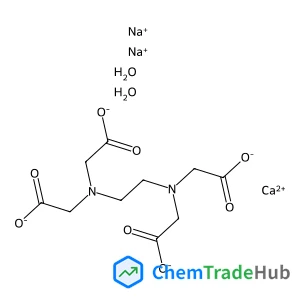
EthylenediaminetetraaceticacidcalciumDisodiumsalthydrate
CAS Number:
23411-34-9
Molecular Formula:
C10H16CaN2Na2O10
Recommended Suppliers





Disclaimer
This page provides academic journal information for reference and research purposes only. We are not affiliated with any journal publishers and do not handle publication submissions. For publication-related inquiries, please contact the respective journal publishers directly.
If you notice any inaccuracies in the information displayed, please contact us at support@chemtradehub.com. We will promptly review and address your concerns.