



Measurement of nitric oxide by 4,5-diaminofluorescein without interferences
Literature Information
Publication Date
2004-11-09
DOI
10.1039/B409394A
Impact Factor
4.616
Authors
Xiaoying Ye, Won-Suk Kim, Stanislav S. Rubakhin, Jonathan V. Sweedler
View Original
Abstract
The fluorescent reagent 4,5-diaminofluorescein (DAF-2) has been widely used for specific and quantitative measurements of nitric oxide (NO) in biological tissues. Recently it was reported that dehydroascorbic acid (DHA) and ascorbic acid (AA) interfere with the measurement of NO using DAF-2. A new method of assaying NO using DAF-2 eliminates these interferences; when frozen on dry ice, the NO in the original solution still diffuses and can react with an adjacent frozen block of DAF-2, but the confounding compounds such as DHA do not. Thus, placing the microliter-volume frozen blocks of solutions containing NO and the solutions of DAF-2 adjacent to each other for 30 min results in the concentration dependent formation of fluorescent product (DAF-2T) from the reaction of NO with DAF-2. The product has been characterized and the method validated using both fluorescence spectroscopy and capillary electrophoresis with laser induced fluorescence detection. With this approach, the presence of DHA and AA does not interfere with NO measurements, and product formation is inhibited in the presence of NO scavengers added to either of the solutions before freezing. The contactless DAF-2 method successfully assays NO in nitric oxide synthase-positive vertebrate and invertebrate tissues. This method allows nondestructive NO detection in biological samples that can subsequently be used for morphological and/or biochemical studies.
Recommended Journals

Pure and Applied Chemistry

Journal of Heterocyclic Chemistry

Russian Chemical Reviews

Fibre Chemistry

Planta Medica

Journal of Catalysis

Journal of Physics and Chemistry of Solids

Pharmacological Reviews

Proceedings of the National Academy of Sciences of the United States of America

Israel Journal of Chemistry
Related Literature
A zero dimensional model of lithium–sulfur batteries during charge and discharge
Monica Marinescu, Teng Zhang, Gregory J. Offer
2015-11-12
Paper
DOI: 10.1039/C5CP05755H
Variable electronic properties of lateral phosphorene–graphene heterostructures
Xiaoqing Tian, Lin Liu, Yu Du, Juan Gu, Jian-bin Xu, Boris I. Yakobson
2015-11-06
Paper
DOI: 10.1039/C5CP05443E
Two equivalent methyl internal rotations in 2,5-dimethylthiophene investigated by microwave spectroscopy
Vinh Van, Wolfgang Stahl, Ha Vinh Lam Nguyen
2015-09-29
Communication
DOI: 10.1039/C5CP03513A
Limits and potentials of quantum chemical methods in modelling photosynthetic antennae
Sandro Jurinovich, Carles Curutchet, Benedetta Mennucci
2015-04-02
Perspective
DOI: 10.1039/C5CP00986C
Synthesis of hollow cobalt oxide nanopowders by a salt-assisted spray pyrolysis process applying nanoscale Kirkendall diffusion and their electrochemical properties
Hyeon Seok Ju, Jung Sang Cho, Jong Hwa Kim, Yun Ju Choi, Yun Chan Kang
2015-11-05
Paper
DOI: 10.1039/C5CP06206C
Revealing photofragmentation dynamics through interactions between Rydberg states: REMPI of HI as a case study
Helgi Rafn Hróðmarsson, Ágúst Kvaran
2015-11-11
Paper
DOI: 10.1039/C5CP06185G
An auxilliary grid method for the calculation of electrostatic terms in density functional theory on a real-space grid
Michael Zuzovski, Amir Boag, Amir Natan
2015-06-30
Paper
DOI: 10.1039/C5CP01090J
CO2 adsorption–desorption performance of mesoporous zirconium hydroxide with robust water durability
Y. Kamimura, A. Endo
2015-12-16
Paper
DOI: 10.1039/C5CP05211D
Heteroatom substituted and decorated graphene: preparation and applications
Nan Chen, Xianke Huang, Liangti Qu
2015-10-01
Perspective
DOI: 10.1039/C5CP04391C
You might also like
Compound Q&A
What are the main uses of 1H-Indazole-6-carbonitrile (CAS: 141290-59-7)?
1H-Indazole-6-carbonitrile finds applications in pharmaceuticals, where it serve...
141290-59-71H-Indazole-6-carbon...
Compound Q&A
How should waste containing Dioctyl (2E)-2-butenedioate (CAS: 2997-85-5) be handled?
Waste containing Dioctyl (2E)-2-butenedioate (CAS: 2997-85-5) should be collecte...
2997-85-5Dioctyl (2E)-2-buten...
Compound Q&A
What industries use Sodium [(1,2-benzoxazol-3-ylmethyl)sulfonyl]azanide (CAS: 68291-98-5)?
Sodium [(1,2-benzoxazol-3-ylmethyl)sulfonyl]azanide is primarily used in pharmac...
68291-98-5Sodium [(1,2-benzoxa...
Compound Q&A
Are there alternatives to Dimethyl 4-(4,4,5,5-tetramethyl-1,3,2-dioxaborolan-2-yl)-2,6-pyridinedicarboxylate (CAS: 741709-66-0) in synthesis?
Dimethyl 4-(4,4,5,5-tetramethyl-1,3,2-dioxaborolan-2-yl)-2,6-pyridinedicarboxyla...
741709-66-0Dimethyl 4-(4,4,5,5-...
Compound Q&A
How should waste containing 2-Fluoro-6-hydrazinopyridine (CAS: 80714-39-2) be handled?
Waste containing 2-Fluoro-6-hydrazinopyridine (CAS: 80714-39-2) should be manage...
80714-39-22-Fluoro-6-hydrazino...
Compound Q&A
What is 6-Formyl-2-pyridinecarboxylic acid (CAS: 499214-11-8)?
6-Formyl-2-pyridinecarboxylic acid is an organic compound with the molecular for...
499214-11-86-Formyl-2-pyridinec...
Compound Q&A
What is the market or research trend for 3-(3,4-dimethoxyphenyl)-2,5-dimethyl-N-(2-morpholin-4-ylethyl)pyrazolo[1,5-a]pyrimidin-7-amine (CAS: 900874-91-1)?
Research trends for this compound indicate a focus on its potential applications...
900874-91-13-(3,4-dimethoxyphen...
Compound Q&A
How is 9H-Tribenzo[b,d,f]azepine (CAS: 29875-73-8) typically synthesized?
9H-Tribenzo[b,d,f]azepine is typically synthesized via a multi-step process invo...
29875-73-89H-Tribenzo[b,d,f]az...
Compound Q&A
How is 1-Cyclopropyl-7-ethoxy-6-fluoro-8-methoxy-4-oxo-1,4-dihydro-3-quinolinecarboxylic acid (CAS: 1797982-51-4) typically synthesized?
1-Cyclopropyl-7-ethoxy-6-fluoro-8-methoxy-4-oxo-1,4-dihydro-3-quinolinecarboxyli...
1797982-51-41-Cyclopropyl-7-etho...
Compound Q&A
How should waste containing Methyl 3-oxo-1,2,3,4-tetrahydro-6-quinoxalinecarboxylate (CAS: 671820-52-3) be handled?
Waste containing Methyl 3-oxo-1,2,3,4-tetrahydro-6-quinoxalinecarboxylate (CAS: ...
671820-52-3Methyl 3-oxo-1,2,3,4...
Source Journal
Analyst

CiteScore:
7.8
Self-citation Rate:
5.6%
Articles per Year:
653
Analyst publishes analytical and bioanalytical research that reports premier fundamental discoveries and inventions, and the applications of those discoveries, unconfined by traditional discipline barriers.
Recommended Compounds
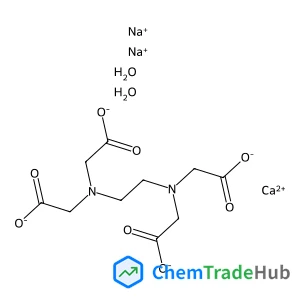
EthylenediaminetetraaceticacidcalciumDisodiumsalthydrate
CAS Number:
23411-34-9
Molecular Formula:
C10H16CaN2Na2O10

Recommended Suppliers






Disclaimer
This page provides academic journal information for reference and research purposes only. We are not affiliated with any journal publishers and do not handle publication submissions. For publication-related inquiries, please contact the respective journal publishers directly.
If you notice any inaccuracies in the information displayed, please contact us at support@chemtradehub.com. We will promptly review and address your concerns.