












Stimuli-responsive non-ionic Gemini amphiphiles for drug delivery applications
Literature Information
Publication Date
2020-09-29
DOI
10.1039/D0PY01040E
Impact Factor
5.582
Authors
Rashmi, Abhishek K. Singh, Katharina Achazi, Christoph Böttcher, Rainer Haag, Sunil K. Sharma
View Original
Abstract
A series of six novel disulfide-bond-linked Gemini amphiphiles have been synthesized using polyethylene glycol (PEG) as hydrophilic units and alkoxy aryl moieties as hydrophobic units. The self-assembling behaviour of the resulting amphiphiles was studied using fluorescence spectroscopy and dynamic light scattering (DLS). The inner hydrophobic core with an alkyl and fluoroalkyl chain aggregates differently in aqueous medium as evidenced by a cryo-TEM study. Also they are found to be capable of encapsulating a lipophilic guest. The encapsulation behaviour was studied using Nile red as a model hydrophobic dye and extended further by including curcumin and an anti-cancerous drug doxorubicin. Furthermore, for biological evaluation, their cytotoxicity and cellular uptake were studied. The presence of stimuli responsive disulfide linkages and the ester functionality provides the possibility of redox responsive and enzymatic release of the encapsulated cargo, which was studied by using various concentrations of glutathione (GSH) and an immobilized lipase Novozym 435.
Related Literature
Spurious serotonin dimer formation using electrokinetic injection in capillary electrophoresis from small volume biological samples
Jeffrey N. Stuart, Nathan G. Hatcher, Xin Zhang, Rhanor Gillette, Jonathan V. Sweedler
2004-12-07
Paper
DOI: 10.1039/B413024C
Measurement of nitric oxide by 4,5-diaminofluorescein without interferences
Xiaoying Ye, Won-Suk Kim, Stanislav S. Rubakhin, Jonathan V. Sweedler
2004-11-09
Paper
DOI: 10.1039/B409394A
A new class of cationic surfactants inspired by N-alkyl-N-methyl pyrrolidinium ionic liquids
Gary A. Baker, Siddharth Pandey, Shubha Pandey, Sheila N. Baker
2004-08-25
Communication
DOI: 10.1039/B410301G
The impact of intramolecular polydispersity on the self-assembly of ABn miktoarm star copolymers
Jiahao Shi, Xianbo Huang, Weihua Li
2023-07-06
Paper
DOI: 10.1039/D3CP00994G
Novel approach for mono-segmented flow micro-titration with sequential injection using a lab-on-valve system: a model study for the assay of acidity in fruit juices
Lop Pathimapornlert
2005-01-10
Paper
DOI: 10.1039/B413585G
Imprinted polymers for chiral resolution of (±)-ephedrine: understanding the pre-polymerisation equilibrium and the action of different mobile phase modifiers
Richard J. Ansell, Kim L. Kuah
2004-12-03
Paper
DOI: 10.1039/B408751H
Interfacial kinetics of synergistic extraction of samarium(iii) studied by micro-two-phase sheath flow/fluorescence microscopy
Takahira Tokimoto, Satoshi Tsukahara, Hitoshi Watarai
2004-08-19
Paper
DOI: 10.1039/B410593A
Second harmonic generation from aluminum plasmonic nanocavities: from scanning to imaging
Tchiya Zar, Alon Krause, Hannah Aharon, Racheli Ron, Martin Oheim
2023-06-29
Paper
DOI: 10.1039/D3CP01678A
The application of a SERS fiber probe for the investigation of sensitive biological samples
R. Geßner, P. Rösch, R. Petry, M. Schmitt, M. A. Strehle, W. Kiefer, J. Popp
2004-11-10
Paper
DOI: 10.1039/B411690A
Quantitative analysis of serum and serum ultrafiltrate by means of Raman spectroscopy
Wolfgang Kiefer, Wolfgang Petrich
2004-08-10
Paper
DOI: 10.1039/B408927H
You might also like
Compound Q&A
What are the main uses of 1H-Indazole-6-carbonitrile (CAS: 141290-59-7)?
1H-Indazole-6-carbonitrile finds applications in pharmaceuticals, where it serve...
141290-59-71H-Indazole-6-carbon...
Compound Q&A
How should waste containing Dioctyl (2E)-2-butenedioate (CAS: 2997-85-5) be handled?
Waste containing Dioctyl (2E)-2-butenedioate (CAS: 2997-85-5) should be collecte...
2997-85-5Dioctyl (2E)-2-buten...
Compound Q&A
What industries use Sodium [(1,2-benzoxazol-3-ylmethyl)sulfonyl]azanide (CAS: 68291-98-5)?
Sodium [(1,2-benzoxazol-3-ylmethyl)sulfonyl]azanide is primarily used in pharmac...
68291-98-5Sodium [(1,2-benzoxa...
Compound Q&A
Are there alternatives to Dimethyl 4-(4,4,5,5-tetramethyl-1,3,2-dioxaborolan-2-yl)-2,6-pyridinedicarboxylate (CAS: 741709-66-0) in synthesis?
Dimethyl 4-(4,4,5,5-tetramethyl-1,3,2-dioxaborolan-2-yl)-2,6-pyridinedicarboxyla...
741709-66-0Dimethyl 4-(4,4,5,5-...
Compound Q&A
How should waste containing 2-Fluoro-6-hydrazinopyridine (CAS: 80714-39-2) be handled?
Waste containing 2-Fluoro-6-hydrazinopyridine (CAS: 80714-39-2) should be manage...
80714-39-22-Fluoro-6-hydrazino...
Compound Q&A
What is 6-Formyl-2-pyridinecarboxylic acid (CAS: 499214-11-8)?
6-Formyl-2-pyridinecarboxylic acid is an organic compound with the molecular for...
499214-11-86-Formyl-2-pyridinec...
Compound Q&A
What is the market or research trend for 3-(3,4-dimethoxyphenyl)-2,5-dimethyl-N-(2-morpholin-4-ylethyl)pyrazolo[1,5-a]pyrimidin-7-amine (CAS: 900874-91-1)?
Research trends for this compound indicate a focus on its potential applications...
900874-91-13-(3,4-dimethoxyphen...
Compound Q&A
How is 9H-Tribenzo[b,d,f]azepine (CAS: 29875-73-8) typically synthesized?
9H-Tribenzo[b,d,f]azepine is typically synthesized via a multi-step process invo...
29875-73-89H-Tribenzo[b,d,f]az...
Compound Q&A
How is 1-Cyclopropyl-7-ethoxy-6-fluoro-8-methoxy-4-oxo-1,4-dihydro-3-quinolinecarboxylic acid (CAS: 1797982-51-4) typically synthesized?
1-Cyclopropyl-7-ethoxy-6-fluoro-8-methoxy-4-oxo-1,4-dihydro-3-quinolinecarboxyli...
1797982-51-41-Cyclopropyl-7-etho...
Compound Q&A
How should waste containing Methyl 3-oxo-1,2,3,4-tetrahydro-6-quinoxalinecarboxylate (CAS: 671820-52-3) be handled?
Waste containing Methyl 3-oxo-1,2,3,4-tetrahydro-6-quinoxalinecarboxylate (CAS: ...
671820-52-3Methyl 3-oxo-1,2,3,4...
Source Journal
Polymer Chemistry

CiteScore:
8.6
Self-citation Rate:
7.3%
Articles per Year:
457
Polymer Chemistry welcomes submissions in all areas of polymer science that have a strong focus on macromolecular chemistry. Manuscripts may cover a broad range of fields, yet no direct application focus is required.
Recommended Compounds
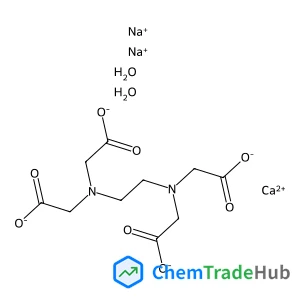
EthylenediaminetetraaceticacidcalciumDisodiumsalthydrate
CAS Number:
23411-34-9
Molecular Formula:
C10H16CaN2Na2O10

Recommended Suppliers





Disclaimer
This page provides academic journal information for reference and research purposes only. We are not affiliated with any journal publishers and do not handle publication submissions. For publication-related inquiries, please contact the respective journal publishers directly.
If you notice any inaccuracies in the information displayed, please contact us at support@chemtradehub.com. We will promptly review and address your concerns.