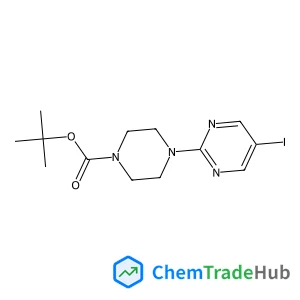
2-Methyl-2-propanyl 4-(5-iodo-2-pyrimidinyl)-1-piperazinecarboxylate
CAS Number:
1027616-32-5
Molecular Formula:
C13H19IN4O2
Roxane Ridolfo, David S. Williams, Jan C. M. van Hest
Polymeric vesicles (polymersomes) are an important class of nanoparticles for various biomedical applications. Their interaction with biological systems is strongly dependent on their topological features such as size, shape and surface charge. We have recently developed a versatile method that enables the formation of tubes or bowl-shaped vesicles (stomatocytes) out of spherical vesicles composed of the biodegradable block copolymer poly(ethylene glycol)-poly(D,L-lactic acid) (PEG-b-PDLLA), via a dialysis process. Applying this method for particles with different surface charge is however a far from trivial task, as the shape change process is affected by spontaneous membrane curvature, which is strongly influenced by the presence of charged polymer end groups. Here we describe an optimized procedure to attain an effective shape transformation toward tubes of PEG-b-PDLLA polymersomes containing PEG blocks with amine (A) or carboxylic acid (CA) end groups. The salt concentration employed during the dialysis process turns out to be key, with the CA-polymersomes requiring substantially lower concentrations than unmodified or A-ones. The ability to control now reliably shape and surface charge in these polymer vesicles, allows a future systematic analysis of the effect of these topological parameters on the biological response of the nanoparticles.

Topics in Catalysis

Journal of Chemical Sciences

Critical Reviews in Solid State and Materials Sciences

NDT & E International

Biocatalysis and Biotransformation

Chinese Journal of Chemistry

Acta Metallurgica Sinica-English Letters

Polycyclic Aromatic Compounds

Electroanalysis

Bioorganic & Medicinal Chemistry Letters
Chanchal Sonkar, Sayantan Sarkar
DOI: 10.1039/D1MD00220A
Nelson A. M. Pereira, Bruno F. O. Nascimento, João Pina, Gonçalo Brites, J. Sérgio Seixas de Melo, Marta Pineiro, Teresa M. V. D. Pinho e Melo
DOI: 10.1039/D0MD00433B
Padma Akkapeddi, Kai Wen Teng
DOI: 10.1039/D1MD00188D
DOI: 10.1039/D0MD00382D
Manuel E. Otero-Ramirez, Kyoko Matoba, Emiko Mihara, Junichi Takagi, Hiroaki Suga
DOI: 10.1039/D0CB00016G
Sahil Mishra, Shreya
DOI: 10.1039/D0MD00318B
DOI: 10.1039/D1MD00022E
Hyunsoo Kim, Yoon Soo Hwang, Mingi Kim
DOI: 10.1039/D1MD00068C
Waste containing 6-Chloro-5-(2'-hydroxy-3'-methoxy-4-biphenylyl)-3-(3-methoxyphe...
(3alpha,5alpha)-3-Hydroxypregnane-11,20-dione is primarily used in the pharmaceu...
The market for 4-Amino-6-chloro-2-pyridinecarboxylic acid (CAS: 546141-56-4) is ...
Alternatives to (2-Benzoylethyl)trimethylammonium chloride (CAS: 24472-88-6) in ...
N-[4-Nitro-3-(trifluoromethyl)phenyl]acetamide (CAS: 393-12-4) is generally safe...
Alternative reagents such as other phosphates or similar functional groups can b...
There are alternatives to N,N'-Bis(3-aminopropyl)-1,3-propanediamine (CAS: 4605-...
When handling Aluminium trihexadecanoate, it is important to use appropriate per...
(1,1-Dioxido-3-oxo-1,2-benzothiazol-2(3H)-yl)acetic acid is a chemical compound ...
Several alternatives to 5,5-dimethyloxolan-2-one (CAS: 3123-97-5) can be used in...

Polymer Chemistry welcomes submissions in all areas of polymer science that have a strong focus on macromolecular chemistry. Manuscripts may cover a broad range of fields, yet no direct application focus is required.
![1-(2-Chlorophenyl)-6-[(2S)-3,3,3-trifluoro-2-methylpropyl]-1,7-dihydro-4H-pyrazolo[3,4-d]pyrimidin-4-one structure](https://static.chemtradehub.com/structs/794/794568-91-5-0c34.webp "1-(2-Chlorophenyl)-6-[(2S)-3,3,3-trifluoro-2-methylpropyl]-1,7-dihydro-4H-pyrazolo[3,4-d]pyrimidin-4-one structure")