












Vesicular assemblies of thermoresponsive amphiphilic polypeptide copolymers for guest encapsulation and release
Literature Information
Publication Date
2020-03-19
DOI
10.1039/D0PY00135J
Impact Factor
5.582
Authors
Mahammad Anas, Somdeb Jana, Tarun K. Mandal
View Original
Abstract
Synthetic polypeptides are bio-inspired materials with good self-assembling capabilities. However, their hydrophobic nature restricts their use in biomedical applications. Pseudopeptidic poly(2-oxazoline)s are also bio-inspired and water-soluble polymers. Thus, the motivation for this research work is to integrate these two units to produce amphiphilic copolymers with a high propensity to self-assemble into vesicular nanostructures that are useful for various potential applications. To achieve this, a convenient “click” grafting technique is utilized to prepare water-soluble amphiphilic poly(cysteine)-graft-poly(2-isopropyl-2-oxazoline) (PCys-g-PiPOx) copolymers. This involves synthesis of propargylated polycysteine (PCys-S-Pr) and azide-functionalized poly(2-isopropyl-2-oxazoline) (PiPOx-N3) blocks via ring-opening polymerization (ROP) of the corresponding N-carboxyanhydride (NCA) and cationic ring-opening polymerization (CROP) techniques, respectively, followed by their grafting. The grafting of the PiPOx block introduces thermoresponsiveness in the copolymer, exhibiting LCST phase behaviour in water, whose cloud point can be tuned by varying the copolymer's composition and concentration. The amphiphilic nature of PCys-g-PiPOx molecules drives them to self-assemble into nanostructures with vesicular morphology in aqueous and nonaqueous media, as clearly evident from the transmission electron microscopic images. These polypeptide copolymer vesicles are capable of encapsulating both hydrophobic and hydrophilic dyes present in different environments and confirmed through fluorescence and confocal microscopy. These copolymer vesicles can also be highly efficiently used for encapsulating the drug doxorubicin and their subsequent triggered release was also studied by absorption and emission spectroscopy.
Related Literature
Macrocyclization strategies for cyclic peptides and peptidomimetics
Clément Bechtler, Christina Lamers
2021-06-29
Review Article
DOI: 10.1039/D1MD00083G
The medicinal chemistry of mitochondrial dysfunction: a critical overview of efforts to modulate mitochondrial health
Maximillian Taro William Lee, William Mahy, Mark David Rackham
2021-06-04
Review Article
DOI: 10.1039/D1MD00113B
Mycobacterial drug discovery
Katherine A. Abrahams, Gurdyal S. Besra
2020-11-06
Review Article
DOI: 10.1039/D0MD00261E
Pharmacokinetics and pharmacodynamics in the treatment of cutaneous leishmaniasis – challenges and opportunities
Katrien Van Bocxlaer, Simon L. Croft
2021-01-07
Review Article
DOI: 10.1039/D0MD00343C
Activity-based protein profiling reveals deubiquitinase and aldehyde dehydrogenase targets of a cyanopyrrolidine probe
Nattawadee Panyain, Aurélien Godinat, Aditya Raymond Thawani, Sofía Lachiondo-Ortega, Katie Mason, Sarah Elkhalifa, Lisa M. Smith, Jeanine A. Harrigan
2021-08-16
Research Article
DOI: 10.1039/D1MD00218J
Fragment-based drug discovery: opportunities for organic synthesis
Jeffrey D. St. Denis, Richard J. Hall, Christopher W. Murray, Tom D. Heightman, David C. Rees
2020-12-24
Review Article
DOI: 10.1039/D0MD00375A
Put a ring on it: application of small aliphatic rings in medicinal chemistry
Matthias R. Bauer, Paolo Di Fruscia, Simon C. C. Lucas, Iacovos N. Michaelides, Jennifer E. Nelson, R. Ian Storer, Benjamin C. Whitehurst
2021-01-07
Review Article
DOI: 10.1039/D0MD00370K
Introducing the metacore concept for multi-target ligand design
Dagmar Stumpfe, Alexander Hoch, Jürgen Bajorath
2021-04-15
Research Article
DOI: 10.1039/D1MD00056J
Cyclisation strategies for stabilising peptides with irregular conformations
Quynh Ngoc Vu, Reginald Young, Haritha Krishna Sudhakar, Tianyi Gao, Tiancheng Huang, Yaw Sing Tan, Yu Heng Lau
2021-04-28
Review Article
DOI: 10.1039/D1MD00098E
Benzimidazole-1,2,3-triazole hybrid molecules: synthesis and study of their interaction with G-quadruplex DNA
Ushasri Chilakamarthi, Namita S. Mahadik, Bhamidipati Keerti, Santosh N. Mokale, Narayana Nagesh
2021-02-22
Research Article
DOI: 10.1039/D0MD00414F
You might also like
Compound Q&A
How should waste containing 6-Chloro-5-(2'-hydroxy-3'-methoxy-4-biphenylyl)-3-(3-methoxyphenyl)-1H-pyrrolo[3,2-d]pyrimidine-2,4(3H,5H)-dione (CAS: 1346607-05-3) be handled?
Waste containing 6-Chloro-5-(2'-hydroxy-3'-methoxy-4-biphenylyl)-3-(3-methoxyphe...
1346607-05-36-Chloro-5-(2'-hydro...
Compound Q&A
What are the main uses of (3alpha,5alpha)-3-Hydroxypregnane-11,20-dione (CAS: 23930-19-0)?
(3alpha,5alpha)-3-Hydroxypregnane-11,20-dione is primarily used in the pharmaceu...
23930-19-0(3alpha,5alpha)-3-Hy...
Compound Q&A
What is the market or research trend for 4-Amino-6-chloro-2-pyridinecarboxylic acid (CAS: 546141-56-4)?
The market for 4-Amino-6-chloro-2-pyridinecarboxylic acid (CAS: 546141-56-4) is ...
546141-56-44-Amino-6-chloro-2-p...
Compound Q&A
Are there alternatives to (2-Benzoylethyl)trimethylammonium chloride (CAS: 24472-88-6) in synthesis?
Alternatives to (2-Benzoylethyl)trimethylammonium chloride (CAS: 24472-88-6) in ...
24472-88-6(2-Benzoylethyl)trim...
Compound Q&A
Is N-[4-Nitro-3-(trifluoromethyl)phenyl]acetamide (CAS: 393-12-4) safe?
N-[4-Nitro-3-(trifluoromethyl)phenyl]acetamide (CAS: 393-12-4) is generally safe...
393-12-4N-[4-Nitro-3-(triflu...
Compound Q&A
Are there alternatives to [(4R,5R,6S)-5-hydroxy-10-imino-3,7-dioxa-1,9-diazatricyclo[6.4.0.02,6]dodeca-8,11-dien-4-yl]methyl dihydrogen phosphate (CAS: 39679-56-6) in synthesis?
Alternative reagents such as other phosphates or similar functional groups can b...
39679-56-6[(4R,5R,6S)-5-hydrox...
Compound Q&A
Are there alternatives to N,N'-Bis(3-aminopropyl)-1,3-propanediamine (CAS: 4605-14-5) in synthesis?
There are alternatives to N,N'-Bis(3-aminopropyl)-1,3-propanediamine (CAS: 4605-...
4605-14-5N,N'-Bis(3-aminoprop...
Compound Q&A
What precautions should be taken when handling Aluminium trihexadecanoate (CAS: 555-35-1)?
When handling Aluminium trihexadecanoate, it is important to use appropriate per...
555-35-1Aluminium trihexadec...
Compound Q&A
What is (1,1-Dioxido-3-oxo-1,2-benzothiazol-2(3H)-yl)acetic acid (CAS: 52188-11-1)?
(1,1-Dioxido-3-oxo-1,2-benzothiazol-2(3H)-yl)acetic acid is a chemical compound ...
52188-11-1(1,1-Dioxido-3-oxo-1...
Compound Q&A
Are there alternatives to 5,5-dimethyloxolan-2-one (CAS: 3123-97-5) in synthesis?
Several alternatives to 5,5-dimethyloxolan-2-one (CAS: 3123-97-5) can be used in...
3123-97-55,5-dimethyloxolan-2...
Source Journal
Polymer Chemistry

CiteScore:
8.6
Self-citation Rate:
7.3%
Articles per Year:
457
Polymer Chemistry welcomes submissions in all areas of polymer science that have a strong focus on macromolecular chemistry. Manuscripts may cover a broad range of fields, yet no direct application focus is required.
Recommended Compounds
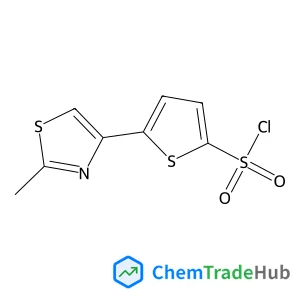
5-(2-Methyl-1,3-thiazol-4-yl)-2-thiophenesulfonyl chloride
CAS Number:
215434-25-6
Molecular Formula:
C8H6ClNO2S3

Recommended Suppliers






Disclaimer
This page provides academic journal information for reference and research purposes only. We are not affiliated with any journal publishers and do not handle publication submissions. For publication-related inquiries, please contact the respective journal publishers directly.
If you notice any inaccuracies in the information displayed, please contact us at support@chemtradehub.com. We will promptly review and address your concerns.