












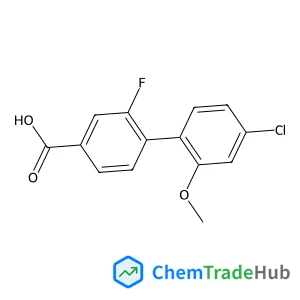
4-(4-Chloro-2-methoxyphenyl)-3-fluorobenzoic acid
CAS Number:
1261970-23-3
Molecular Formula:
C14H10ClFO3
The first page of this article is displayed as the abstract.
Lin Guo, Jinyu Zheng
DOI: 10.1039/D3CC03990K
Jiawei Huang, Xiaoman Li, Yu Wei, Liang Xu
DOI: 10.1039/D3CC04351G
Pol Salles, Pamela Machado, Pengmei Yu, Mariona Coll
DOI: 10.1039/D3CC03030J
Zhigang Ma, Xinxin Wu, Haotian Li, Zhu Cao
DOI: 10.1039/D3SC04886A
Xue-Ying Zhang, Yong Zhang, Yong Gao, Hong Zhao
DOI: 10.1039/D3CC04217K
Anna A. Wilson, Lucy Hart, Thomas Shalvey, Michael Sachs, Weidong Xu, Benjamin Moss, Eva Mazzolini, Asim Mumtaz
DOI: 10.1039/D3CC04616H
Yuxuan Liang, Meijia Qiu, Peng Sun, Wenjie Mai
DOI: 10.1039/D3SC05334B
Kai Wu, Xiaojing Wang, Piaoru Wu, Yiyang Cao, Xiuhong Lu, Yixin Xu
DOI: 10.1039/D3SC04636B
Qifei Shen, Kai Gao, Zhiqin Zhao, Anran Gao, Yanzi Xu, Heng Wang, Mingming Zhang, Dongfeng Dang
DOI: 10.1039/D3CC04166B
Ivan G. N. Silva, Bruno J. Ferreira, Alexandre C. Teixeira, Huayna Terraschke, Fernando A. Garcia, Danilo Mustafa
DOI: 10.1039/D3CC03066K
(5-Sulfamoyl-3-pyridinyl)boronic acid is primarily used in chemical synthesis, p...
Benzyl 2-methyl-2-(methylsulfonyl)-4-pentenoate is typically synthesized via est...
When handling 8-Fluoroquinolin-6-ol (CAS: 209353-22-0), it is important to use p...
1,3-Dibromo-5-(2-methyl-2-propanyl)benzene (CAS: 129316-09-2) is a crystalline c...
Ethyl 7-chloro-4-oxo-1-(1,3-thiazol-2-yl)-1,4-dihydro-1,8-naphthyridine-3-carbox...
When handling Delta-7-Avenasterol (CAS: 23290-26-8), it is important to wear app...
Proper handling involves the use of personal protective equipment such as gloves...
When handling 2-Methyl-2-proanyl 4-[(2-aminophenyl)amino]-1-piperidinecarboxylat...
N-Methyl-4-chlorobenzylamine hydrochloride (CAS: 65542-24-7) is a organic compou...
[2-(Dodecyloxy)ethoxy]acetic acid (CAS: 27306-90-7) is generally considered safe...

Physical Chemistry Chemical Physics (PCCP) is an international journal co-owned by 19 physical chemistry and physics societies from around the world. This journal publishes original, cutting-edge research in physical chemistry, chemical physics and biophysical chemistry. To be suitable for publication in PCCP, articles must include significant innovation and/or insight into physical chemistry; this is the most important criterion that reviewers and Editors will judge against when evaluating submissions. The journal has a broad scope and welcomes contributions spanning experiment, theory, computation and data science. Topical coverage includes spectroscopy, dynamics, kinetics, statistical mechanics, thermodynamics, electrochemistry, catalysis, surface science, quantum mechanics, quantum computing and machine learning. Interdisciplinary research areas such as polymers and soft matter, materials, nanoscience, energy, surfaces/interfaces, and biophysical chemistry are welcomed if they demonstrate significant innovation and/or insight into physical chemistry. Joined experimental/theoretical studies are particularly appreciated when complementary and based on up-to-date approaches.
![2-Methyl-2-propanyl 4-oxo-3,9-diazabicyclo[4.2.1]nonane-9-carboxylate structure](https://static.chemtradehub.com/structs/131/1312456-05-5-9a15.webp "2-Methyl-2-propanyl 4-oxo-3,9-diazabicyclo[4.2.1]nonane-9-carboxylate structure")
![4,10-Dihydroxy-3H-pyrano[3,4,5-kl]xanthen-3-one structure](https://static.chemtradehub.com/structs/125/1259330-61-4-de48.webp "4,10-Dihydroxy-3H-pyrano[3,4,5-kl]xanthen-3-one structure")





