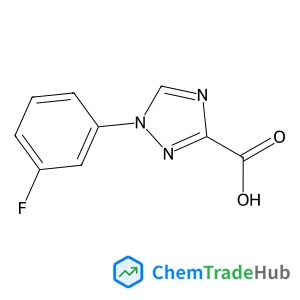
1-(3-Fluorophenyl)-1H-1,2,4-triazole-3-carboxylic acid
CAS Number:
1292369-51-7
Molecular Formula:
C9H6FN3O2
Yufeng Xie, Juan Zhao, Yibin Hu, Xiang Ye, Yiqun Xie, Ronggen Cao
Monolayer phosphorene has outstanding spintronic properties including a nanosecond spin lifetime, and micrometer spin relaxation length, combined with excellent mechanical flexibility, making it rather attractive in low-dimensional flexible spintronic devices. However, knowledge on the spin-transport properties of phosphorene under mechanical strain is currently very limited. Here, we study the transport properties of the spin-polarized photocurrent in the flexible Ni–phosphorene–Ni photodetector, which is driven by the photogalvanic effect (PGE) under mechanical tension stress and bending. Broadband PGE photocurrent is generated at zero bias under the illumination of linearly polarized light due to the broken inversion symmetry of the photodetector. Remarkable spin-transport performances including the fully spin-polarized photocurrent, perfect spin-valve effect, and enhanced pure spin current are generated in a broad visible range by applying appropriate mechanical tension stress or bending. Our results indicate that the PGE-driven phosphorene-based photodetector has promising applications in flexible and low-power spintronic devices.
Qian Xu, Yifu Yang, Huixia Shao
DOI: 10.1039/C5CP02789F
Goutam Nandi, Bhaskar Chilukuri, K. W. Hipps, Ursula Mazur
DOI: 10.1039/C6CP04454A
Hamed Attariani, Richard A. LeSar
DOI: 10.1039/C6CP04007A
DOI: 10.1039/C6CP02177H
Mitsunori Kitta, Riki Kataoka, Masanori Kohyama
DOI: 10.1039/C6CP03379B
Yongjin Lee, Alexander J. Pak, Gyeong S. Hwang
DOI: 10.1039/C6CP04388G
Annabell G. Bonn, Oliver S. Wenger
DOI: 10.1039/C5CP04718H
Ranna Tolouei, Jerome Harrison, Carlo Paternoster, Stephane Turgeon, Pascale Chevallier, Diego Mantovani
DOI: 10.1039/C6CP02451C
Jingya Dai, Qitang Fan, Tao Wang, Julian Kuttner, Gerhard Hilt, J. Michael Gottfried, Junfa Zhu
DOI: 10.1039/C6CP03551E
Kamil Sobczak, Piotr Dłużewski, Anna Reszka, Bogdan J. Kowalski, Łukasz Kłopotowski, Danek Elbaum, Krzysztof Fronc
DOI: 10.1039/C5CP02278A
Waste containing N-Methoxy-N-methyl-1,3-thiazole-5-carboxamide (CAS: 898825-89-3...
N-(4-Biphenylyl)dibenzo[b,d]furan-4-amine should be stored in a tightly sealed c...
The market for 3-Acetamido-5-amino-2,4,6-triiodobenzoic acid (CAS: 1713-07-1) is...
Benzyl 2-O-acetyl-3,4,6-tri-O-benzyl-beta-D-galactopyranoside (CAS: 61820-03-9) ...
2-Ethylpiperazine dihydrochloride (CAS: 438050-52-3) is regulated under the Glob...
1,1'-[1,3-Phenylenebis(methylene)]bis(3-methyl-1H-pyrrole-2,5-dione) (CAS: 11946...
Several alternatives can be used in the synthesis of 5-Fluoro-2-(1-pyrrolidinyl)...
Proper personal protective equipment (PPE) must be worn when handling this compo...
When handling 6-Bromoimidazo[1,2-a]pyridin-8-amine, it is important to wear appr...
Alternatives to (2S,4R)-4-(4-Nitrobenzyl)pyrrolidine-2-carboxylic acid hydrochlo...

Physical Chemistry Chemical Physics (PCCP) is an international journal co-owned by 19 physical chemistry and physics societies from around the world. This journal publishes original, cutting-edge research in physical chemistry, chemical physics and biophysical chemistry. To be suitable for publication in PCCP, articles must include significant innovation and/or insight into physical chemistry; this is the most important criterion that reviewers and Editors will judge against when evaluating submissions. The journal has a broad scope and welcomes contributions spanning experiment, theory, computation and data science. Topical coverage includes spectroscopy, dynamics, kinetics, statistical mechanics, thermodynamics, electrochemistry, catalysis, surface science, quantum mechanics, quantum computing and machine learning. Interdisciplinary research areas such as polymers and soft matter, materials, nanoscience, energy, surfaces/interfaces, and biophysical chemistry are welcomed if they demonstrate significant innovation and/or insight into physical chemistry. Joined experimental/theoretical studies are particularly appreciated when complementary and based on up-to-date approaches.

![tert-Butyl 6-chloro-4-oxospiro[chroman-2,4'-piperidine]-1'-carboxylate structure](https://static.chemtradehub.com/structs/101/1011482-37-3-88a5.webp "tert-Butyl 6-chloro-4-oxospiro[chroman-2,4'-piperidine]-1'-carboxylate structure")