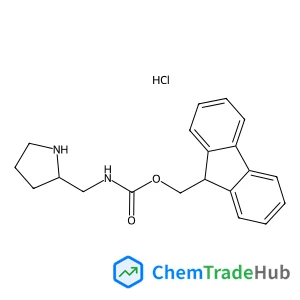
(S)-(9H-Fluoren-9-yl)methyl (pyrrolidin-2-ylmethyl)carbamate hydrochloride
CAS Number:
1217813-15-4
Molecular Formula:
C20H23ClN2O2
Jingya Dai, Qitang Fan, Tao Wang, Julian Kuttner, Gerhard Hilt, J. Michael Gottfried, Junfa Zhu
The influences of the substrate structure on the formation of one-dimensional organometallic and covalent oligomers on a Cu(110) surface were studied using scanning tunneling microscopy (STM), X-ray photoemission spectroscopy (XPS), and low energy electron diffraction (LEED) in ultrahigh vacuum (UHV). Vapor deposition of submonolayer 4,4′′-dibromo-meta-terphenyl (DMTP) onto a Cu(110) surface at 300 K leads to scission of C–Br bonds and the formation of organometallic chains (cis/trans and all-trans) connected by C–Cu–C bonds. Larger islands (120 × 120 nm2) of all-trans zigzag organometallic chains as sole products were obtained by the deposition of DMTP onto Cu(110) held at 383 K. The domains are oriented along two directions with an angle of ±13° relative to the [0 0 1] direction due to the two-fold symmetry of the Cu(110) surface lattice. This study reveals at a sub-molecular level that the organometallic chains firstly lose copper atoms and then undergo C–C coupling into oligophenylene chains at a substrate temperature around 417 K. Annealing the large islands of organometallic chains at 458 K results in the formation of completely C–C covalently bonded zigzag oligophenylene chains. The zigzag angle of 125° slightly deviates from the ideal value of 120°. This is attributed to a stretching of the zigzag oligophenylene chains due to substrate template effects.
Haley L. Swanson, Chengchen Guo, Michael Cao, J. Bennett Addison, Gregory P. Holland
DOI: 10.1039/D0CP03472J
Milan Kumar Hazra, Yaakov Levy
DOI: 10.1039/D0CP02764B
Jianzhong Chen, Wei Wang, Laixue Pang, Weiliang Zhu
DOI: 10.1039/D0CP03766D
Hongqian Sang, Yan Jun Li
DOI: 10.1039/D0CP03549A
Gildas Goldsztejn, Venkateswara Rao Mundlapati, Jérémy Donon, Benjamin Tardivel, Eric Gloaguen, Valérie Brenner, Michel Mons
DOI: 10.1039/D0CP02825H
Alexandra Lisovskaya, Kotchaphan Kanjana, David M. Bartels
DOI: 10.1039/D0CP03214J
Ronny Cheng, Chun Wu, Zexing Cao, Binju Wang
DOI: 10.1039/D0CP03053H
DOI: 10.1039/C9CP03473K
James E. T. Smith, Sandeep Sharma
DOI: 10.1039/D0CP03614E
Waste containing N-Methoxy-N-methyl-1,3-thiazole-5-carboxamide (CAS: 898825-89-3...
N-(4-Biphenylyl)dibenzo[b,d]furan-4-amine should be stored in a tightly sealed c...
The market for 3-Acetamido-5-amino-2,4,6-triiodobenzoic acid (CAS: 1713-07-1) is...
Benzyl 2-O-acetyl-3,4,6-tri-O-benzyl-beta-D-galactopyranoside (CAS: 61820-03-9) ...
2-Ethylpiperazine dihydrochloride (CAS: 438050-52-3) is regulated under the Glob...
1,1'-[1,3-Phenylenebis(methylene)]bis(3-methyl-1H-pyrrole-2,5-dione) (CAS: 11946...
Several alternatives can be used in the synthesis of 5-Fluoro-2-(1-pyrrolidinyl)...
Proper personal protective equipment (PPE) must be worn when handling this compo...
When handling 6-Bromoimidazo[1,2-a]pyridin-8-amine, it is important to wear appr...
Alternatives to (2S,4R)-4-(4-Nitrobenzyl)pyrrolidine-2-carboxylic acid hydrochlo...

Physical Chemistry Chemical Physics (PCCP) is an international journal co-owned by 19 physical chemistry and physics societies from around the world. This journal publishes original, cutting-edge research in physical chemistry, chemical physics and biophysical chemistry. To be suitable for publication in PCCP, articles must include significant innovation and/or insight into physical chemistry; this is the most important criterion that reviewers and Editors will judge against when evaluating submissions. The journal has a broad scope and welcomes contributions spanning experiment, theory, computation and data science. Topical coverage includes spectroscopy, dynamics, kinetics, statistical mechanics, thermodynamics, electrochemistry, catalysis, surface science, quantum mechanics, quantum computing and machine learning. Interdisciplinary research areas such as polymers and soft matter, materials, nanoscience, energy, surfaces/interfaces, and biophysical chemistry are welcomed if they demonstrate significant innovation and/or insight into physical chemistry. Joined experimental/theoretical studies are particularly appreciated when complementary and based on up-to-date approaches.
![4-[(2-{2-[2-(2-Aminoethoxy)ethoxy]ethoxy}ethyl)amino]-2-(2,6-dioxo-3-piperidinyl)-1H-isoindole-1,3(2H)-dione structure](https://static.chemtradehub.com/structs/209/2093416-31-8-3162.webp "4-[(2-{2-[2-(2-Aminoethoxy)ethoxy]ethoxy}ethyl)amino]-2-(2,6-dioxo-3-piperidinyl)-1H-isoindole-1,3(2H)-dione structure")