












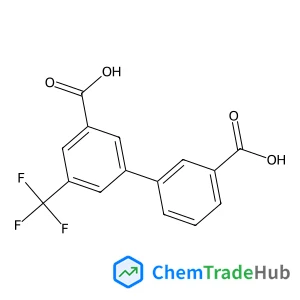
3-(3-Carboxyphenyl)-5-(trifluoromethyl)benzoic acid
CAS Number:
1261930-96-4
Molecular Formula:
C15H9F3O4
Kangying Cao, Changwei Wang, Shiwei Yin
Understanding the relationship between charge mobilities and the molecular stacking structures of π-conjugated organic semiconducting materials is essential for their development. In this study, a quantum mechanics (QM)-derived state-specific polarizable force field (SS-PFF) is applied to explicitly estimate the external reorganization energies (λext) during electron transfer (ET) or hole transfer (HT) processes using our recently proposed two-point model (J. Phys. Chem. A, 2018, 122, 8957–8964). Different from the Marcus two-sphere model, the application of the explicit two-point model produces a notably asymmetric λext for ET and HT processes in oligoacene crystals. For the same charge transfer channels, the λext of ET is 7–10 times higher than that of HT, which results in a larger intrinsic hole mobility. This successfully rationalizes why acenes are prone to be p-type conducting materials. Perfluorination can change the polarity of the molecular surface electrostatic potential (ESP). Thus, perfluorination is a possible approach to reduce the external reorganization energies for ET reactions, which can be used to tune the order of λext of ET and HT processes. The two-point model with the SS-PFF, therefore, opens the door to revisit the intrinsic mobilities of electrons and holes in organic semiconductors.
Kirsten Harth, Ralf Stannarius
DOI: 10.1039/C3CP44055A
Idan Hod, Zion Tachan, Menny Shalom, Arie Zaban
DOI: 10.1039/C3CP50242B
Yeru Liu, James Robert Jennings, Xingzhu Wang, Qing Wang
DOI: 10.1039/C3CP50998B
Haoguang Li, Mickael Rivallan, Frederic Thibault-Starzyk, Arnaud Travert
DOI: 10.1039/C3CP50442E
Ivan A. Popov, Yafei Li, Zhongfang Chen, Alexander I. Boldyrev
DOI: 10.1039/C3CP43921F
Andrew P. Ault, Defeng Zhao, Carlena J. Ebben, Michael J. Tauber, Franz M. Geiger, Vicki H. Grassian
DOI: 10.1039/C3CP43899F
Aleksey B. Alekseyev, Heinz-Peter Liebermann, Robert J. Buenker
DOI: 10.1039/C3CP44237C
Rebecca C. Quardokus, Natalie A. Wasio, Ryan P. Forrest, Craig S. Lent, Steven A. Corcelli, John A. Christie, Kenneth W. Henderson, S. Alex Kandel
DOI: 10.1039/C3CP50225B
Shinji Aono, Takashi Hosoya, Shigeyoshi Sakaki
DOI: 10.1039/C3CP43892A
Christoph Kölbl, Beate Stempfle
DOI: 10.1039/C3CP44693J
4-Benzyl-2,2-dimethylmorpholine is generally considered safe when handled under ...
(5,6-Dimethoxy-3-pyridinyl)boronic acid is a chemical compound with the molecula...
1,1,3,3-Tetramethyl-1,3-bis(2-methyl-2-propanyl)disiloxane is synthesized throug...
(2R,4S)-1-Boc-4-methylpyrrolidine-2-carboxylic acid is primarily used as a build...
When handling 2,3-Dichloroacrylonitrile, it is crucial to wear appropriate perso...
(S)-1-(o-Tolyl)ethanamine hydrochloride should be stored in a cool, dry place to...
Benzyl [1-(hydroxyamino)-1-imino-2-methyl-2-propanyl]carbamate (CAS: 518047-98-8...
2-Methyloxazole-5-carbaldehyde is used in the pharmaceutical industry for the sy...
The market for 2-Methyl-2-propanyl 4-[(1S)-1-hydroxyethyl]-1-piperidinecarboxyla...
1-Butyl-3-methylpyridinium bromide is generally considered safe for laboratory u...

Physical Chemistry Chemical Physics (PCCP) is an international journal co-owned by 19 physical chemistry and physics societies from around the world. This journal publishes original, cutting-edge research in physical chemistry, chemical physics and biophysical chemistry. To be suitable for publication in PCCP, articles must include significant innovation and/or insight into physical chemistry; this is the most important criterion that reviewers and Editors will judge against when evaluating submissions. The journal has a broad scope and welcomes contributions spanning experiment, theory, computation and data science. Topical coverage includes spectroscopy, dynamics, kinetics, statistical mechanics, thermodynamics, electrochemistry, catalysis, surface science, quantum mechanics, quantum computing and machine learning. Interdisciplinary research areas such as polymers and soft matter, materials, nanoscience, energy, surfaces/interfaces, and biophysical chemistry are welcomed if they demonstrate significant innovation and/or insight into physical chemistry. Joined experimental/theoretical studies are particularly appreciated when complementary and based on up-to-date approaches.
![9-Ethyl-3-{(E)-[ethyl(2-methylphenyl)hydrazono]methyl}-9H-carbazole structure](https://static.chemtradehub.com/structs/127/1274948-12-7-301f.webp "9-Ethyl-3-{(E)-[ethyl(2-methylphenyl)hydrazono]methyl}-9H-carbazole structure")

![2-Methyl-2-propanyl 4-[3-(aminomethyl)phenyl]-1-piperazinecarboxylate structure](https://static.chemtradehub.com/structs/889/889948-55-4-5c12.webp "2-Methyl-2-propanyl 4-[3-(aminomethyl)phenyl]-1-piperazinecarboxylate structure")




