












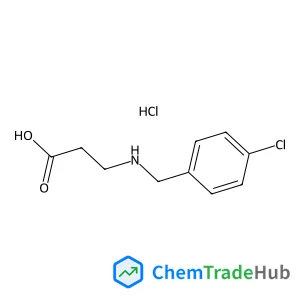
N-(4-Chlorobenzyl)-beta-alanine hydrochloride (1:1)
CAS Number:
1172479-10-5
Molecular Formula:
C10H13Cl2NO2
Jan Valenta, Michael Greben, Goutam Pramanik, Petr Cigler
The optical properties of colloidal near-infrared (NIR) emitting gold nanoclusters (AuNCs) are thoroughly investigated at variable temperatures and excitation powers. Both absorption and photoluminescence (PL) excitation spectra reveal optical transitions expected from literature models of thiolated AuNCs – with the exception of the lowest energy transition which has the form of a featureless absorption tail partially overlapping with the PL band. The absorption cross section is determined via the PL saturation and PL modulation techniques to be in the range of 2–3 × 10⁻¹⁴ cm2 for excitation at 405 nm (relatively large value for such small clusters) and decreases ∼20 times toward 633 nm. Slow transient quenching (perfectly reversible) of PL is observed when the excitation power exceeds the saturation threshold, i.e. when the probability of achieving the second absorption in an excited AuNC before its relaxation is significant. A stable PL quenched level is reached within a fraction of a minute or a few minutes after the start of the excitation. Similar time intervals are needed for AuNCs to relax back to the original state in the dark. By comparing thermally-induced and light-induced PL decreases and PL kinetics speed up, we conclude that the transient quenching is due to heating caused by the dissipated excitation power. The light-induced PL amplitude reduction is much stronger (up to ∼80% under 405 nm, 60 W cm−2 excitation) than changes in PL decay time (∼20%), which is due to PL blinking and PL switching-off in a fraction of the AuNC ensemble. The potential application of these AuNCs in nanothermometry is discussed.
Jingya Dai, Qitang Fan, Tao Wang, Julian Kuttner, Gerhard Hilt, J. Michael Gottfried, Junfa Zhu
DOI: 10.1039/C6CP03551E
Yuhua Duan
DOI: 10.1039/C5CP03968A
A. V. Pomogaeva, A. Y. Timoshkin
DOI: 10.1039/C6CP02576E
Yunjun Cao, Shujun Hu, Min Yu, Shishen Yan, Mingchun Xu
DOI: 10.1039/C5CP04013B
Yongjin Lee, Alexander J. Pak, Gyeong S. Hwang
DOI: 10.1039/C6CP04388G
Vlastimil Peksa, Petra Lebrušková, Hana Šípová, Josef Štěpánek, Jiří Bok, Jiří Homola, Marek Procházka
DOI: 10.1039/C6CP02752K
A. Aerts, S. Gavrilov, G. Manfredi, A. Marino, K. Rosseel, J. Lim
DOI: 10.1039/C6CP01561A
Florian Thöle, Liwen F. Wan, David Prendergast
DOI: 10.1039/C5CP03046C
Hongxia Guan, Ye Sheng, Chengyi Xu, Yunzhi Dai, Xiaoming Xie, Haifeng Zou
DOI: 10.1039/C6CP03989H
M. Ligare, F. Siouri, O. Bludsky, D. Nachtigallová, M. S. de Vries
DOI: 10.1039/C5CP03516C
Waste containing N-Methoxy-N-methyl-1,3-thiazole-5-carboxamide (CAS: 898825-89-3...
N-(4-Biphenylyl)dibenzo[b,d]furan-4-amine should be stored in a tightly sealed c...
The market for 3-Acetamido-5-amino-2,4,6-triiodobenzoic acid (CAS: 1713-07-1) is...
Benzyl 2-O-acetyl-3,4,6-tri-O-benzyl-beta-D-galactopyranoside (CAS: 61820-03-9) ...
2-Ethylpiperazine dihydrochloride (CAS: 438050-52-3) is regulated under the Glob...
1,1'-[1,3-Phenylenebis(methylene)]bis(3-methyl-1H-pyrrole-2,5-dione) (CAS: 11946...
Several alternatives can be used in the synthesis of 5-Fluoro-2-(1-pyrrolidinyl)...
Proper personal protective equipment (PPE) must be worn when handling this compo...
When handling 6-Bromoimidazo[1,2-a]pyridin-8-amine, it is important to wear appr...
Alternatives to (2S,4R)-4-(4-Nitrobenzyl)pyrrolidine-2-carboxylic acid hydrochlo...

Physical Chemistry Chemical Physics (PCCP) is an international journal co-owned by 19 physical chemistry and physics societies from around the world. This journal publishes original, cutting-edge research in physical chemistry, chemical physics and biophysical chemistry. To be suitable for publication in PCCP, articles must include significant innovation and/or insight into physical chemistry; this is the most important criterion that reviewers and Editors will judge against when evaluating submissions. The journal has a broad scope and welcomes contributions spanning experiment, theory, computation and data science. Topical coverage includes spectroscopy, dynamics, kinetics, statistical mechanics, thermodynamics, electrochemistry, catalysis, surface science, quantum mechanics, quantum computing and machine learning. Interdisciplinary research areas such as polymers and soft matter, materials, nanoscience, energy, surfaces/interfaces, and biophysical chemistry are welcomed if they demonstrate significant innovation and/or insight into physical chemistry. Joined experimental/theoretical studies are particularly appreciated when complementary and based on up-to-date approaches.
![2-(7,7-Difluorobicyclo[4.1.0]hept-1-yl)ethanamine structure](https://static.chemtradehub.com/structs/209/2098065-08-6-ff24.webp "2-(7,7-Difluorobicyclo[4.1.0]hept-1-yl)ethanamine structure")
![tert-Butyl 6-chloro-4-oxospiro[chroman-2,4'-piperidine]-1'-carboxylate structure](https://static.chemtradehub.com/structs/101/1011482-37-3-88a5.webp "tert-Butyl 6-chloro-4-oxospiro[chroman-2,4'-piperidine]-1'-carboxylate structure")
![[(5-Methyl-1,3,4-thiadiazol-2-yl)sulfanyl]acetic acid structure](https://static.chemtradehub.com/structs/509/50918-26-8-4ce8.webp "[(5-Methyl-1,3,4-thiadiazol-2-yl)sulfanyl]acetic acid structure")






