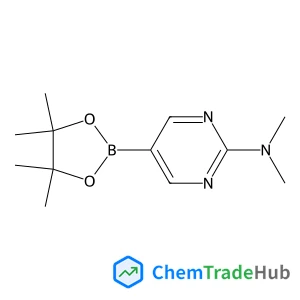
N,N-Dimethyl-5-(4,4,5,5-tetramethyl-1,3,2-dioxaborolan-2-yl)-2-pyrimidinamine
CAS Number:
1032759-30-0
Molecular Formula:
C12H20BN3O2
Niloofar Zarrabi, Brandon J. Bayard, Sairaman Seetharaman, Noah Holzer, Paul Karr, Susanna Ciuti, Antonio Barbon, Marilena Di Valentin, Art van der Est, Francis D’Souza, Prashanth K. Poddutoori
Photosensitizers with high energy, long lasting charge-transfer states are important components in systems designed for solar energy conversion by multistep electron transfer. Here, we show that in a push–pull type, μ-oxo-bridged porphyrin heterodimer composed of octaethylporphyrinatoaluminum(III) and octaethylporphyrinatophosphorus(V), the strong excitonic coupling between the porphyrins and the different electron withdrawing abilities of Al(III) and P(V) promote the formation of a high energy CT state. Using, an array of optical and magnetic resonance spectroscopic methods along with theoretical calculations, we demonstrate photodynamics of the heterodimer that involves the initial formation of a singlet CT which relaxes to a triplet CT state with a lifetime of ∼130 ps. The high-energy triplet CT state (3CT = 1.68 eV) lasts for nearly 105 μs prior to relaxing to the ground state.
Tzofit Kehat, Moshe Portnoy
DOI: 10.1039/B703016A
Stefan Meuer, Lydia Braun, Rudolf Zentel
DOI: 10.1039/B803099E
Sungjin Park, Yunha Lee, Bumjung Kim, Jisun Lee, Youngdo Jeong, Jaegeun Noh, Atsushi Takahara, Daewon Sohn
DOI: 10.1039/B706505A
Yoshiro Hirai, Masayuki Kirihara
DOI: 10.1039/B802502A
Pier Giorgio Cozzi, Fides Benfatti, Montse Guiteras Capdevila, Alessandro Mignogna
DOI: 10.1039/B805197F
Tetsuo Okujima, Noboru Ono
DOI: 10.1039/B719964C
Masao Morita, Yasushi Obora, Yasutaka Ishii
DOI: 10.1039/B702293J
Hiroshi Shimizu, Masahiro Murakami
DOI: 10.1039/B704105E
Shi-Qiang Bai, T. S. Andy Hor
DOI: 10.1039/B802043D
When considering alternatives to 1-(4-Chlorophenyl)-N-hydroxymethanimine (CAS: 3...
This compound should be stored in a cool, dry place away from direct sunlight. I...
3-(4-Bromophenyl)-5-(2-fluorophenyl)-1,2,4-oxadiazole is synthesized through a m...
5-Chloro-2-(4-chlorophenyl)-4-methyl-6-[3-(1-piperidinyl)propoxy]pyrimidine (CAS...
2-Chloro-4-(difluoromethoxy)pyridine is used in the pharmaceutical industry for ...
3-Chloro-6-methylpyridazine (CAS: 1121-79-5) is classified under the Globally Ha...
Several alternatives can be used in the synthesis of Methyl 4,5-dimethyl-2-nitro...
Alternatives to (2E,2'E)-3,3'-(1,4-Phenylene)bisacrylaldehyde include other acry...
3-Amino-5-chloropyridin-2-ol hydrochloride is an organic compound with the CAS n...
When handling 6,7-Difluoro-2,3-dihydro-4H-chromen-4-one, it is essential to wear...

Physical Chemistry Chemical Physics (PCCP) is an international journal co-owned by 19 physical chemistry and physics societies from around the world. This journal publishes original, cutting-edge research in physical chemistry, chemical physics and biophysical chemistry. To be suitable for publication in PCCP, articles must include significant innovation and/or insight into physical chemistry; this is the most important criterion that reviewers and Editors will judge against when evaluating submissions. The journal has a broad scope and welcomes contributions spanning experiment, theory, computation and data science. Topical coverage includes spectroscopy, dynamics, kinetics, statistical mechanics, thermodynamics, electrochemistry, catalysis, surface science, quantum mechanics, quantum computing and machine learning. Interdisciplinary research areas such as polymers and soft matter, materials, nanoscience, energy, surfaces/interfaces, and biophysical chemistry are welcomed if they demonstrate significant innovation and/or insight into physical chemistry. Joined experimental/theoretical studies are particularly appreciated when complementary and based on up-to-date approaches.