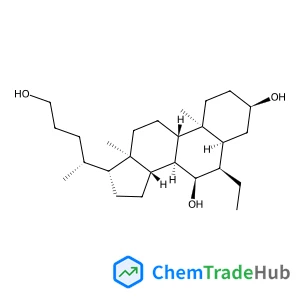
(3alpha,5beta,6alpha,7alpha)-6-Ethylcholane-3,7,24-triol
CAS Number:
1537866-49-1
Molecular Formula:
C26H46O3
Ezequiel Fragoso Vieira Leitão, Miguel Angelo Fonseca de Souza, Silmar Andrade do Monte, Elizete Ventura
Understanding the mechanism responsible for peroxides decomposition is essential to explain several biochemical processes. The mechanisms of the intrinsic reactions between the superoxide radical anion (O2˙−) and methyl, ethyl, and tert-butyl hydroperoxides (ROOH, with R = Me, Et, and t-Bu) have been characterized to understand the mechanism responsible for peroxides decomposition. The reaction energy diagrams suggest a competition between the spin-allowed and spin-forbidden electron transfer (ET), and base-induced elimination (ECO2) mechanisms. In all cases, the spin-allowed ET mechanism describes formation of the ozonide anion radical (O3˙−), either complexed with an alcohol molecule or separated. For the O2˙−/MeOOH(EtOOH) reactions, HCO2− (MeCO2−) + H2O + HO˙ and OH− + CH2O(MeCHO) + HO2˙ products are associated with the spin-forbidden ET and ECO2 channels, respectively. On the other hand, for the reaction between O2˙− and t-BuOOH, the spin-forbidden ET route describes formation of the MeCOCH2− enolate (either separated or hydrated) along with the methyl peroxyl (MeO2˙) radical. In addition, the regeneration of O2˙−via spin-forbidden ET and ECO2 channels was also characterized from the decomposition of ROOH, yielding diols (CH2(OH)2 and MeCH(OH)2), aldehydes (CH2O and MeCHO), and oxirane (cyc-CH2CMe2O).
Natalie Forbes, Jeong Eun Shin, Maria Ogunyankin, Joseph A. Zasadzinski
DOI: 10.1039/C4CP05881J
Gregory J. Dutton, Steven W. Robey
DOI: 10.1039/C5CP02800K
Manik Kumer Ghosh, Tae Hoon Choi, Cheol Ho Choi
DOI: 10.1039/C5CP02182K
Jose M. Ortiz-Roldan, A. Rabdel Ruiz-Salvador, Sofía Calero, Francisco Montero-Chacón, Elena García-Pérez, Javier Segurado, Ignacio Martin-Bragado, Said Hamad
DOI: 10.1039/C5CP01785H
Jonas Elm, Patrick Norman, Kurt V. Mikkelsen
DOI: 10.1039/C5CP01012H
Yufeng Guo, Wanlin Guo
DOI: 10.1039/C5CP02494C
Christoph Bannwarth, Stefan Grimme
DOI: 10.1039/C5CP01417D
Zheng Shi, Jonathan N. Sachs, Elizabeth Rhoades, Tobias Baumgart
DOI: 10.1039/C4CP05883F
Kaushik Pal, Suman Mallick, Apurba L. Koner
DOI: 10.1039/C5CP01696G
Waste containing 6-Chloro-5-(2'-hydroxy-3'-methoxy-4-biphenylyl)-3-(3-methoxyphe...
(3alpha,5alpha)-3-Hydroxypregnane-11,20-dione is primarily used in the pharmaceu...
The market for 4-Amino-6-chloro-2-pyridinecarboxylic acid (CAS: 546141-56-4) is ...
Alternatives to (2-Benzoylethyl)trimethylammonium chloride (CAS: 24472-88-6) in ...
N-[4-Nitro-3-(trifluoromethyl)phenyl]acetamide (CAS: 393-12-4) is generally safe...
Alternative reagents such as other phosphates or similar functional groups can b...
There are alternatives to N,N'-Bis(3-aminopropyl)-1,3-propanediamine (CAS: 4605-...
When handling Aluminium trihexadecanoate, it is important to use appropriate per...
(1,1-Dioxido-3-oxo-1,2-benzothiazol-2(3H)-yl)acetic acid is a chemical compound ...
Several alternatives to 5,5-dimethyloxolan-2-one (CAS: 3123-97-5) can be used in...

Physical Chemistry Chemical Physics (PCCP) is an international journal co-owned by 19 physical chemistry and physics societies from around the world. This journal publishes original, cutting-edge research in physical chemistry, chemical physics and biophysical chemistry. To be suitable for publication in PCCP, articles must include significant innovation and/or insight into physical chemistry; this is the most important criterion that reviewers and Editors will judge against when evaluating submissions. The journal has a broad scope and welcomes contributions spanning experiment, theory, computation and data science. Topical coverage includes spectroscopy, dynamics, kinetics, statistical mechanics, thermodynamics, electrochemistry, catalysis, surface science, quantum mechanics, quantum computing and machine learning. Interdisciplinary research areas such as polymers and soft matter, materials, nanoscience, energy, surfaces/interfaces, and biophysical chemistry are welcomed if they demonstrate significant innovation and/or insight into physical chemistry. Joined experimental/theoretical studies are particularly appreciated when complementary and based on up-to-date approaches.