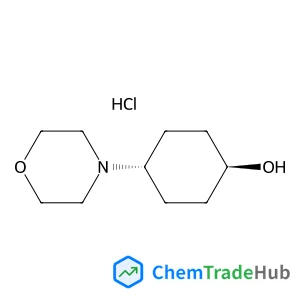
trans-4-(4-Morpholinyl)cyclohexanol hydrochloride (1:1)
CAS Number:
1588441-09-1
Molecular Formula:
C10H20ClNO2
Jessica Exner, Sina Klabunde, Michael R. Hansen, Armido Studer
The synthesis, photophysical characterization, and quantum chemical calculations of a series of benzotriazinyl radicals and their styryl radical trapping products are presented. The benzotriazinyl radicals are non-luminescent but surprisingly the corresponding styryl radical trapping products exhibit high fluorescence quantum yields (up to 60% in some cases), making them highly valuable probes or labels. Additionally, the influence of the substitution pattern on the optical properties of the radical trapping products was observed experimentally and interpreted by means of quantum chemical calculations. Specific substitution patterns showed a bathochromic shift compared to the unsubstituted compound. Computationally, it was shown that this substitution pattern leads to a stronger energetic stabilization of the lowest unoccupied molecular orbital than the highest occupied molecular orbital. Analysis of the influence of the substitution pattern on the optical properties showed a bathochromic shift in several examples, which was interpreted by means of quantum chemical calculations.
M. Khurram N. Qureshi, Martin D. Smith
DOI: 10.1039/B611882H
Jin Hong Kim, Ji Woong Lee, Ueon Sang Shin, Jin Yong Lee, Sang-gi Lee, Choong Eui Song
DOI: 10.1039/B712060E
Tomoki Ogoshi, Tada-aki Yamagishi, Yoshiaki Nakamoto
DOI: 10.1039/B711800G
Shaojun Dong
DOI: 10.1039/B612080F
Richard F. Kelley, Michael J. Tauber, Thea M. Wilson, Michael R. Wasielewski
DOI: 10.1039/B708318A
Deborah Berhanu, Kuveshni Govender, David Smyth-Boyle, Martin Archbold, Douglas P. Halliday, Paul O'Brien
DOI: 10.1039/B612934J
Esfandiar Rafii, Benjamin Dassonneville, Andreas Heumann
DOI: 10.1039/B613961B
Zuhui Zhang, Chongfeng Pan, Zhiyong Wang
DOI: 10.1039/B711613F
Shuhei Ikeda, Masatoshi Shibuya, Yoshiharu Iwabuchi
DOI: 10.1039/B611121A
Amit Basak, Sandip K. Roy, Sanket Das, Amrita B. Hazra, Subhash C. Ghosh, Shailendra Jha
DOI: 10.1039/B612114D
Ethyl 4-chlorothieno[2,3-b]pyridine-5-carboxylate (CAS: 59713-58-5) can be synth...
5-Methyl-1H-indole-3-carbaldehyde (CAS: 52562-50-2) is subject to various regula...
(1,3-Dimethyl-2,4-dioxo-1,2,3,4-tetrahydro-5-pyrimidinyl)boronic acid is a white...
Waste containing Sulfocostunolide A (CAS: 1016983-51-9) should be handled with c...
When handling Murraxocin (CAS: 88478-44-8), ensure proper personal protective eq...
Formvar (CAS: 63148-64-1) is an alkyd resin characterized by a high molecular we...
(S)-4-benzyl-2-((benzyloxy)methyl)morpholine is generally safe when handled with...
Methyl 1-(5-bromo-2-pyrimidinyl)cyclopropanecarboxylate (CAS: 1447607-69-3) is p...
2-Methyl-1-phenyl-1-propanamine hydrochloride (CAS: 24290-47-9) is generally con...
3-(4-Bromophenyl)-2-methylpropanoic acid is synthesized through a multi-step pro...

Physical Chemistry Chemical Physics (PCCP) is an international journal co-owned by 19 physical chemistry and physics societies from around the world. This journal publishes original, cutting-edge research in physical chemistry, chemical physics and biophysical chemistry. To be suitable for publication in PCCP, articles must include significant innovation and/or insight into physical chemistry; this is the most important criterion that reviewers and Editors will judge against when evaluating submissions. The journal has a broad scope and welcomes contributions spanning experiment, theory, computation and data science. Topical coverage includes spectroscopy, dynamics, kinetics, statistical mechanics, thermodynamics, electrochemistry, catalysis, surface science, quantum mechanics, quantum computing and machine learning. Interdisciplinary research areas such as polymers and soft matter, materials, nanoscience, energy, surfaces/interfaces, and biophysical chemistry are welcomed if they demonstrate significant innovation and/or insight into physical chemistry. Joined experimental/theoretical studies are particularly appreciated when complementary and based on up-to-date approaches.
![4-{1-[4-(4,4,5,5-Tetramethyl-1,3,2-dioxaborolan-2-yl)phenyl]cyclopropyl}morpholine structure](https://static.chemtradehub.com/structs/120/1206594-08-2-7afb.webp "4-{1-[4-(4,4,5,5-Tetramethyl-1,3,2-dioxaborolan-2-yl)phenyl]cyclopropyl}morpholine structure")
![9H-Fluoren-9-ylmethyl [(2S)-1-hydroxy-3-(1H-indol-3-yl)-2-propanyl]carbamate structure](https://static.chemtradehub.com/structs/153/153815-60-2-a67d.webp "9H-Fluoren-9-ylmethyl [(2S)-1-hydroxy-3-(1H-indol-3-yl)-2-propanyl]carbamate structure")