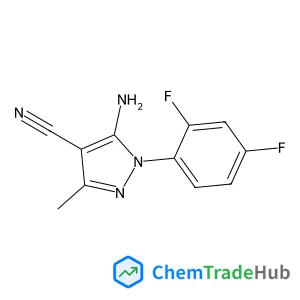
5-Amino-1-(2,4-difluorophenyl)-3-methyl-1H-pyrazole-4-carbonitrile
CAS Number:
1020057-92-4
Molecular Formula:
C11H8F2N4
Zhiguo Zhu, Hongying Lü, Ming Zhang, Hengquan Yang
Deep eutectic solvents (DESs) have been intensively pursued in the field of separation processes, catalytic reactions, polymers, nanomaterial science, and sensing technologies due to their unique features such as the low cost of components, ease of preparation, tunable physicochemical properties, negligible vapor pressure, non-toxicity, renewability, and biodegradability in the recent decade. Considering these appealing merits, DESs are widely used as extraction agents, solvents and/or catalysts in the desulfurization process since 2013. This review is focused on summarizing the physicochemical properties of DESs (i.e., freezing point, density, viscosity, ionic conductivity, acidity, hydrophilicity/hydrophobicity, polarity, surface tension, and diffusion) to some extent, and their significant advances in applications related to desulfurization processes such as extraction desulfurization, extraction–oxidation desulfurization, and biomimetic desulfurization. In particular, we systematically compile very recent works concerning the selective aerobic oxidation desulfurization (AODS) under extremely mild conditions (60 °C and ambient pressure) via a biomimetic approach coupling DESs with polyoxometallates (POMs). In this system, DESs act as multifunctional roles such as extraction agents, solvents, and catalysts, while POMs serve as electron transfer mediators. This strategy is inspirational since biomimetic or bioinspired catalysis is the “Holy Grail” of oxidation catalysis, which overcomes the difficulty of O2 activation via introducing electron transfer mediators into this system. It not only can be used for AODS, but also paves a novel way for oxidation catalysis, such as the selective oxyfunctionalization of hydrocarbon. Eventually, the conclusion, current challenges, and future opportunities are discussed. The aim is to provide necessary guidance for precisely designing tailor-made DESs, and to inspire chemists to use DESs as a powerful platform in the field of catalysis science.
Chris Ritchie, Eric M. Burkholder, De-Liang Long, David Adam, Paul Kögerler, Leroy Cronin
DOI: 10.1039/B612741J
Robert G. Potter, Thomas S. Hughes
DOI: 10.1039/B706807G
Dmytro S. Nesterov, Volodymyr N. Kokozay, Viktoriya V. Dyakonenko, Oleg V. Shishkin, Julia Jezierska, Andrew Ozarowski, Alexander M. Kirillov, Maximilian N. Kopylovich, Armando J. L. Pombeiro
DOI: 10.1039/B608790F
DOI: 10.1039/B709898G
Abid Khan, Jon D. Silversides, Leigh Madden, John Greenman, Stephen J. Archibald
DOI: 10.1039/B614557D
Susanne D. Riegel, Neil Burford, Michael D. Lumsden, Andreas Decken
DOI: 10.1039/B707741F
Dapeng Zou, Samir Andersson, Rong Zhang, Shiguo Sun, Björn Åkermark, Licheng Sun
DOI: 10.1039/B712980G
Jered C. Garrison, Matthew J. Panzner, Paul D. Custer, D. Venkat Reddy, Peter L. Rinaldi, Claire A. Tessier, Wiley J. Youngs
DOI: 10.1039/B608991G
Serdar Atilgan, Zeynep Ekmekci, A. Lale Dogan, Dicle Guc, Engin U. Akkaya
DOI: 10.1039/B612347C
Ethyl 4-chlorothieno[2,3-b]pyridine-5-carboxylate (CAS: 59713-58-5) can be synth...
5-Methyl-1H-indole-3-carbaldehyde (CAS: 52562-50-2) is subject to various regula...
(1,3-Dimethyl-2,4-dioxo-1,2,3,4-tetrahydro-5-pyrimidinyl)boronic acid is a white...
Waste containing Sulfocostunolide A (CAS: 1016983-51-9) should be handled with c...
When handling Murraxocin (CAS: 88478-44-8), ensure proper personal protective eq...
Formvar (CAS: 63148-64-1) is an alkyd resin characterized by a high molecular we...
(S)-4-benzyl-2-((benzyloxy)methyl)morpholine is generally safe when handled with...
Methyl 1-(5-bromo-2-pyrimidinyl)cyclopropanecarboxylate (CAS: 1447607-69-3) is p...
2-Methyl-1-phenyl-1-propanamine hydrochloride (CAS: 24290-47-9) is generally con...
3-(4-Bromophenyl)-2-methylpropanoic acid is synthesized through a multi-step pro...

Physical Chemistry Chemical Physics (PCCP) is an international journal co-owned by 19 physical chemistry and physics societies from around the world. This journal publishes original, cutting-edge research in physical chemistry, chemical physics and biophysical chemistry. To be suitable for publication in PCCP, articles must include significant innovation and/or insight into physical chemistry; this is the most important criterion that reviewers and Editors will judge against when evaluating submissions. The journal has a broad scope and welcomes contributions spanning experiment, theory, computation and data science. Topical coverage includes spectroscopy, dynamics, kinetics, statistical mechanics, thermodynamics, electrochemistry, catalysis, surface science, quantum mechanics, quantum computing and machine learning. Interdisciplinary research areas such as polymers and soft matter, materials, nanoscience, energy, surfaces/interfaces, and biophysical chemistry are welcomed if they demonstrate significant innovation and/or insight into physical chemistry. Joined experimental/theoretical studies are particularly appreciated when complementary and based on up-to-date approaches.