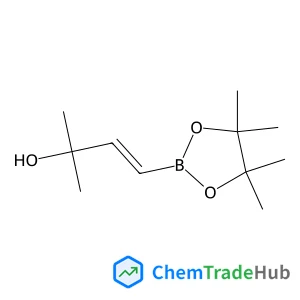
(E)-2-methyl-4-(4,4,5,5-tetramethyl-1,3,2-dioxaborolan-2-yl)but-3-en-2-ol
CAS Number:
581802-26-8
Molecular Formula:
C11H21BO3
Xin-Yang Li, Meng-Han Zhang, Miao-Juan Ren, Chang-Wen Zhang
Nodal-line half-metals (NLHMs) are highly desirable for future spintronic devices due to their exotic quantum properties. However, the experimental realization in spin-polarized materials is nontrivial to date. Herein we perform first-principles calculations to demonstrate a 2D honeycomb, AgN, as a promising candidate of NLHMs, which is thermodynamically and dynamically stable. Band structure analysis reveals that two concentric NLs coexist centered at a Γ point near EF, accompanied by the electron and hole pockets that touch each other linearly with single-spin components. Inclusion of SOC can enrich the electronic structures of AgN, sensitive to the protection of mirror reflection symmetry: the NLHM survives if the spin is perpendicular to the Mz mirror plane, while it tunes into Wyle nodal-points by rotating spins from the out-of-plane to the in-plane direction. The characteristics of HM and NL can be well maintained on semiconducting h-BN and is immune to mechanical strains. These tunable magnetic properties render 2D AgN suitable for exotic quantum transports in nodal fermions as well as related spintronic devices.
Toshishige M. Suzuki
DOI: 10.1039/B816461D
Diako Ebrahimi, Danielle F. Kennedy, Barbara A. Messerle, D. Brynn Hibbert
DOI: 10.1039/B719501J
Jiongjia Cheng, Deqian Huang, Jing Zhang, Wenjing Yang, Na Wang, Yongbo Sun, Keyu Wang, Xiangyin Mo, Shuping Bi
DOI: 10.1039/B823096J
Atsushi Urakawa, Franz Trachsel, Philipp Rudolf von Rohr, Alfons Baiker
DOI: 10.1039/B808984C
Dong Xiang, Michele Konigsberger, Busolo Wabuyele, Karl Hornung, James Cheney
DOI: 10.1039/B821836F
Mehjabin Kathiwala, Andrews Obeng Affum, Jason Perry, Anna Brajter-Toth
DOI: 10.1039/B718125F
Joseph R. Lakowicz, Krishanu Ray, Mustafa Chowdhury, Henryk Szmacinski, Yi Fu, Jian Zhang, Kazimierz Nowaczyk
DOI: 10.1039/B802918K
Nicoletta Nicolaou, Royston Goodacre
DOI: 10.1039/B804439B
When considering alternatives to 1-(4-Chlorophenyl)-N-hydroxymethanimine (CAS: 3...
This compound should be stored in a cool, dry place away from direct sunlight. I...
3-(4-Bromophenyl)-5-(2-fluorophenyl)-1,2,4-oxadiazole is synthesized through a m...
5-Chloro-2-(4-chlorophenyl)-4-methyl-6-[3-(1-piperidinyl)propoxy]pyrimidine (CAS...
2-Chloro-4-(difluoromethoxy)pyridine is used in the pharmaceutical industry for ...
3-Chloro-6-methylpyridazine (CAS: 1121-79-5) is classified under the Globally Ha...
Several alternatives can be used in the synthesis of Methyl 4,5-dimethyl-2-nitro...
Alternatives to (2E,2'E)-3,3'-(1,4-Phenylene)bisacrylaldehyde include other acry...
3-Amino-5-chloropyridin-2-ol hydrochloride is an organic compound with the CAS n...
When handling 6,7-Difluoro-2,3-dihydro-4H-chromen-4-one, it is essential to wear...

Physical Chemistry Chemical Physics (PCCP) is an international journal co-owned by 19 physical chemistry and physics societies from around the world. This journal publishes original, cutting-edge research in physical chemistry, chemical physics and biophysical chemistry. To be suitable for publication in PCCP, articles must include significant innovation and/or insight into physical chemistry; this is the most important criterion that reviewers and Editors will judge against when evaluating submissions. The journal has a broad scope and welcomes contributions spanning experiment, theory, computation and data science. Topical coverage includes spectroscopy, dynamics, kinetics, statistical mechanics, thermodynamics, electrochemistry, catalysis, surface science, quantum mechanics, quantum computing and machine learning. Interdisciplinary research areas such as polymers and soft matter, materials, nanoscience, energy, surfaces/interfaces, and biophysical chemistry are welcomed if they demonstrate significant innovation and/or insight into physical chemistry. Joined experimental/theoretical studies are particularly appreciated when complementary and based on up-to-date approaches.