












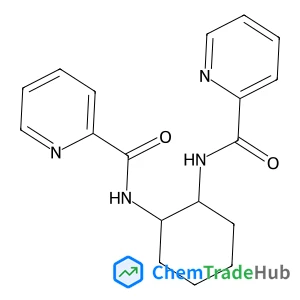
N,N'-(1R,2R)-1,2-Cyclohexanediyldi(2-pyridinecarboxamide)
CAS Number:
218290-24-5
Molecular Formula:
C18H20N4O2
Toshishige M. Suzuki
Dithizone nanofiber-coated membranes (dithizone membranes), which are useful for sensitive and selective determination of Hg(II), were fabricated. Simply by filtration of the aqueous dispersion of dithizone nanofiber through a cellulose ester membrane filter, a dithizone nanofiber layer of less than 500 nm thickness was coated firmly and uniformly over the membrane filter surface. The steel blue color of the membrane remained unchanged for more than three months when fabricated in the presence of ascorbic acid and stored with an oxygen absorber in an evacuated aluminium bag. Determination at the parts per billion level of Hg(II) was achieved by filtration-enrichment of a sample solution and simultaneous colorimetric analysis using a TLC scanner (500 nm). Consequently, Hg(II) ion was concentrated in the dithizone layer as reddish brown complexes by filtration of a sample solution at pH 2.7. More than 90% of 10 ppb Hg(II) was retained in the dithizone layer at the filtration rate of 1.3–9.3 ml min−1. The presence of Na+ (10 000 ppm), K+ (5000 ppm), Ca(II) (5000 ppm), Cu(II) (6.4 ppm), Fe(II) (100 ppm), Zn(II) (100 ppm), Pb(II) (100 ppm) and Cd(II) (10 ppm) by using 2.5 × 10⁻⁴ M of ethylenediamine tetraacetic acid (EDTA) as a masking reagent did not interfere with the detection of Hg(II) (10 ppb). Most of anions did not interfere with the determination of Hg(II). The present method was tested for the detection of simulated wastewater, river water and seawater spiked with 10 ppb of Hg(II).
Małgorzata Biczysko, Riccardo Tarroni
DOI: 10.1039/B107282J
DOI: 10.1039/B111564M
DOI: 10.1039/B109277B
Michael J. Blandamer, Paul M. Cullis, Peter T. Gleeson
DOI: 10.1039/B107646A
John Tomkinson, Stewart F. Parker, Dale A. Braden, Bruce S. Hudson
DOI: 10.1039/B110091B
James A. J. Fitzpatrick, Oleg V. Chekhlov, David R. Morgan, Robert W. Burrows, Colin M. Western
DOI: 10.1039/B111198C
A. Rassat
DOI: 10.1039/B109712C
DOI: 10.1039/B110358J
Camilla Haavik, Tooru Atake, Svein Stølen
DOI: 10.1039/B109683D
DOI: 10.1039/B108822J
6-Bromo-2-methylimidazo[1,2-a]pyrimidine (CAS: 1111638-05-1) falls under various...
While there are no direct alternatives, similar compounds like 1-Pyrrolidineetha...
4-Methyl-2,6-bis(2-methyl-2-propanyl)phenyl methylcarbamate (CAS: 1918-11-2) is ...
2-(3-Bromo-4-fluorophenyl)-1,3-dioxolane (CAS: 77771-04-1) should be stored in a...
4,5,6,7-Tetrahydro-1H-indazole hydrochloride is a white crystalline solid with a...
(2R)-1-Methoxy-3-phenyl-2-propanamine is a chiral organic compound with the CAS ...
Ethyl 1-(1-phenylethyl)-1H-imidazole-5-carboxylate is used in various industries...
4-[(1E,3S)-1-(4-Hydroxyphenyl)-1,4-pentadien-3-yl]phenol (CAS: 17676-24-3) falls...
(S)-3-Amino-5-phenylpentanoic acid hydrochloride is primarily used in the pharma...
7-Methoxy-1-benzothiophene-2-carboxylic acid is typically synthesized by reactin...

Analyst publishes analytical and bioanalytical research that reports premier fundamental discoveries and inventions, and the applications of those discoveries, unconfined by traditional discipline barriers.
![(3R)-4-(4-Chlorophenyl)-3-({[(2-methyl-2-propanyl)oxy]carbonyl}amino)butanoic acid structure](https://static.chemtradehub.com/structs/218/218608-96-9-f871.webp "(3R)-4-(4-Chlorophenyl)-3-({[(2-methyl-2-propanyl)oxy]carbonyl}amino)butanoic acid structure")





