












Experimental study of the proton-transfer reaction C + H2+ → CH+ + H and its isotopic variant (D2+)
Literature Information
Publication Date
2020-11-10
DOI
10.1039/D0CP04810K
Impact Factor
3.676
Authors
Kyle P. Bowen, Fabrice Dayou, Kenneth A. Miller, Nathalie de Ruette, Xavier Urbain, Daniel W. Savin
View Original
Abstract
We report absolute integral cross section (ICS) measurements using a dual-source merged-fast-beams apparatus to study the titular reactions over the relative translational energy range of Er ∼ 0.01–10 eV. We used photodetachment of C− to produce a pure beam of atomic C in the ground electronic 3P term, with statistically populated fine-structure levels. The H2+ and D2+ were formed in an electron impact ionization source, with well known vibrational and rotational distributions. The experimental work is complemented by a theoretical study of the CH2+ electronic system in the reactant and product channels, which helps to clarify the possible reaction mechanisms underlying the ICS measurements. Our measurements provide evidence that the reactions are barrierless and exoergic. They also indicate the apparent absence of an intermolecular isotope effect, to within the total experimental uncertainties. Capture models, taking into account either the charge-induced dipole interaction potential or the combined charge-quadrupole and charge-induced dipole interaction potentials, produce reaction cross sections that lie a factor of ∼4 above the experimental results. Based on our theoretical study, we hypothesize that the reaction is most likely to proceed adiabatically through the 14A′ and 14A′′ states of CH2+via the reaction C(3P) + H2+(2Σ+g) → CH+(3Π) + H(2S). We also hypothesize that at low collision energies only H2+(v ≤ 2) and D2+(v ≤ 3) contribute to the titular reactions, due to the onset of dissociative charge transfer for higher vibrational v levels. Incorporating these assumptions into the capture models brings them into better agreement with the experimental results. Still, for energies ≲0.1 eV where capture models are most relevant, the modified charge-induced dipole model yields reaction cross sections with an incorrect energy dependence and lying ∼10% below the experimental results. The capture cross section obtained from the combined charge-quadrupole and charge-induced dipole model better matches the measured energy dependence but lies ∼30–50% above the experimental results. These findings provide important guidance for future quasiclassical trajectory and quantum mechanical treatments of this reaction.
Related Literature
A triad molecular conductor: simultaneous control of charge and molecular arrangements
Naoya Kinoshita, Atsuya Maruyama
2023-10-10
Communication
DOI: 10.1039/D3CC03198E
Aggregation-induced emission (AIE)-active metallacycles with near-infrared emission for photodynamic therapy
Qifei Shen, Kai Gao, Zhiqin Zhao, Anran Gao, Yanzi Xu, Heng Wang, Mingming Zhang, Dongfeng Dang
2023-11-02
Communication
DOI: 10.1039/D3CC04166B
Substituted benzophenone imines for COF synthesis via formal transimination‡
Josefine Sprachmann, Niklas Grabicki, Anna Möckel, Jeremy Maltitz, José Refugio Monroy, Glen J. Smales, Oliver Dumele
2023-10-18
Communication
DOI: 10.1039/D3CC03735E
A cavitand-based supramolecular artificial light-harvesting system with sequential energy transfer for photocatalysis
Qian Liu, Minzan Zuo, Kaiya Wang, Xiao-Yu Hu
2023-10-25
Communication
DOI: 10.1039/D3CC04040B
A high-performance crystalline Ti2O1.3(PO4)1.6/TiO2 carbon-coated composite as an anode for lithium-ion batteries
Yuefo Yi, Wenbin Zhou, Yichao Wang, Zhengfei Chen
2023-10-26
Communication
DOI: 10.1039/D3CC04633H
Fabrication of porous polyimide as cathode for high performance lithium-ion battery
Xianyu Liu, Mingxun Xie, Yunxia Wei, Yongliang Guo, Zheng Liu
2023-10-24
Communication
DOI: 10.1039/D3CC04287A
Poly(ferrocenylene iminoborane): an inorganic–organic hybrid polymer comprising a backbone of moderately interacting ferrocenes‡
Vivien Zeh, Johannes S. Schneider, Jonas Bachmann, Ivo Krummenacher, Holger Braunschweig, Holger Helten
2023-10-26
Communication
DOI: 10.1039/D3CC03523A
Reply to the ‘Comment on “CO2 as oxidant: an unusual light-assisted catalyst free oxidation of aldehydes to acids under mild conditions”’ by S. R. Khan, S. Saini, K. Naresh, A. Kumari, V. Aniya, P. K. Khatri, A. Ray and S. L. Jain, Chem. Commun., 2022, 58, 2208
Shafiur Rehman Khan, K. Naresh, Alka Kumari, Vineet Aniya, Praveen K Khatri, Anjan Ray, Suman L Jain
2023-11-02
Comment
DOI: 10.1039/D3CC04389D
You might also like
Compound Q&A
What are the main uses of (5-Sulfamoyl-3-pyridinyl)boronic acid (CAS: 951233-61-7)?
(5-Sulfamoyl-3-pyridinyl)boronic acid is primarily used in chemical synthesis, p...
951233-61-7(5-Sulfamoyl-3-pyrid...
Compound Q&A
How is Benzyl 2-methyl-2-(methylsulfonyl)-4-pentenoate (CAS: 1942858-50-5) typically synthesized?
Benzyl 2-methyl-2-(methylsulfonyl)-4-pentenoate is typically synthesized via est...
1942858-50-5Benzyl 2-methyl-2-(m...
Compound Q&A
What precautions should be taken when handling 8-Fluoroquinolin-6-ol (CAS: 209353-22-0)?
When handling 8-Fluoroquinolin-6-ol (CAS: 209353-22-0), it is important to use p...
209353-22-08-Fluoroquinolin-6-o...
Compound Q&A
What are the physical and chemical properties of 1,3-Dibromo-5-(2-methyl-2-propanyl)benzene (CAS: 129316-09-2)?
1,3-Dibromo-5-(2-methyl-2-propanyl)benzene (CAS: 129316-09-2) is a crystalline c...
129316-09-21,3-Dibromo-5-(2-met...
Compound Q&A
What industries use Ethyl 7-chloro-4-oxo-1-(1,3-thiazol-2-yl)-1,4-dihydro-1,8-naphthyridine-3-carboxylate (CAS: 174726-87-5)?
Ethyl 7-chloro-4-oxo-1-(1,3-thiazol-2-yl)-1,4-dihydro-1,8-naphthyridine-3-carbox...
174726-87-5Ethyl 7-chloro-4-oxo...
Compound Q&A
What precautions should be taken when handling Delta-7-Avenasterol (CAS: 23290-26-8)?
When handling Delta-7-Avenasterol (CAS: 23290-26-8), it is important to wear app...
23290-26-8Delta-7-Avenasterol
Compound Q&A
What precautions should be taken when handling N-({(5R)-3-[3-Fluoro-4-(4-morpholinyl)phenyl]-2-oxo-1,3-oxazolidin-5-yl}methyl)acetamide (CAS: 872992-20-6)?
Proper handling involves the use of personal protective equipment such as gloves...
872992-20-6N-({(5R)-3-[3-Fluoro...
Compound Q&A
What precautions should be taken when handling 2-Methyl-2-proanyl 4-[(2-aminophenyl)amino]-1-piperidinecarboxylate (CAS: 79099-00-6)?
When handling 2-Methyl-2-proanyl 4-[(2-aminophenyl)amino]-1-piperidinecarboxylat...
79099-00-62-Methyl-2-propanyl ...
Compound Q&A
What is N-Methyl-4-chlorobenzylamine hydrochloride (CAS: 65542-24-7)?
N-Methyl-4-chlorobenzylamine hydrochloride (CAS: 65542-24-7) is a organic compou...
65542-24-7N-Methyl-4-chloroben...
Compound Q&A
Is [2-(Dodecyloxy)ethoxy]acetic acid (CAS: 27306-90-7) safe?
[2-(Dodecyloxy)ethoxy]acetic acid (CAS: 27306-90-7) is generally considered safe...
27306-90-7[2-(Dodecyloxy)ethox...
Source Journal
Physical Chemistry Chemical Physics

CiteScore:
5.5
Self-citation Rate:
10.3%
Articles per Year:
3036
Physical Chemistry Chemical Physics (PCCP) is an international journal co-owned by 19 physical chemistry and physics societies from around the world. This journal publishes original, cutting-edge research in physical chemistry, chemical physics and biophysical chemistry. To be suitable for publication in PCCP, articles must include significant innovation and/or insight into physical chemistry; this is the most important criterion that reviewers and Editors will judge against when evaluating submissions. The journal has a broad scope and welcomes contributions spanning experiment, theory, computation and data science. Topical coverage includes spectroscopy, dynamics, kinetics, statistical mechanics, thermodynamics, electrochemistry, catalysis, surface science, quantum mechanics, quantum computing and machine learning. Interdisciplinary research areas such as polymers and soft matter, materials, nanoscience, energy, surfaces/interfaces, and biophysical chemistry are welcomed if they demonstrate significant innovation and/or insight into physical chemistry. Joined experimental/theoretical studies are particularly appreciated when complementary and based on up-to-date approaches.
Recommended Compounds
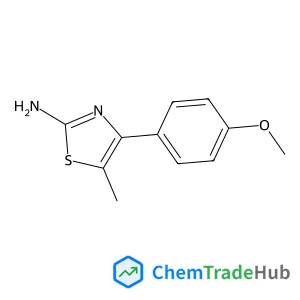
4-(4-Methoxyphenyl)-5-methyl-1,3-thiazol-2-amine
CAS Number:
105512-88-7
Molecular Formula:
C11H12N2OS
Recommended Suppliers





Disclaimer
This page provides academic journal information for reference and research purposes only. We are not affiliated with any journal publishers and do not handle publication submissions. For publication-related inquiries, please contact the respective journal publishers directly.
If you notice any inaccuracies in the information displayed, please contact us at support@chemtradehub.com. We will promptly review and address your concerns.