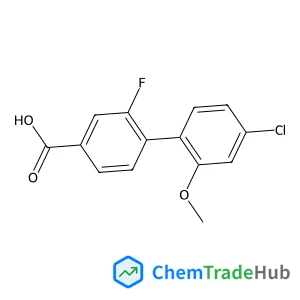
4-(4-Chloro-2-methoxyphenyl)-3-fluorobenzoic acid
CAS Number:
1261970-23-3
Molecular Formula:
C14H10ClFO3
Xiuwen Zhou, Benjamin J. Powell
It has recently been proposed that the dominant non-radiative decay mechanism in blue Ir(III) phosphors at room temperature is due to the low-lying non-radiative metal-centred triplet states. These are populated thermally via an activated transition from the highly radiative metal-to-ligand-charge-transfer states that are initially populated due to intersystem crossing following the radiative or electronic excitation of the phosphor. We apply transition state theory to quantitatively calculate the non-radiative decay rate of a family of Ir(III) complexes containing N-heterocyclic carbene (NHC) ligands. We compare the, computationally inexpensive, one-dimensional theory with the, more accurate, multi-dimensional theory. Both methods find a non-radiative rate with an Arrhenius form (knr = kae−ΔE/kBT). The pre-exponential factors, ka, and activation energies, ΔE, are evaluated via density functional theory (DFT). The multi-dimensional theory shows that there is an order of magnitude variation in ka within this family of materials (between 3 × 10¹¹ s−1 and 3 × 10¹² s−1). This is not captured by the one-dimensional theory, which predicts very uniform rate constants in the middle of this range (∼1012 s−1). Nevertheless, the activated process involved, and the linear relationship between ka and knr, mean that ka plays a subtle role in determining knr. Consistent with this we find that both methods capture the trend observed experimentally in the non-radiative rates. Furthermore, the magnitude of the calculated knr is similar in both methods and in good agreement with experimental values [except for one complex with a very shallow activation barrier (<0.1 eV)]. It has previously been demonstrated that radiative decay rates can be accurately calculated from DFT. Combined with our results for the non-radiative rates, this implies that DFT methods can accurately predict the emission efficiency in Ir(III) phosphors. Therefore, DFT calculations are both fast and accurate enough to play a significant role in the design of new deep blue Ir(III) phosphors with high emission efficiency. Even the one-dimensional theory provides reasonable agreement with experiment. This suggests that a funneling approach – where only the best performing molecules, according to the one-dimensional theory, are studied in the more laborious multi-dimensional framework – could be a powerful strategy for designing active materials for phosphorescent organic light-emitting diodes (PHOLEDs) from first principles.
Lawerence Kenning, Graeme J. Stasiuk
DOI: 10.1039/D3CC03430E
Yuxuan Liang, Meijia Qiu, Peng Sun, Wenjie Mai
DOI: 10.1039/D3SC05334B
Yu-Ling Tseng, Tian Zeng, Maxwell J. Robb
DOI: 10.1039/D3SC06359C
Pol Salles, Pamela Machado, Pengmei Yu, Mariona Coll
DOI: 10.1039/D3CC03030J
Elena S. Osipova, Sergey A. Kovalenko, Oleg A. Filippov, Natalia V. Belkova, Laure Vendier, Yves Canac, Elena S. Shubina, Dmitry A. Valyaev
DOI: 10.1039/D3SC05356C
Qifei Shen, Kai Gao, Zhiqin Zhao, Anran Gao, Yanzi Xu, Heng Wang, Mingming Zhang, Dongfeng Dang
DOI: 10.1039/D3CC04166B
Minze Li, Jingzhen Wang, Qiuye Wang, Honglai Lu, Guofeng Wang, Honggang Fu
DOI: 10.1039/D3SC05464K
DOI: 10.1039/D3SC05530B
Ishani V. Gaidhane, Helen E. Erickson, Prachi Agarwal, Yashpal S. Chhonker, Donald R. Ronning
DOI: 10.1039/D3CC02364H
(5-Sulfamoyl-3-pyridinyl)boronic acid is primarily used in chemical synthesis, p...
Benzyl 2-methyl-2-(methylsulfonyl)-4-pentenoate is typically synthesized via est...
When handling 8-Fluoroquinolin-6-ol (CAS: 209353-22-0), it is important to use p...
1,3-Dibromo-5-(2-methyl-2-propanyl)benzene (CAS: 129316-09-2) is a crystalline c...
Ethyl 7-chloro-4-oxo-1-(1,3-thiazol-2-yl)-1,4-dihydro-1,8-naphthyridine-3-carbox...
When handling Delta-7-Avenasterol (CAS: 23290-26-8), it is important to wear app...
Proper handling involves the use of personal protective equipment such as gloves...
When handling 2-Methyl-2-proanyl 4-[(2-aminophenyl)amino]-1-piperidinecarboxylat...
N-Methyl-4-chlorobenzylamine hydrochloride (CAS: 65542-24-7) is a organic compou...
[2-(Dodecyloxy)ethoxy]acetic acid (CAS: 27306-90-7) is generally considered safe...

Physical Chemistry Chemical Physics (PCCP) is an international journal co-owned by 19 physical chemistry and physics societies from around the world. This journal publishes original, cutting-edge research in physical chemistry, chemical physics and biophysical chemistry. To be suitable for publication in PCCP, articles must include significant innovation and/or insight into physical chemistry; this is the most important criterion that reviewers and Editors will judge against when evaluating submissions. The journal has a broad scope and welcomes contributions spanning experiment, theory, computation and data science. Topical coverage includes spectroscopy, dynamics, kinetics, statistical mechanics, thermodynamics, electrochemistry, catalysis, surface science, quantum mechanics, quantum computing and machine learning. Interdisciplinary research areas such as polymers and soft matter, materials, nanoscience, energy, surfaces/interfaces, and biophysical chemistry are welcomed if they demonstrate significant innovation and/or insight into physical chemistry. Joined experimental/theoretical studies are particularly appreciated when complementary and based on up-to-date approaches.