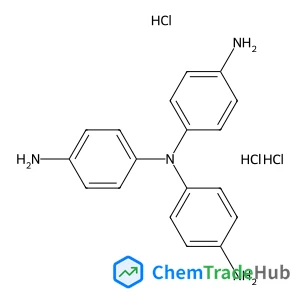
N1,N1-Bis(4-aminophenyl)benzene-1,4-diamine trihydrochloride
CAS Number:
114254-48-7
Molecular Formula:
C18H21Cl3N4
Zhi Li, Christophe Winisdoerffer
The ab initio (ai) Gibbs ensemble (GE) Monte Carlo (MC) method coupled with Kohn–Sham density functional theory is successful in predicting the liquid–vapour equilibrium of insulating systems. Here we show that the aiGEMC method can be used to study also metallic systems, where the excited electronic states play an important role and cannot be neglected. For this we include the electronic free energy in the formulation of the effective energy of the system to be used in the acceptance criteria for the MC moves. The application of this aiGEMC method to sodium yields a good agreement with available experimental data on the liquid–vapour equilibrium densities. We predict a critical point for sodium at 2338 ± 108 K and 0.24 ± 0.03 g cm−3. The liquid structure stemming from aiGEMC simulations is very similar to the one from ab initio molecular dynamics. Since this method can determine phase transition without computing the Gibbs free energy, it may offer a new possibility to study other materials with a reasonable computational cost.
Mohamed Ben Bechir, Faisal Alresheedi
DOI: 10.1039/D3CP04645A
Yi Zeng, Wen Shi, Qian Peng, Yingli Niu, Zhiying Ma, Xiaoyan Zheng
DOI: 10.1039/D3CP03852A
Fakhrul H. Bhuiyan, Ashlie Martini
DOI: 10.1039/D3CP05320B
Alberto García-Fernández, Stefania Riva, Håkan Rensmo
DOI: 10.1039/D3CP05061K
Alasdair D. Keith, Elizabeth B. Sawyer, Desmond C. Y. Choy, Yuhang Xie, George S. Biggs, Oskar James Klein, Paul D. Brear, David J. Wales, Paul D. Barker
DOI: 10.1039/D3CP03897A
Laura T. Wey, Jouko Peltonen, Yagut Allahverdiyeva
DOI: 10.1039/D3SE01185B
Qian Wang, Yu Zhuang, Abuduwayiti Aierken, Qiaogang Song, Qin Zhang, Youbo Dou, Qiuli Zhang, Shuyi Zhang
DOI: 10.1039/D3CP05309A
Akira Yamaguchi, Tomoki Kujirai, Takeshi Fujita, Hideki Abe, Masahiro Miyauchi
DOI: 10.1039/D3SE01346D
Md Al Mamunur Rashid, Sein Min, Sung Keon Namgoong, Keunhong Jeong
DOI: 10.1039/D3CP04310J
Shouqiang Wu, An Yong Li
DOI: 10.1039/D3CP05101C
Waste containing N-Methoxy-N-methyl-1,3-thiazole-5-carboxamide (CAS: 898825-89-3...
N-(4-Biphenylyl)dibenzo[b,d]furan-4-amine should be stored in a tightly sealed c...
The market for 3-Acetamido-5-amino-2,4,6-triiodobenzoic acid (CAS: 1713-07-1) is...
Benzyl 2-O-acetyl-3,4,6-tri-O-benzyl-beta-D-galactopyranoside (CAS: 61820-03-9) ...
2-Ethylpiperazine dihydrochloride (CAS: 438050-52-3) is regulated under the Glob...
1,1'-[1,3-Phenylenebis(methylene)]bis(3-methyl-1H-pyrrole-2,5-dione) (CAS: 11946...
Several alternatives can be used in the synthesis of 5-Fluoro-2-(1-pyrrolidinyl)...
Proper personal protective equipment (PPE) must be worn when handling this compo...
When handling 6-Bromoimidazo[1,2-a]pyridin-8-amine, it is important to wear appr...
Alternatives to (2S,4R)-4-(4-Nitrobenzyl)pyrrolidine-2-carboxylic acid hydrochlo...

Physical Chemistry Chemical Physics (PCCP) is an international journal co-owned by 19 physical chemistry and physics societies from around the world. This journal publishes original, cutting-edge research in physical chemistry, chemical physics and biophysical chemistry. To be suitable for publication in PCCP, articles must include significant innovation and/or insight into physical chemistry; this is the most important criterion that reviewers and Editors will judge against when evaluating submissions. The journal has a broad scope and welcomes contributions spanning experiment, theory, computation and data science. Topical coverage includes spectroscopy, dynamics, kinetics, statistical mechanics, thermodynamics, electrochemistry, catalysis, surface science, quantum mechanics, quantum computing and machine learning. Interdisciplinary research areas such as polymers and soft matter, materials, nanoscience, energy, surfaces/interfaces, and biophysical chemistry are welcomed if they demonstrate significant innovation and/or insight into physical chemistry. Joined experimental/theoretical studies are particularly appreciated when complementary and based on up-to-date approaches.