












Tunable valley polarization, magnetic anisotropy and Dzyaloshinskii–Moriya interaction in two-dimensional intrinsic ferromagnetic Janus 2H-VSeX (X = S, Te) monolayers
Literature Information
Publication Date
2020-09-22
DOI
10.1039/D0CP03292A
Impact Factor
3.676
Authors
Shengmei Qi, Jiawei Jiang, Wenbo Mi
View Original
Abstract
Two-dimensional (2D) Janus materials are a novel kind of 2D materials, which have potential applications in nanoelectronics, optoelectronics and spintronics. However, a 2D Janus material combined with intrinsic ferromagnetism, electric dipole moment, valley polarization and Dzyaloshinskii–Moriya interaction (DMI) remains rarely reported. Here, the electronic structure and magnetic properties of 2D intrinsic ferromagnetic Janus 2H-VSeX (X = S, Te) monolayers are investigated systematically using the density-functional theory. Janus 2H-VSeX (X = S, Te) monolayers are intrinsic ferromagnetic semiconductors with in-plane magnetic anisotropy (IMA). The valley splitting of Janus 2H-VSeX (X = S, Te) monolayers appears by considering the spin–orbit coupling (SOC) effect and out of plane magnetization. Additionally, spontaneous vertical electric dipole moment and a large DMI are also found in Janus 2H-VSeX (X = S, Te) monolayers due to the broken inversion symmetry. Moreover, the valley splitting and DMI can be significantly increased by applying in-plane biaxial strain. These results provide an interesting 2D intrinsic ferromagnetic Janus material, which has potential applications in spintronic and valleytronic devices.
Related Literature
Skeletal rearrangement of a boron-containing annulenic molecule into a macrocycle bridged by an electronically stabilized boron cation
2023-10-24
Communication
DOI: 10.1039/D3CC04830F
Switchover from singlet oxygen to superoxide radical through a photoinduced two-step sequential energy transfer process
Shengsheng Yu, Rong-Xin Zhu, Kai-Kai Niu, Ning Han, Hui Liu, Ling-Bao Xing
2024-01-05
Edge Article
DOI: 10.1039/D3SC05820D
Reply to the ‘Comment on “CO2 as oxidant: an unusual light-assisted catalyst free oxidation of aldehydes to acids under mild conditions”’ by S. R. Khan, S. Saini, K. Naresh, A. Kumari, V. Aniya, P. K. Khatri, A. Ray and S. L. Jain, Chem. Commun., 2022, 58, 2208
Shafiur Rehman Khan, K. Naresh, Alka Kumari, Vineet Aniya, Praveen K Khatri, Anjan Ray, Suman L Jain
2023-11-02
Comment
DOI: 10.1039/D3CC04389D
Total biosynthesis of fungal tetraketide pyrones
Yunlong Sun, Dongsong Tian, Eric Kuhnert, Geraldine Le Goff, Guillaume Arcile, Jamal Ouazzani, Russell J. Cox
2023-10-23
Communication
DOI: 10.1039/D3CC04758J
Visible-light-induced bifunctionalisation of (homo)propargylic amines with CO2 and arylsulfinates
2023-10-31
Communication
DOI: 10.1039/D3CC04160C
Enolate addition to bicyclobutanes enables expedient access to 2-oxo-bicyclohexane scaffolds
Kyla J. Woelk, Kushal Dhake, Nathan D. Schley, David C. Leitch
2023-10-10
Communication
DOI: 10.1039/D3CC04234K
Room temperature solid-state deformation induced high-density lithium grain boundaries to enhance the cycling stability of lithium metal batteries
Xue-Ying Zhang, Yong Zhang, Yong Gao, Hong Zhao
2023-10-25
Communication
DOI: 10.1039/D3CC04217K
Water-soluble organic macrocycles based on dye chromophores and their applications
Luying Zhang, Yanqing Xu, Wei Wei
2023-10-20
Feature Article
DOI: 10.1039/D3CC04159J
Graphdiyne chelated AuNPs for ultrasensitive electrochemical detection of tyrosine
Zhuanzhuan Shi, Yunpeng Li, Xiaoshuai Wu, Kaiwen Zhang, Jiatao Gu, Wei Sun, Chang Ming Li, Chun Xian Guo
2023-10-23
Communication
DOI: 10.1039/D3CC04148D
You might also like
Compound Q&A
What are the main uses of (5-Sulfamoyl-3-pyridinyl)boronic acid (CAS: 951233-61-7)?
(5-Sulfamoyl-3-pyridinyl)boronic acid is primarily used in chemical synthesis, p...
951233-61-7(5-Sulfamoyl-3-pyrid...
Compound Q&A
How is Benzyl 2-methyl-2-(methylsulfonyl)-4-pentenoate (CAS: 1942858-50-5) typically synthesized?
Benzyl 2-methyl-2-(methylsulfonyl)-4-pentenoate is typically synthesized via est...
1942858-50-5Benzyl 2-methyl-2-(m...
Compound Q&A
What precautions should be taken when handling 8-Fluoroquinolin-6-ol (CAS: 209353-22-0)?
When handling 8-Fluoroquinolin-6-ol (CAS: 209353-22-0), it is important to use p...
209353-22-08-Fluoroquinolin-6-o...
Compound Q&A
What are the physical and chemical properties of 1,3-Dibromo-5-(2-methyl-2-propanyl)benzene (CAS: 129316-09-2)?
1,3-Dibromo-5-(2-methyl-2-propanyl)benzene (CAS: 129316-09-2) is a crystalline c...
129316-09-21,3-Dibromo-5-(2-met...
Compound Q&A
What industries use Ethyl 7-chloro-4-oxo-1-(1,3-thiazol-2-yl)-1,4-dihydro-1,8-naphthyridine-3-carboxylate (CAS: 174726-87-5)?
Ethyl 7-chloro-4-oxo-1-(1,3-thiazol-2-yl)-1,4-dihydro-1,8-naphthyridine-3-carbox...
174726-87-5Ethyl 7-chloro-4-oxo...
Compound Q&A
What precautions should be taken when handling Delta-7-Avenasterol (CAS: 23290-26-8)?
When handling Delta-7-Avenasterol (CAS: 23290-26-8), it is important to wear app...
23290-26-8Delta-7-Avenasterol
Compound Q&A
What precautions should be taken when handling N-({(5R)-3-[3-Fluoro-4-(4-morpholinyl)phenyl]-2-oxo-1,3-oxazolidin-5-yl}methyl)acetamide (CAS: 872992-20-6)?
Proper handling involves the use of personal protective equipment such as gloves...
872992-20-6N-({(5R)-3-[3-Fluoro...
Compound Q&A
What precautions should be taken when handling 2-Methyl-2-proanyl 4-[(2-aminophenyl)amino]-1-piperidinecarboxylate (CAS: 79099-00-6)?
When handling 2-Methyl-2-proanyl 4-[(2-aminophenyl)amino]-1-piperidinecarboxylat...
79099-00-62-Methyl-2-propanyl ...
Compound Q&A
What is N-Methyl-4-chlorobenzylamine hydrochloride (CAS: 65542-24-7)?
N-Methyl-4-chlorobenzylamine hydrochloride (CAS: 65542-24-7) is a organic compou...
65542-24-7N-Methyl-4-chloroben...
Compound Q&A
Is [2-(Dodecyloxy)ethoxy]acetic acid (CAS: 27306-90-7) safe?
[2-(Dodecyloxy)ethoxy]acetic acid (CAS: 27306-90-7) is generally considered safe...
27306-90-7[2-(Dodecyloxy)ethox...
Source Journal
Physical Chemistry Chemical Physics

CiteScore:
5.5
Self-citation Rate:
10.3%
Articles per Year:
3036
Physical Chemistry Chemical Physics (PCCP) is an international journal co-owned by 19 physical chemistry and physics societies from around the world. This journal publishes original, cutting-edge research in physical chemistry, chemical physics and biophysical chemistry. To be suitable for publication in PCCP, articles must include significant innovation and/or insight into physical chemistry; this is the most important criterion that reviewers and Editors will judge against when evaluating submissions. The journal has a broad scope and welcomes contributions spanning experiment, theory, computation and data science. Topical coverage includes spectroscopy, dynamics, kinetics, statistical mechanics, thermodynamics, electrochemistry, catalysis, surface science, quantum mechanics, quantum computing and machine learning. Interdisciplinary research areas such as polymers and soft matter, materials, nanoscience, energy, surfaces/interfaces, and biophysical chemistry are welcomed if they demonstrate significant innovation and/or insight into physical chemistry. Joined experimental/theoretical studies are particularly appreciated when complementary and based on up-to-date approaches.
Recommended Compounds
![2-Azaspiro[4.5]decane-3,8-dione structure](https://static.chemtradehub.com/structs/914/914780-96-4-e94b.webp "2-Azaspiro[4.5]decane-3,8-dione structure")
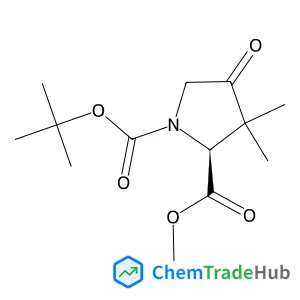
2-Methyl 1-(2-methyl-2-propanyl) (2S)-3,3-dimethyl-4-oxo-1,2-pyrrolidinedicarboxylate
CAS Number:
478698-30-5
Molecular Formula:
C13H21NO5
![2-Methyl-2-propanyl 4-oxo-3,9-diazabicyclo[4.2.1]nonane-9-carboxylate structure](https://static.chemtradehub.com/structs/131/1312456-05-5-9a15.webp "2-Methyl-2-propanyl 4-oxo-3,9-diazabicyclo[4.2.1]nonane-9-carboxylate structure")
2-Methyl-2-propanyl 4-oxo-3,9-diazabicyclo[4.2.1]nonane-9-carboxylate
CAS Number:
1312456-05-5
Molecular Formula:
C12H20N2O3
Recommended Suppliers





Disclaimer
This page provides academic journal information for reference and research purposes only. We are not affiliated with any journal publishers and do not handle publication submissions. For publication-related inquiries, please contact the respective journal publishers directly.
If you notice any inaccuracies in the information displayed, please contact us at support@chemtradehub.com. We will promptly review and address your concerns.