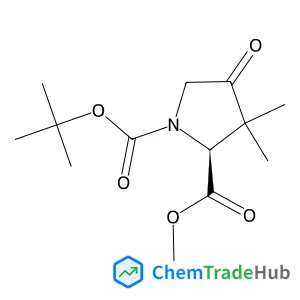
2-Methyl 1-(2-methyl-2-propanyl) (2S)-3,3-dimethyl-4-oxo-1,2-pyrrolidinedicarboxylate
CAS Number:
478698-30-5
Molecular Formula:
C13H21NO5
We study analytically the spectrum of excitons in disordered semiconductors like transition metal dichalcogenides, which are important for photovoltaic and spintronic applications. We show that ambient disorder exerts a strong influence on the exciton spectra. For example, in such a case, the well-known degeneracy of the hydrogenic problem (related to Runge–Lenz vector conservation) is lifted so that the exciton energy starts to depend on both the principal quantum number n and orbital l. We model the disorder phenomenologically substituting the ordinary Laplacian in the corresponding Schrödinger equation by the fractional one with Lévy index μ, characterizing the degree of disorder. Our variational treatment (corroborated by numerical results) shows that an exciton exists for 1 < μ ≤ 2. The case μ = 2 corresponds to the “ordered” hydrogenic problem, while in the opposite case μ = 1 the exciton collapses. The exciton spectrum is dominated by the sample areas with moderate disorder. Our theory permits controlled predictions to be made of the excitonic properties in semiconductor samples with different degrees of disorder.

Bioorganic & Medicinal Chemistry Letters

Medicinal Chemistry Research

Critical Reviews in Solid State and Materials Sciences

Journal of Chemical Sciences

Colloid Journal

NDT & E International

Journal of the Indian Institute of Science

Heteroatom Chemistry

Journal of Asian Natural Products Research

Electroanalysis
Ömer Reis, Serkan Eymur, Barbaros Reis, Ayhan S. Demir
DOI: 10.1039/B817474A
Dhilon S. Patel, Prasad V. Bharatam
DOI: 10.1039/B816595E
Suzanne Crilly, Edmond Magner
DOI: 10.1039/B819618D
Zhixun Luo, Yi Luo, Jie Li, Kai Liu, Hongbing Fu, Ying Ma, Jiannian Yao
DOI: 10.1039/B819402E
Dragoslav Vidovic, Glesni A. Pierce, Simon Aldridge
DOI: 10.1039/B816042B
Hiroshi Shinokubo, Atsuhiro Osuka
DOI: 10.1039/B817941G
Sang Ick Lee, Naoto Chatani
DOI: 10.1039/B812466C
(5-Sulfamoyl-3-pyridinyl)boronic acid is primarily used in chemical synthesis, p...
Benzyl 2-methyl-2-(methylsulfonyl)-4-pentenoate is typically synthesized via est...
When handling 8-Fluoroquinolin-6-ol (CAS: 209353-22-0), it is important to use p...
1,3-Dibromo-5-(2-methyl-2-propanyl)benzene (CAS: 129316-09-2) is a crystalline c...
Ethyl 7-chloro-4-oxo-1-(1,3-thiazol-2-yl)-1,4-dihydro-1,8-naphthyridine-3-carbox...
When handling Delta-7-Avenasterol (CAS: 23290-26-8), it is important to wear app...
Proper handling involves the use of personal protective equipment such as gloves...
When handling 2-Methyl-2-proanyl 4-[(2-aminophenyl)amino]-1-piperidinecarboxylat...
N-Methyl-4-chlorobenzylamine hydrochloride (CAS: 65542-24-7) is a organic compou...
[2-(Dodecyloxy)ethoxy]acetic acid (CAS: 27306-90-7) is generally considered safe...

Physical Chemistry Chemical Physics (PCCP) is an international journal co-owned by 19 physical chemistry and physics societies from around the world. This journal publishes original, cutting-edge research in physical chemistry, chemical physics and biophysical chemistry. To be suitable for publication in PCCP, articles must include significant innovation and/or insight into physical chemistry; this is the most important criterion that reviewers and Editors will judge against when evaluating submissions. The journal has a broad scope and welcomes contributions spanning experiment, theory, computation and data science. Topical coverage includes spectroscopy, dynamics, kinetics, statistical mechanics, thermodynamics, electrochemistry, catalysis, surface science, quantum mechanics, quantum computing and machine learning. Interdisciplinary research areas such as polymers and soft matter, materials, nanoscience, energy, surfaces/interfaces, and biophysical chemistry are welcomed if they demonstrate significant innovation and/or insight into physical chemistry. Joined experimental/theoretical studies are particularly appreciated when complementary and based on up-to-date approaches.
![N-[2,6-Di(9-anthryl)-4-oxido-8,9,10,11,12,13,14,15-octahydrodinaphtho[2,1-d:1',2'-f][1,3,2]dioxaphosphepin-4-yl]-1,1,1-trifluoromethanesulfonamide structure](https://static.chemtradehub.com/structs/122/1227374-64-2-cdb5.webp "N-[2,6-Di(9-anthryl)-4-oxido-8,9,10,11,12,13,14,15-octahydrodinaphtho[2,1-d:1',2'-f][1,3,2]dioxaphosphepin-4-yl]-1,1,1-trifluoromethanesulfonamide structure")
![(4-Methyl-1H-benzo[d]imidazol-2-yl)methanamine structure](https://static.chemtradehub.com/structs/933/933756-31-1-7b0b.webp "(4-Methyl-1H-benzo[d]imidazol-2-yl)methanamine structure")
![4-Fluoro-2-(4-{[(3S,4R)-4-(2-hydroxy-2-propanyl)-3-pyrrolidinyl]amino}-6,7-dimethoxy-2-quinazolinyl)phenol hydrochloride (1:1) structure](https://static.chemtradehub.com/structs/143/1431697-96-9-619c.webp "4-Fluoro-2-(4-{[(3S,4R)-4-(2-hydroxy-2-propanyl)-3-pyrrolidinyl]amino}-6,7-dimethoxy-2-quinazolinyl)phenol hydrochloride (1:1) structure")