












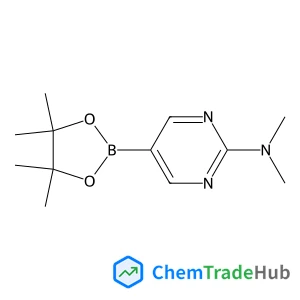
N,N-Dimethyl-5-(4,4,5,5-tetramethyl-1,3,2-dioxaborolan-2-yl)-2-pyrimidinamine
CAS Number:
1032759-30-0
Molecular Formula:
C12H20BN3O2
Shuaicheng Han, Yuee Li, Zhong Wang
The construction of type-II van der Waals heterostructure is an effective method to design efficient photocatalysts. In this study, we constructed the PtSe2/SiH van der Waals heterojunction, investigated its structural, electronic and optical properties, and discussed its application in photocatalysis. The PtSe2/SiH heterostructure is an indirect bandgap heterojunction with a 1.553 eV bandgap. The phonon dispersion curves and electron localization functions are calculated to investigate the stability of the heterojunction and the bonding mechanism between layers. According to projected density of state, it is known that PtSe2/SiH is a type-II band alignment. By calculating the work functions, the charge density difference and the plane-averaged electrostatic potential drop across the interface, we explored and discussed the interface charge transfer. In order to investigate the photocatalytic application of the PtSe2/SiH heterostructure, the band edge position and absorption coefficient were calculated. The band edge position of the heterojunction crosses the redox potential of water, indicating that it has the ability for photocatalytic water splitting. Moreover, the excellent absorption coefficient of the PtSe2/SiH heterojunction is higher than that of almost all previous studies. The absorption coefficient spans the whole region of visible light and has a peak value of 3.34 × 105 cm−1. Meanwhile, there was a peak of 4 × 105 cm−1 in the near ultraviolet region. Our results demonstrate that PtSe2/SiH has excellent properties and is a promising photocatalytic candidate.
Jan Martin Nölle, Sebastian Primpke, Klaus Müllen, Philipp Vana
DOI: 10.1039/C6PY00590J
Mingming Zuo, Tianqing Liu, Jingjing Han
DOI: 10.1039/C4PY00616J
D.-L. Versace, J. Bourgon, E. Leroy, F. Dumur, D. Gigmes, J. P. Fouassier, J. Lalevée
DOI: 10.1039/C4PY00716F
Lichao Sun, Jinchuan Liu, Hanying Zhao
DOI: 10.1039/C4PY00938J
DOI: 10.1039/C6PY00480F
P. S. Kulkarni, M. K. Haldar, M. I. Confeld, C. J. Langaas, X. Yang, S. Y. Qian, S. Mallik
DOI: 10.1039/C6PY00623J
Laibing Wang, Nozomu Suzuki, Jiangfei Liu, Takashi Matsuda, Nor Azura Abdul Rahim, Wei Zhang, Michiya Fujiki, Zhengbiao Zhang, Nianchen Zhou, Xiulin Zhu
DOI: 10.1039/C4PY00865K
When considering alternatives to 1-(4-Chlorophenyl)-N-hydroxymethanimine (CAS: 3...
This compound should be stored in a cool, dry place away from direct sunlight. I...
3-(4-Bromophenyl)-5-(2-fluorophenyl)-1,2,4-oxadiazole is synthesized through a m...
5-Chloro-2-(4-chlorophenyl)-4-methyl-6-[3-(1-piperidinyl)propoxy]pyrimidine (CAS...
2-Chloro-4-(difluoromethoxy)pyridine is used in the pharmaceutical industry for ...
3-Chloro-6-methylpyridazine (CAS: 1121-79-5) is classified under the Globally Ha...
Several alternatives can be used in the synthesis of Methyl 4,5-dimethyl-2-nitro...
Alternatives to (2E,2'E)-3,3'-(1,4-Phenylene)bisacrylaldehyde include other acry...
3-Amino-5-chloropyridin-2-ol hydrochloride is an organic compound with the CAS n...
When handling 6,7-Difluoro-2,3-dihydro-4H-chromen-4-one, it is essential to wear...

Physical Chemistry Chemical Physics (PCCP) is an international journal co-owned by 19 physical chemistry and physics societies from around the world. This journal publishes original, cutting-edge research in physical chemistry, chemical physics and biophysical chemistry. To be suitable for publication in PCCP, articles must include significant innovation and/or insight into physical chemistry; this is the most important criterion that reviewers and Editors will judge against when evaluating submissions. The journal has a broad scope and welcomes contributions spanning experiment, theory, computation and data science. Topical coverage includes spectroscopy, dynamics, kinetics, statistical mechanics, thermodynamics, electrochemistry, catalysis, surface science, quantum mechanics, quantum computing and machine learning. Interdisciplinary research areas such as polymers and soft matter, materials, nanoscience, energy, surfaces/interfaces, and biophysical chemistry are welcomed if they demonstrate significant innovation and/or insight into physical chemistry. Joined experimental/theoretical studies are particularly appreciated when complementary and based on up-to-date approaches.
![2-{[(1R,2S)-2-Aminocyclohexyl]amino}-4-{[3-(2H-1,2,3-triazol-2-yl)phenyl]amino}-5-pyrimidinecarboxamide structure](https://static.chemtradehub.com/structs/137/1370261-96-3-40df.webp "2-{[(1R,2S)-2-Aminocyclohexyl]amino}-4-{[3-(2H-1,2,3-triazol-2-yl)phenyl]amino}-5-pyrimidinecarboxamide structure")




