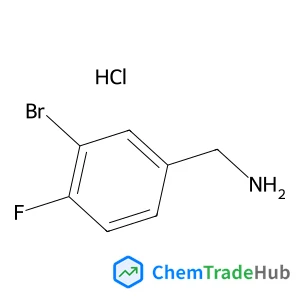
1-(3-Bromo-4-fluorophenyl)methanamine hydrochloride (1:1)
CAS Number:
202865-68-7
Molecular Formula:
C7H8BrClFN
D.-L. Versace, J. Bourgon, E. Leroy, F. Dumur, D. Gigmes, J. P. Fouassier, J. Lalevée
[N,N′-Bis(salicylidene)-1,2-phenylenediamine]zinc(II) (ZnC) exhibits unexpected properties as a photoinitiator or additive for both free-radical photopolymerization reactions and in situ formation of Zn-based fillers under light activation and aerated conditions. The ZnC/2,2-dimethoxy-2-phenylacetophenone (DMPA) and ZnC/N-methyldiethanolamine (MDEA) couples are characterized by remarkable properties: (i) a photoinitiating efficiency for the radical polymerization of an acrylate matrix under air higher than that of a reference Type I photoinitiator such as DMPA (final conversion of ∼30–45% vs. 15%) and therefore a good ability to overcome the oxygen inhibition effect and (ii) a never reported in situ formation of Zn-based fillers (100 μm thick sticks) or composites. The photochemical properties of the ZnC are investigated by fluorescence and UV-visible spectroscopy and Electron Spin Resonance (ESR). The photodecomposition of ZnC under air is governed by either an addition of peroxyl radicals onto ZnC when associated with DMPA, or a H-abstraction mechanism when combined with MDEA. When using a ZnC/MDEA/silver salt photoinitiating system, a highly efficient polymerization of the acrylate matrix under air and a concomitant in situ production of Ag(0) NPs are observed.

Current Opinion in Colloid & Interface Science

Russian Journal of Bioorganic Chemistry

Journal of Saudi Chemical Society

Russian Journal of General Chemistry

Russian Chemical Bulletin

Journal of Natural Medicines

Nature Medicine

Chemical Communications

Chemistry Education Research and Practice

New Journal of Chemistry
DOI: 10.1039/C3CP51650D
Minhua Shao, Brandon H. Smith, Sandra Guerrero, Lesia Protsailo, Dong Su, Keiichi Kaneko, Jonathan H. Odell, Michael P. Humbert, Kotaro Sasaki, Jesse Marzullo, Robert M. Darling
DOI: 10.1039/C3CP52252K
Jaume Puy, Joan Cecília, Josep Galceran
DOI: 10.1039/C3CP51038G
Rana Tabassum, Satyendra K. Mishra, Banshi D. Gupta
DOI: 10.1039/C3CP51525G
Antonio Politano, Davide Campi
DOI: 10.1039/C3CP51954F
Yuqi Zhang, Loujun Gao, Liping Wen, Liping Heng, Yanlin Song
DOI: 10.1039/C3CP51324F
Jukka Jokisaari, Juha Vaara
DOI: 10.1039/C3CP50625H
Erik C. Neyts, Umedjon Khalilov, Bart Partoens
DOI: 10.1039/C3CP51621K
George Y. Margulis, Bogyu Lim, Brian E. Hardin, Eva L. Unger, Jun-Ho Yum, Johann M. Feckl, Dina Fattakhova-Rohlfing, Thomas Bein, Michael Grätzel, Alan Sellinger, Michael D. McGehee
DOI: 10.1039/C3CP51018B
When considering alternatives to 1-(4-Chlorophenyl)-N-hydroxymethanimine (CAS: 3...
This compound should be stored in a cool, dry place away from direct sunlight. I...
3-(4-Bromophenyl)-5-(2-fluorophenyl)-1,2,4-oxadiazole is synthesized through a m...
5-Chloro-2-(4-chlorophenyl)-4-methyl-6-[3-(1-piperidinyl)propoxy]pyrimidine (CAS...
2-Chloro-4-(difluoromethoxy)pyridine is used in the pharmaceutical industry for ...
3-Chloro-6-methylpyridazine (CAS: 1121-79-5) is classified under the Globally Ha...
Several alternatives can be used in the synthesis of Methyl 4,5-dimethyl-2-nitro...
Alternatives to (2E,2'E)-3,3'-(1,4-Phenylene)bisacrylaldehyde include other acry...
3-Amino-5-chloropyridin-2-ol hydrochloride is an organic compound with the CAS n...
When handling 6,7-Difluoro-2,3-dihydro-4H-chromen-4-one, it is essential to wear...

Polymer Chemistry welcomes submissions in all areas of polymer science that have a strong focus on macromolecular chemistry. Manuscripts may cover a broad range of fields, yet no direct application focus is required.
![[4-(Isobutyrylamino)phenyl]boronic acid structure](https://static.chemtradehub.com/structs/874/874219-50-8-6ab5.webp "[4-(Isobutyrylamino)phenyl]boronic acid structure")