


First-principles calculations combined with experiments to study the gas-sensing performance of Zn-substituted SnS
Literature Information
Publication Date
2020-07-13
DOI
10.1039/D0CP01521K
Impact Factor
3.676
Authors
View Original
Abstract
Two-dimensional group-IV monochalcogenides MX (M = Ge, and Sn; X = S, and Se) are explored for their potential in gas-sensing applications. In this work, a combined theoretical and experimental study on pure SnS and Zn-substituted SnS for promising methanol sensors is performed. The adsorption characteristics of methanol on pure and Zn-substituted SnS were first calculated using first-principles based on density functional theory (DFT). It is clarified theoretically that the incorporation of Zn dopant could enhance the adsorption capability of the SnS surface to methanol molecules, thus achieving obvious response enhancement and selectivity improvement. Further experimental investigation is carried out based on the successful synthesis of pure and Zn-substituted SnS with hierarchical architecture via a one-step solvothermal process. Gas-sensing measurement indicates that the Zn-substituted SnS sensor is promising for selective detection of rarefied methanol. At room temperature, the as-synthesized hierarchical SnS with an appropriate amount of Zn-doping can sense methanol vapor of as low as 100 ppb. In particular, Zn-doping can enhance the sensing response of methanol significantly, with a 32.8-fold increase in response value achieved in comparison to that of the pure SnS. The underlying mechanism for the response enhancement of Zn-substituted SnS is also analyzed and demonstrated in detail. The present work demonstrates that Zn-doping is highly effective for improving the response and selectivity of SnS towards methanol vapor, and the Zn-substituted SnS is promising for highly sensitive methanol sensors with low consumption.
Recommended Journals

Proceedings of the National Academy of Sciences of the United States of America

Nature

Journal of Organometallic Chemistry

Russian Chemical Reviews

Journal of Heterocyclic Chemistry

Helvetica Chimica Acta

Journal of Catalysis

Israel Journal of Chemistry

Science Progress

European Journal of Wood and Wood Products
Related Literature
One-pot synthesis and postpolymerization functionalization of cyclic carbonate/epoxide-difunctional polycarbonates prepared by regioselective diepoxide/CO2 copolymerization
Bing Han, Li Zhang, Hongye Zhang, Huining Ding, Binyuan Liu, Xianhong Wang
2016-05-30
Communication
DOI: 10.1039/C6PY00563B
Catechol/boronic acid chemistry for the creation of block copolymers with a multi-stimuli responsive junction
Fanny Coumes, Aurélie Malfait, Marc Bria, Joël Lyskawa, Patrice Woisel, David Fournier
2016-06-17
Paper
DOI: 10.1039/C6PY00738D
Highly selective and efficient chelating fiber functionalized by bis(2-pyridylmethyl)amino group for heavy metal ions
2016-04-25
Paper
DOI: 10.1039/C6PY00335D
The effect of different chalcogenophenes in isoindigo-based conjugated copolymers on photovoltaic properties
Eui Hyuk Jung, Seunghwan Bae, Tae Woong Yoo, Won Ho Jo
2014-07-29
Paper
DOI: 10.1039/C4PY00791C
Mitochondria-targeted fluorescent polymersomes for drug delivery to cancer cells
P. S. Kulkarni, M. K. Haldar, M. I. Confeld, C. J. Langaas, X. Yang, S. Y. Qian, S. Mallik
2016-05-24
Communication
DOI: 10.1039/C6PY00623J
You might also like
Compound Q&A
Are there alternatives to 1-(4-Chlorophenyl)-N-hydroxymethanimine (CAS: 3848-36-0) in synthesis?
When considering alternatives to 1-(4-Chlorophenyl)-N-hydroxymethanimine (CAS: 3...
3848-36-01-(4-Chlorophenyl)-N...
Compound Q&A
How should (1R,9S,10S,12S,14E,16S,19R,20R,21S,22R)-3,9,21-Trihydroxy-5,10,12,14,16,20,22-heptamethyl-23,24-dioxatetracyclo[17.3.1.1~6,9~.0~2,7~]tetracosa-2,5,7,14-tetraen-4-one (CAS: 183202-73-5) be stored?
This compound should be stored in a cool, dry place away from direct sunlight. I...
183202-73-5(1R,9S,10S,12S,14E,1...
Compound Q&A
How is 3-(4-Bromophenyl)-5-(2-fluorophenyl)-1,2,4-oxadiazole (CAS: 419553-16-5) typically synthesized?
3-(4-Bromophenyl)-5-(2-fluorophenyl)-1,2,4-oxadiazole is synthesized through a m...
419553-16-53-(4-Bromophenyl)-5-...
Compound Q&A
How is 5-Chloro-2-(4-chlorophenyl)-4-methyl-6-[3-(1-piperidinyl)propoxy]pyrimidine (CAS: 1639220-19-1) typically synthesized?
5-Chloro-2-(4-chlorophenyl)-4-methyl-6-[3-(1-piperidinyl)propoxy]pyrimidine (CAS...
1639220-19-15-Chloro-2-(4-chloro...
Compound Q&A
What industries use 2-Chloro-4-(difluoromethoxy)pyridine (CAS: 1206978-15-5)?
2-Chloro-4-(difluoromethoxy)pyridine is used in the pharmaceutical industry for ...
1206978-15-52-Chloro-4-(difluoro...
Compound Q&A
What regulatory guidelines apply to 3-Chloro-6-methylpyridazine (CAS: 1121-79-5)?
3-Chloro-6-methylpyridazine (CAS: 1121-79-5) is classified under the Globally Ha...
1121-79-53-Chloro-6-methylpyr...
Compound Q&A
Are there alternatives to Methyl 4,5-dimethyl-2-nitrobenzoate in synthesis?
Several alternatives can be used in the synthesis of Methyl 4,5-dimethyl-2-nitro...
90922-74-0Methyl 4,5-dimethyl-...
Compound Q&A
Are there alternatives to (2E,2'E)-3,3'-(1,4-Phenylene)bisacrylaldehyde in synthesis?
Alternatives to (2E,2'E)-3,3'-(1,4-Phenylene)bisacrylaldehyde include other acry...
63405-68-5(2E,2'E)-3,3'-(1,4-P...
Compound Q&A
What is 3-Amino-5-chloropyridin-2-ol hydrochloride (CAS: 1261906-29-9)?
3-Amino-5-chloropyridin-2-ol hydrochloride is an organic compound with the CAS n...
1261906-29-93-Amino-5-chloropyri...
Compound Q&A
What precautions should be taken when handling 6,7-Difluoro-2,3-dihydro-4H-chromen-4-one (CAS: 1092349-93-3)?
When handling 6,7-Difluoro-2,3-dihydro-4H-chromen-4-one, it is essential to wear...
1092349-93-36,7-Difluoro-2,3-dih...
Source Journal
Physical Chemistry Chemical Physics

CiteScore:
5.5
Self-citation Rate:
10.3%
Articles per Year:
3036
Physical Chemistry Chemical Physics (PCCP) is an international journal co-owned by 19 physical chemistry and physics societies from around the world. This journal publishes original, cutting-edge research in physical chemistry, chemical physics and biophysical chemistry. To be suitable for publication in PCCP, articles must include significant innovation and/or insight into physical chemistry; this is the most important criterion that reviewers and Editors will judge against when evaluating submissions. The journal has a broad scope and welcomes contributions spanning experiment, theory, computation and data science. Topical coverage includes spectroscopy, dynamics, kinetics, statistical mechanics, thermodynamics, electrochemistry, catalysis, surface science, quantum mechanics, quantum computing and machine learning. Interdisciplinary research areas such as polymers and soft matter, materials, nanoscience, energy, surfaces/interfaces, and biophysical chemistry are welcomed if they demonstrate significant innovation and/or insight into physical chemistry. Joined experimental/theoretical studies are particularly appreciated when complementary and based on up-to-date approaches.
Recommended Compounds
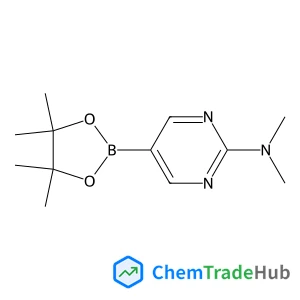
N,N-Dimethyl-5-(4,4,5,5-tetramethyl-1,3,2-dioxaborolan-2-yl)-2-pyrimidinamine
CAS Number:
1032759-30-0
Molecular Formula:
C12H20BN3O2
Recommended Suppliers




Disclaimer
This page provides academic journal information for reference and research purposes only. We are not affiliated with any journal publishers and do not handle publication submissions. For publication-related inquiries, please contact the respective journal publishers directly.
If you notice any inaccuracies in the information displayed, please contact us at support@chemtradehub.com. We will promptly review and address your concerns.