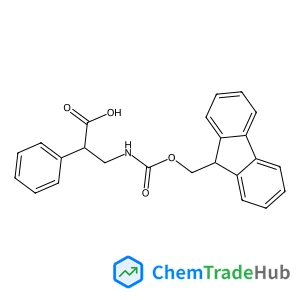
(S)-3-((((9H-Fluoren-9-yl)methoxy)carbonyl)amino)-2-phenylpropanoic acid
CAS Number:
1217663-60-9
Molecular Formula:
C24H21NO4
A bis(2-pyridylmethyl)amino group-modified polyacrylonitrile fiber (BPEN-PANF) was firstly prepared. The BPEN-PANF displays excellent selective complexation affinity in a 1 : 1 binding stoichiometry for the common toxic heavy metal ions, viz. Pb2+, Hg2+, Cd2+, Ag+, Zn2+, Cu2+, Ni2+, Co2+, and Cr3+. Meanwhile, it was significant that a much weaker binding ability was expressed for other light metal ions (Ca2+, Al3+, and Mg2+). Taking Pb2+ as an example, the maximum absorption capacity was as large as 303 mg g−1 calculated by the Langmuir isotherm model with an equilibrium time of 60 min. And the BPEN-PANF exhibits high absorption capacities for Pb2+ over a wide range of pH values from 3 to 11. Furthermore, it has an absorption limit of 4.76 ppb which is much lower than the drinking water standard of 10 ppb issued by the WHO. More positively, it can be easily recycled by filtration from the metal ion solutions and reused more than 20 times. In summary, the BPEN-PANF has the advantages of having inexpensive raw materials, simple preparation, high selectivity for heavy metal ions, and excellent recyclability and reusability, which surely indicates that the BPEN-PANF is a particularly useful material for rapid and simultaneous removal of heavy metal ions from polluted water.
Iakov Polyak, Eliot Boulanger, Kakali Sen, Walter Thiel
DOI: 10.1039/C3CP51669E
Ahmad Fahs, Guy Louarn
DOI: 10.1039/C3CP51007G
DOI: 10.1039/C3CP51743H
Cristina Greco, Geoffrey R. Luckhurst, Alberta Ferrarini
DOI: 10.1039/C3CP52222A
Jaume Puy, Joan Cecília, Josep Galceran
DOI: 10.1039/C3CP51038G
Imre Bakó, Ákos Bencsura, Kersti Hermannson, Szabolcs Bálint, Tamás Grósz, Julianna Oláh
DOI: 10.1039/C3CP52271G
Dima Vingurt, David Fuks, Miron V. Landau, Roxana Vidruk, Moti Herskowitz
DOI: 10.1039/C3CP51086G
When considering alternatives to 1-(4-Chlorophenyl)-N-hydroxymethanimine (CAS: 3...
This compound should be stored in a cool, dry place away from direct sunlight. I...
3-(4-Bromophenyl)-5-(2-fluorophenyl)-1,2,4-oxadiazole is synthesized through a m...
5-Chloro-2-(4-chlorophenyl)-4-methyl-6-[3-(1-piperidinyl)propoxy]pyrimidine (CAS...
2-Chloro-4-(difluoromethoxy)pyridine is used in the pharmaceutical industry for ...
3-Chloro-6-methylpyridazine (CAS: 1121-79-5) is classified under the Globally Ha...
Several alternatives can be used in the synthesis of Methyl 4,5-dimethyl-2-nitro...
Alternatives to (2E,2'E)-3,3'-(1,4-Phenylene)bisacrylaldehyde include other acry...
3-Amino-5-chloropyridin-2-ol hydrochloride is an organic compound with the CAS n...
When handling 6,7-Difluoro-2,3-dihydro-4H-chromen-4-one, it is essential to wear...

Polymer Chemistry welcomes submissions in all areas of polymer science that have a strong focus on macromolecular chemistry. Manuscripts may cover a broad range of fields, yet no direct application focus is required.