


Decoding the molecular water structure at complex interfaces through surface-specific spectroscopy of the water bending mode
Literature Information
Publication Date
2020-04-23
DOI
10.1039/D0CP01269F
Impact Factor
3.676
Authors
Takakazu Seki, Chun-Chieh Yu, Xiaoqing Yu, Tatsuhiko Ohto, Mischa Bonn, Yuki Nagata
View Original
Abstract
The structure of interfacial water determines atmospheric chemistry, wetting properties of materials, and protein folding. The challenge of investigating the properties of specific interfacial water molecules has frequently been confronted using surface-specific sum-frequency generation (SFG) vibrational spectroscopy using the O–H stretch mode. While perfectly suited for the water–air interface, for complex interfaces, a potential complication arises from the contribution of hydroxyl or amine groups of non-water species present at the surface, such as surface hydroxyls on minerals, or O–H and N–H groups contained in proteins. Here, we present a protocol to extract the hydrogen bond strength selectively of interfacial water, through the water bending mode. The bending mode vibrational frequency distribution provides a new avenue for unveiling the hydrogen bonding structure of interfacial water at complex aqueous interfaces. We demonstrate this method for the water–CaF2 and water–protein interfaces. For the former, we show that this method can indeed single out water O–H groups from surface hydroxyls, and that with increasing pH, the hydrogen-bonded network of interfacial water strengthens. Furthermore, we unveil enhanced hydrogen bonding of water, compared to bulk water, at the interface with human serum albumin proteins, a prototypical bio-interface.
Recommended Journals

Journal of Chemical Sciences

Colloid Journal

Main Group Chemistry

Critical Reviews in Solid State and Materials Sciences

Polycyclic Aromatic Compounds

Biocatalysis and Biotransformation

NDT & E International

Herald of the Russian Academy of Sciences

Journal of Asian Natural Products Research

Journal of the Indian Institute of Science
Related Literature
Visible-light-driven CO2 photoreduction over ZnxCd1−xS solid solution coupling with tetra(4-carboxyphenyl)porphyrin iron(iii) chloride
Xuehua Zhang, Chunchao Hou, Lin Lin
2018-05-25
Paper
DOI: 10.1039/C8CP02774A
Antisite-disorder engineering in La-based oxide heterostructures via oxygen vacancy control
Urmimala Dey, Swastika Chatterjee
2018-06-04
Paper
DOI: 10.1039/C8CP01500G
How accurate are static polarizability predictions from density functional theory? An assessment over 132 species at equilibrium geometry
Diptarka Hait
2018-07-16
Paper
DOI: 10.1039/C8CP03569E
Fe3+ chelating quinoline–hydrazone hybrids with proven cytotoxicity, leishmanicidal, and trypanocidal activities
Juan Carlos Coa, Wilson Cardona-Galeano, Albeiro Restrepo
2018-07-17
Paper
DOI: 10.1039/C8CP04174A
Predictive modeling of intrinsic strengths for several groups of chemically related monolayers by a reference model
2018-02-08
Paper
DOI: 10.1039/C7CP06621J
The quest for determining one-electron redox potentials of azulene-1-carbonitriles by calculation
Nicolai Ree, Cecilie Lindholm Andersen, Martin Drøhse Kilde, Ole Hammerich, Mogens Brøndsted Nielsen, Kurt V. Mikkelsen
2018-02-19
Paper
DOI: 10.1039/C7CP08687C
Mechanisms of reinforcement in polymer nanocomposites
N. Molinari, A. P. Sutton
2018-08-31
Paper
DOI: 10.1039/C8CP03281E
Vibrational spectra of small methylamine clusters accessed by an ab initio anharmonic approach
Qian-Rui Huang, Ying-Cheng Li, Kun-Lin Ho, Jer-Lai Kuo
2018-02-13
Paper
DOI: 10.1039/C8CP00533H
You might also like
Compound Q&A
How should waste containing N-Methoxy-N-methyl-1,3-thiazole-5-carboxamide (CAS: 898825-89-3) be handled?
Waste containing N-Methoxy-N-methyl-1,3-thiazole-5-carboxamide (CAS: 898825-89-3...
898825-89-3N-Methoxy-N-methyl-1...
Compound Q&A
How should N-(4-Biphenylyl)dibenzo[b,d]furan-4-amine (CAS: 1318338-47-4) be stored?
N-(4-Biphenylyl)dibenzo[b,d]furan-4-amine should be stored in a tightly sealed c...
1318338-47-4N-(4-Biphenylyl)dibe...
Compound Q&A
What is the market or research trend for 3-Acetamido-5-amino-2,4,6-triiodobenzoic acid (CAS: 1713-07-1)?
The market for 3-Acetamido-5-amino-2,4,6-triiodobenzoic acid (CAS: 1713-07-1) is...
1713-07-13-Acetamido-5-amino-...
Compound Q&A
How should Benzyl 2-O-acetyl-3,4,6-tri-O-benzyl-beta-D-galactopyranoside (CAS: 61820-03-9) be stored?
Benzyl 2-O-acetyl-3,4,6-tri-O-benzyl-beta-D-galactopyranoside (CAS: 61820-03-9) ...
61820-03-9Benzyl 2-O-acetyl-3,...
Compound Q&A
What regulatory guidelines apply to 2-Ethylpiperazine dihydrochloride (CAS: 438050-52-3)?
2-Ethylpiperazine dihydrochloride (CAS: 438050-52-3) is regulated under the Glob...
438050-52-32-Ethylpiperazine di...
Compound Q&A
What regulatory guidelines apply to 1,1'-[1,3-Phenylenebis(methylene)]bis(3-methyl-1H-pyrrole-2,5-dione) (CAS: 119462-56-5)?
1,1'-[1,3-Phenylenebis(methylene)]bis(3-methyl-1H-pyrrole-2,5-dione) (CAS: 11946...
119462-56-51,1'-[1,3-Phenyleneb...
Compound Q&A
Are there alternatives to 5-Fluoro-2-(1-pyrrolidinyl)pyridine (CAS: 1287217-79-1) in synthesis?
Several alternatives can be used in the synthesis of 5-Fluoro-2-(1-pyrrolidinyl)...
1287217-79-15-Fluoro-2-(1-pyrrol...
Compound Q&A
What precautions should be taken when handling 1-((2R,3R,4R,5R)-5-((bis(4-methoxyphenyl)(phenyl)methoxy)methyl)-4-hydroxy-3-methoxytetrahydrofuran-2-yl)-5-methylpyrimidine-2,4(1H,3H)-dione (CAS: 153631-19-7)?
Proper personal protective equipment (PPE) must be worn when handling this compo...
153631-19-71-((2R,3R,4R,5R)-5-(...
Compound Q&A
What precautions should be taken when handling 6-Bromoimidazo[1,2-a]pyridin-8-amine (CAS: 676371-00-9)?
When handling 6-Bromoimidazo[1,2-a]pyridin-8-amine, it is important to wear appr...
676371-00-96-Bromoimidazo[1,2-a...
Compound Q&A
Are there alternatives to (2S,4R)-4-(4-Nitrobenzyl)pyrrolidine-2-carboxylic acid hydrochloride (CAS: 1049740-22-8) in synthesis?
Alternatives to (2S,4R)-4-(4-Nitrobenzyl)pyrrolidine-2-carboxylic acid hydrochlo...
1049740-22-8(2S,4R)-4-(4-Nitrobe...
Source Journal
Physical Chemistry Chemical Physics

CiteScore:
5.5
Self-citation Rate:
10.3%
Articles per Year:
3036
Physical Chemistry Chemical Physics (PCCP) is an international journal co-owned by 19 physical chemistry and physics societies from around the world. This journal publishes original, cutting-edge research in physical chemistry, chemical physics and biophysical chemistry. To be suitable for publication in PCCP, articles must include significant innovation and/or insight into physical chemistry; this is the most important criterion that reviewers and Editors will judge against when evaluating submissions. The journal has a broad scope and welcomes contributions spanning experiment, theory, computation and data science. Topical coverage includes spectroscopy, dynamics, kinetics, statistical mechanics, thermodynamics, electrochemistry, catalysis, surface science, quantum mechanics, quantum computing and machine learning. Interdisciplinary research areas such as polymers and soft matter, materials, nanoscience, energy, surfaces/interfaces, and biophysical chemistry are welcomed if they demonstrate significant innovation and/or insight into physical chemistry. Joined experimental/theoretical studies are particularly appreciated when complementary and based on up-to-date approaches.
Recommended Compounds
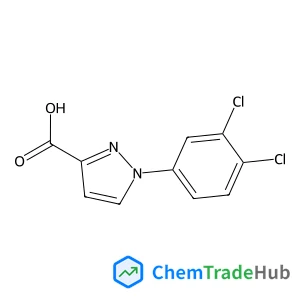
1-(3,4-Dichlorophenyl)-1H-pyrazole-3-carboxylic acid
CAS Number:
1152949-12-6
Molecular Formula:
C10H6Cl2N2O2
![2-Methyl-2-propanyl {3-[4-(4,4,5,5-tetramethyl-1,3,2-dioxaborolan-2-yl)phenyl]-3-oxetanyl}carbamate structure](https://static.chemtradehub.com/structs/127/1279090-25-3-1b84.webp "2-Methyl-2-propanyl {3-[4-(4,4,5,5-tetramethyl-1,3,2-dioxaborolan-2-yl)phenyl]-3-oxetanyl}carbamate structure")
2-Methyl-2-propanyl {3-[4-(4,4,5,5-tetramethyl-1,3,2-dioxaborolan-2-yl)phenyl]-3-oxetanyl}carbamate
CAS Number:
1279090-25-3
Molecular Formula:
C20H30BNO5
Recommended Suppliers




Disclaimer
This page provides academic journal information for reference and research purposes only. We are not affiliated with any journal publishers and do not handle publication submissions. For publication-related inquiries, please contact the respective journal publishers directly.
If you notice any inaccuracies in the information displayed, please contact us at support@chemtradehub.com. We will promptly review and address your concerns.