












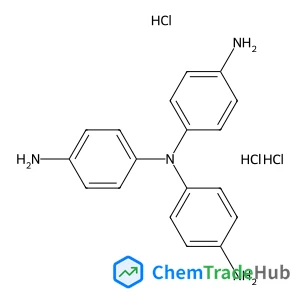
N1,N1-Bis(4-aminophenyl)benzene-1,4-diamine trihydrochloride
CAS Number:
114254-48-7
Molecular Formula:
C18H21Cl3N4
Arpad Mihai Rostas, Andrei Cristian Kuncser, Daniela Ghica, Alexandra Palici, Valentin Adrian Maraloiu, Ioana Dorina Vlaicu
The aim of this paper is the study of the thermal behavior of the simonkolleite Zn5(OH)8Cl2·H2O (ZHC) by electron paramagnetic resonance (EPR) spectroscopy, in particular. It is well known that during heating ZHC undergoes a complex transformation which involves several overlapping stages. However, with reference to the data reported on this subject, it can be concluded that there is still an ongoing debate regarding the intermediate stages of this process. The data presented in this study support a simple decomposition process of the ZHC prepared using the precipitation method. The EPR data correlated to the data obtained by other experimental techniques, such as XRD, TEM, SEM and EDX, indicate that during the thermal treatment the ZHC suffers a partial decomposition to ZnO with no intermediate products. After annealing at 500 °C for 1 h, a recombination process of ZHC is observed. Moreover, the kinetics associated to these decomposition steps were determined and the evolution of the paramagnetic centers was also followed and studied. This study offers new information related to the thermal behavior of ZHC, especially regarding the EPR data which is reported for the first time on this subject and material.
Bratislav P. Marinković, Jaime Rosado, Francisco Blanco, Gustavo García, Jelena B. Maljković
DOI: 10.1039/D3CP05052A
Jiali Nie, Ying Li, Dongyue Gao, Yi Fang, Jing Lin, Chengchun Tang, Zhonglu Guo
DOI: 10.1039/D3CP04718K
Alasdair D. Keith, Elizabeth B. Sawyer, Desmond C. Y. Choy, Yuhang Xie, George S. Biggs, Oskar James Klein, Paul D. Brear, David J. Wales, Paul D. Barker
DOI: 10.1039/D3CP03897A
Zifeng Song, Haoliang Liu, Baiyi Chen, Qin Jiang, Fengxiang Sui, Kai Wu, Yonghong Cheng, Bing Xiao
DOI: 10.1039/D3CP05035A
Hainan Jiang, Yaolong He, Xiaolin Li, Zhiyao Jin, Huijie Yu, Dawei Li
DOI: 10.1039/D3CP04274J
T. V. Pavlova, V. M. Shevlyuga
DOI: 10.1039/D3CP04962K
Yang Zhang, Wenxing Jiang, Zhenying Chen, Yingying Liu, Chengwei Deng, Xiaodong Zhuang, Junliang Zhang, Changchun Ke
DOI: 10.1039/D3SE01401K
Yi-Rong Liu, Yan Jiang
DOI: 10.1039/D3CP04702D
Meng Xia, Xinyao Liu, Zhaorong Shang, Fuqiang Fan
DOI: 10.1039/D3CP03879C
Waste containing N-Methoxy-N-methyl-1,3-thiazole-5-carboxamide (CAS: 898825-89-3...
N-(4-Biphenylyl)dibenzo[b,d]furan-4-amine should be stored in a tightly sealed c...
The market for 3-Acetamido-5-amino-2,4,6-triiodobenzoic acid (CAS: 1713-07-1) is...
Benzyl 2-O-acetyl-3,4,6-tri-O-benzyl-beta-D-galactopyranoside (CAS: 61820-03-9) ...
2-Ethylpiperazine dihydrochloride (CAS: 438050-52-3) is regulated under the Glob...
1,1'-[1,3-Phenylenebis(methylene)]bis(3-methyl-1H-pyrrole-2,5-dione) (CAS: 11946...
Several alternatives can be used in the synthesis of 5-Fluoro-2-(1-pyrrolidinyl)...
Proper personal protective equipment (PPE) must be worn when handling this compo...
When handling 6-Bromoimidazo[1,2-a]pyridin-8-amine, it is important to wear appr...
Alternatives to (2S,4R)-4-(4-Nitrobenzyl)pyrrolidine-2-carboxylic acid hydrochlo...

Physical Chemistry Chemical Physics (PCCP) is an international journal co-owned by 19 physical chemistry and physics societies from around the world. This journal publishes original, cutting-edge research in physical chemistry, chemical physics and biophysical chemistry. To be suitable for publication in PCCP, articles must include significant innovation and/or insight into physical chemistry; this is the most important criterion that reviewers and Editors will judge against when evaluating submissions. The journal has a broad scope and welcomes contributions spanning experiment, theory, computation and data science. Topical coverage includes spectroscopy, dynamics, kinetics, statistical mechanics, thermodynamics, electrochemistry, catalysis, surface science, quantum mechanics, quantum computing and machine learning. Interdisciplinary research areas such as polymers and soft matter, materials, nanoscience, energy, surfaces/interfaces, and biophysical chemistry are welcomed if they demonstrate significant innovation and/or insight into physical chemistry. Joined experimental/theoretical studies are particularly appreciated when complementary and based on up-to-date approaches.
![4-[(2-{2-[2-(2-Aminoethoxy)ethoxy]ethoxy}ethyl)amino]-2-(2,6-dioxo-3-piperidinyl)-1H-isoindole-1,3(2H)-dione structure](https://static.chemtradehub.com/structs/209/2093416-31-8-3162.webp "4-[(2-{2-[2-(2-Aminoethoxy)ethoxy]ethoxy}ethyl)amino]-2-(2,6-dioxo-3-piperidinyl)-1H-isoindole-1,3(2H)-dione structure")




