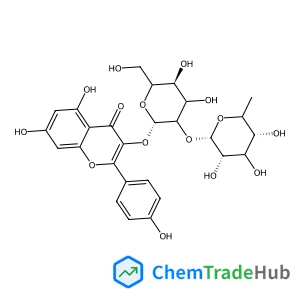
5,7-Dihydroxy-2-(4-hydroxyphenyl)-4-oxo-4H-chromen-3-yl 2-O-(6-deoxy-alpha-L-mannopyranosyl)-beta-D-glucopyranoside
CAS Number:
32602-81-6
Molecular Formula:
C27H30O15
The first page of this article is displayed as the abstract.
Mar Estévez-Fregoso, Jesús Hernández-Trujillo
DOI: 10.1039/C5CP06993A
Dongqing Zou, Wenkai Zhao, Changfeng Fang, Bin Cui
DOI: 10.1039/C6CP01159D
Z. M. Jendi, P. Servio, A. D. Rey
DOI: 10.1039/C5CP06530E
Seyedeh Mozhgan Seyed-Talebi, Iraj Kazeminezhad, Javad Beheshtian
DOI: 10.1039/C5CP04666A
Nanna Holmgaard List, Hans Jørgen Aagaard Jensen, Jacob Kongsted
DOI: 10.1039/C6CP00669H
Venkatesan Srinivasan, Murugesan Panneer, Madhavan Jaccob, Nagaraj Pavithra, Sambandam Anandan, Arunkumar Kathiravan
DOI: 10.1039/C5CP05338B
Pascal Puech, Iann C. Gerber
DOI: 10.1039/C5CP04594K
Jian Wang, Fujun Zhang, Qiaoshi An, Qianqian Sun, Jian Zhang
DOI: 10.1039/C5CP05471K
Bhagyashree Sancheti, G. N. Pandey
DOI: 10.1039/C5CP05213K
Ji Wu, Xianghong Wang, Yongyun Ji, Linli He, Shiben Li
DOI: 10.1039/C5CP08030D
(3.beta.)-3-Hydroxy-N,N-dimethyl-chol-5-en-24-amide (CAS: 79066-03-8) is primari...
5-(Aminomethyl)-2-methoxyphenol (CAS: 89702-89-6) is classified under GHS as a s...
Thieno[2,3-c]pyridin-7(6H)-one (CAS: 28981-13-7) is a heterocyclic organic compo...
1-[(6-Methoxy-3-pyridinyl)methyl]-4-piperidinamine dihydrochloride is generally ...
[(2E)-3-Phenyl-2-propen-1-yl]phosphonic acid (CAS: 146404-58-2) is regulated und...
6-Bromo-7-methoxyquinoline (CAS: 1620515-86-7) falls under the scope of the Glob...
This compound is primarily used in the pharmaceutical industry for the developme...
1-Ethyl-7-[2-methyl-6-(4H-1,2,4-triazol-3-yl)-3-pyridinyl]-3,5-dihydropyrazino[2...
Alternative reagents such as 2-[(dimethylamino)methyl]phenylboronic acid or rela...
3-(Piperidin-4-yloxy)pyridine (CAS: 310881-48-2) is an organic compound with the...

Chem Soc Rev publishes review articles covering important topics at the forefront of the chemical sciences. Reviews should be of the very highest quality and international impact. We particularly encourage international and multidisciplinary collaborations among our authors. Our scope covers the breadth of the chemical sciences, including interdisciplinary topics where the article has a basis in chemistry. Topics include: Analytical chemistry Biomaterials chemistry Bioorganic/medicinal chemistry Catalysis Chemical Biology Coordination Chemistry Crystal Engineering Energy Sustainable chemistry Green chemistry Inorganic chemistry Inorganic materials Main group chemistry Nanoscience Organic chemistry Organic materials Organometallics Physical chemistry Supramolecular chemistry Synthetic methodology Theoretical and computational chemistry