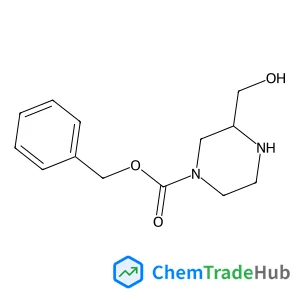
Benzyl 3-(hydroxymethyl)-1-piperazinecarboxylate
CAS Number:
191739-40-9
Molecular Formula:
C13H18N2O3
Fufu Han, Qiunan Shi, Liuqiao Zhang, Baolei Liu, Yajie Zhang, Yang Gao, Rui Jia, Zhengbiao Zhang
As a primary structure, the sequence plays an important role in the hierarchical self-assembly and the performance of polymers. However, sequence control is a tough challenge, especially for chain polymerization. Herein, toward more diversified sequence structures, two stereoisomeric furan/maleimide adducts, i.e., endo- and exo-isomers were introduced as latent monomers. The endo-latent monomer can be activated under a low temperature, ∼40 °C, while the exo-isomer can only be significantly activated under a high temperature, ∼110 °C. The distinct temperature of maleimide activation (or deprotection) enabled the selective release of maleimide by finely tuning the polymerization temperature. The sequence structures were thus greatly enriched by manipulating the temperature change mode, time of each temperature slot, and feed ratio of co-monomers. Here, a sequence-controlled triblock quadripolymer was unprecedentedly created from the stereoisomeric latent monomers via one-shot feeding of four co-monomers at the beginning. The stereoisomeric latent monomers reinforced the latent monomer strategy and led to greatly diversified sequence structures, offering more models for exploring the structure/property relationship.
Yeongrok Gim, Daekyeom Kim, Minkyu Kyeong, Seunghwan Byun, Yuri Park, Sooncheol Kwon, Heejoo Kim, Yves Lansac, Yun Hee Jang
DOI: 10.1039/C5CP07536J
Neha Agnihotri, Ronald P. Steer
DOI: 10.1039/C6CP00300A
Carolin M. Sutter-Fella, Dirk Lützenkirchen-Hecht, Ronald Frahm, Susan Schorr, Thomas Unold
DOI: 10.1039/C6CP00178E
Sukanya Dhar, V. Kranthi Kumar, Tanushree H. Choudhury, S. A. Shivashankar, S. Raghavan
DOI: 10.1039/C6CP01617K
Long Yang, Da-Jun Shu, Shao-Chun Li, Mu Wang
DOI: 10.1039/C6CP01106C
R. R. Wu, M. T. Rodgers
DOI: 10.1039/C6CP01445C
Yan Song, Qian Zhang, Wenbo Mi, Xiaocha Wang
DOI: 10.1039/C6CP01986B
Mrinal Dutta, Kanad Ray, Daisuke Fujita, Anirban Bandyopadhyay
DOI: 10.1039/C6CP00447D
Lixiu Guan, Guifeng Chen, Junguang Tao
DOI: 10.1039/C6CP01803C
Xiao Wang, Frank Schreiber, Alfred J. Meixner, Dai Zhang
DOI: 10.1039/C6CP01153E
4-Benzyl-2,2-dimethylmorpholine is generally considered safe when handled under ...
(5,6-Dimethoxy-3-pyridinyl)boronic acid is a chemical compound with the molecula...
1,1,3,3-Tetramethyl-1,3-bis(2-methyl-2-propanyl)disiloxane is synthesized throug...
(2R,4S)-1-Boc-4-methylpyrrolidine-2-carboxylic acid is primarily used as a build...
When handling 2,3-Dichloroacrylonitrile, it is crucial to wear appropriate perso...
(S)-1-(o-Tolyl)ethanamine hydrochloride should be stored in a cool, dry place to...
Benzyl [1-(hydroxyamino)-1-imino-2-methyl-2-propanyl]carbamate (CAS: 518047-98-8...
2-Methyloxazole-5-carbaldehyde is used in the pharmaceutical industry for the sy...
The market for 2-Methyl-2-propanyl 4-[(1S)-1-hydroxyethyl]-1-piperidinecarboxyla...
1-Butyl-3-methylpyridinium bromide is generally considered safe for laboratory u...

Polymer Chemistry welcomes submissions in all areas of polymer science that have a strong focus on macromolecular chemistry. Manuscripts may cover a broad range of fields, yet no direct application focus is required.