












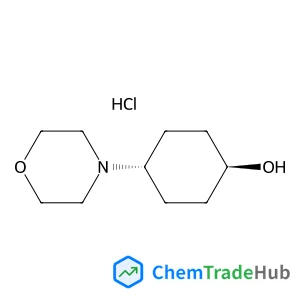
trans-4-(4-Morpholinyl)cyclohexanol hydrochloride (1:1)
CAS Number:
1588441-09-1
Molecular Formula:
C10H20ClNO2
The first page of this article is displayed as the abstract.
Rafael Grande-Aztatzi, Elena Formoso, Jon I. Mujika, Jesus M. Ugalde, Xabier Lopez
DOI: 10.1039/C5CP06379E
Yizhen Li, Jiaying Yu, Wei Li, Guoli Fan, Lan Yang, Feng Li
DOI: 10.1039/C5CP07371E
Eric B. Lindgren, Ho-Kei Chan, Anthony J. Stace, Elena Besley
DOI: 10.1039/C5CP07709E
Soree Kim, Sang-Won Park, YounJoon Jung
DOI: 10.1039/C5CP07368E
Fei Peng, Xue-Qing Chen, Ge-Bo Pan
DOI: 10.1039/C5CP07378B
Sulata K. Sahu, Baiyu Huang, Kristina Lilova, Brian F. Woodfield, Alexandra Navrotsky
DOI: 10.1039/C5CP02972D
Luigi Cigarini, Davide Vanossi, Claudio Fontanesi
DOI: 10.1039/C5CP01852H
Sten Sarman, Bin Li, Aatto Laaksonen
DOI: 10.1039/C5CP02586A
Afshan Mohajeri, Akbar Omidvar
DOI: 10.1039/C5CP02453F
1-(2,4,6-Trifluorophenyl)ethanol is an organic compound with the CAS number 1250...
1-(2,4-Dimethoxybenzyl)-4-(hydroxymethyl)-2-pyrrolidinone (CAS: 919111-34-5) is ...
(7S,15R)-6β,15-Diacetoxy-7α,20-epoxy-7-hydroxykaura-2,16-dien-1-one is a crystal...
The compound rac-ethyl (1r,4r)-4-hydroxycyclohexane-1-carboxylate, trans (CAS: 3...
The market for 2-(2,4-Difluorophenoxy)-3-nitropyridine (CAS: 175135-62-3) is cur...
The main uses of 6-Diazo-5-oxo-L-norleucine (CAS: 157-03-9) include research in ...
When handling 2-Aminoethyl-mono-amide-DOTA-tris(tBu ester) (CAS: 173308-19-5), i...
5-Methylimidazo[1,2-a]pyridine-3-carbaldehyde (CAS: 178488-37-4) can be synthesi...
There are alternative reagents that can be used in the synthesis of 2,4,6-Trihyd...
(2Z)-3-(5-Fluoro-1H-indol-3-yl)-2-sulfanylacrylic acid is a chemical compound wi...

Organic & Biomolecular Chemistry (OBC) publishes original and high impact research and reviews in organic chemistry. We welcome research that shows new or significantly improved protocols or methodologies in total synthesis, synthetic methodology or physical and theoretical organic chemistry as well as research that shows a significant advance in the organic chemistry or molecular design aspects of chemical biology, catalysis, supramolecular and macromolecular chemistry, theoretical chemistry, mechanism-oriented physical organic chemistry, medicinal chemistry or natural products. Articles published in the journal should report new work which makes a highly-significant impact in the field. Routine and incremental work is generally not suitable for publication in the journal. More details about key areas of our scope are below. In all cases authors should include in their article clear rationale for why their research has been carried out.
![9H-Fluoren-9-ylmethyl [(2S)-1-hydroxy-3-(1H-indol-3-yl)-2-propanyl]carbamate structure](https://static.chemtradehub.com/structs/153/153815-60-2-a67d.webp "9H-Fluoren-9-ylmethyl [(2S)-1-hydroxy-3-(1H-indol-3-yl)-2-propanyl]carbamate structure")
![9,9'-Spirobi[fluoren]-2-amine structure](https://static.chemtradehub.com/structs/118/118951-68-1-0d14.webp "9,9'-Spirobi[fluoren]-2-amine structure")





