












Phosphorylation promotes Al(iii) binding to proteins: GEGEGSGG as a case study
Literature Information
Publication Date
2016-02-03
DOI
10.1039/C5CP06379E
Impact Factor
3.676
Authors
Rafael Grande-Aztatzi, Elena Formoso, Jon I. Mujika, Jesus M. Ugalde, Xabier Lopez
View Original
Abstract
Aluminum, the third most abundant element in the Earth's crust and one of the key industrial components of our everyday life, has been associated with several neurodegenerative diseases due to its ability to promote neurofilament tangles and β-amyloid peptide aggregation. However, the experimental characterization of aluminum speciation in vivo is a difficult task. In the present study, we develop a theoretical protocol that combines molecular dynamics simulations, clustering of structures, and density functional theory for the characterization of the binding of aluminum to the synthetic neurofilament analogue octapeptide GEGEGSGG and its phosphorylated variant. Our protocol is tested with respect to previous NMR experimental data, which allows for a full interpretation of the experimental information available and its relationship with key thermodynamic quantities. Our results demonstrate the importance of phosphorylation in the ability of a peptide to bind to aluminum. Thus, phosphorylation: (i) changes the binding pattern of aluminum to GEGEGSGG, shifting the preferential binding site from the C-terminal to S6(P); (ii) increases the binding affinity by a factor of around 15 kcal mol−1 in free energy; and (iii) may cause significant changes in the secondary structure and stiffness of the polypeptide chain, specially in the case of bidentate binding modes. Our results shed light on the possibility of aluminum to induce aggregation of β-amyloid proteins and neurofilament tangles.
Related Literature
N-Acetoxy-phthalimide (NAPI) as a new H-abstracting agent at high temperature: application to the melt functionalization of polyethylene
Denis Bélékian, Philippe Cassagnau, Jean-Jacques Flat, Sébastien Quinebeche, Laurent Autissier, Denis Bertin, Didier Siri, Didier Gigmes, Yohann Guillaneuf, Philippe Chaumont, Emmanuel Beyou
2013-03-15
Communication
DOI: 10.1039/C3PY00246B
One-pot controlled synthesis of double thermoresponsive N-vinylcaprolactam-based copolymers with tunable LCSTs
Anthony Kermagoret, Charles-André Fustin, Maxime Bourguignon, Christophe Detrembleur, Christine Jérôme, Antoine Debuigne
2013-02-18
Paper
DOI: 10.1039/C3PY00134B
Inorganic nanoparticle synthesis in flow reactors – applications and future directions
Olga Długosz, Marcin Banach
2020-08-06
Review Article
DOI: 10.1039/D0RE00188K
Hydration capabilities and structures of carbonyl and ether groups in poly(3-(2-methoxyethyl)-N-vinyl-2-pyrrolidone) film
Hengjie Lai, Peiyi Wu
2013-03-13
Paper
DOI: 10.1039/C3PY00239J
Polymerization behaviors and polymer branching structures in ATRP of monovinyl and divinyl monomers
Hongjun Yang, Xiaoqiang Xue, Bibiao Jiang, Jianhai Chen, Yang Yang, Hongting Pu, Yun Liu, Dongliang Zhang, Lizhi Kong, Guangqun Zhai
2013-04-03
Paper
DOI: 10.1039/C3PY00338H
Supramolecular micelles with dual temperature and redox responses for multi-controlled drug release
Hui Zou, Wen Guo, Tianxiang Shen
2013-02-27
Communication
DOI: 10.1039/C3PY00211J
Benzotrithiophene and benzodithiophene-based polymers for efficient polymer solar cells with high open-circuit voltage
Guobing Zhang, Jianyu Yuan, Jingxuan Ma, Hongbo Lu, Longzhen Qiu, Wanli Ma
2013-03-22
Paper
DOI: 10.1039/C3PY00251A
Living radical polymerization of vinyl acetate and methyl acrylate mediated by Co(Salen*) complexes
Chei-Ming Liao, Ching-Chun Hsu, Fu-Sheng Wang, Bradford B. Wayland, Chi-How Peng
2013-03-14
Paper
DOI: 10.1039/C3PY00282A
Particle nucleation in high solids nitroxide mediated emulsion polymerization of n-butyl acrylate with a difunctional alkoxyamine initiator
Mary E. Thomson, Jason S. Ness, Scott C. Schmidt, Noah Macy, Timothy F. L. McKenna, Michael F. Cunningham
2013-01-04
Paper
DOI: 10.1039/C2PY21003G
You might also like
Compound Q&A
What is 1-(2,4,6-Trifluorophenyl)ethanol (CAS: 1250113-83-7)?
1-(2,4,6-Trifluorophenyl)ethanol is an organic compound with the CAS number 1250...
1250113-83-71-(2,4,6-Trifluoroph...
Compound Q&A
Is 1-(2,4-Dimethoxybenzyl)-4-(hydroxymethyl)-2-pyrrolidinone (CAS: 919111-34-5) safe?
1-(2,4-Dimethoxybenzyl)-4-(hydroxymethyl)-2-pyrrolidinone (CAS: 919111-34-5) is ...
919111-34-51-(2,4-Dimethoxybenz...
Compound Q&A
What are the physical and chemical properties of (7S,15R)-6β,15-Diacetoxy-7α,20-epoxy-7-hydroxykaura-2,16-dien-1-one (CAS: 51419-51-3)?
(7S,15R)-6β,15-Diacetoxy-7α,20-epoxy-7-hydroxykaura-2,16-dien-1-one is a crystal...
51419-51-3(7S,15R)-6β,15-Diace...
Compound Q&A
What regulatory guidelines apply to rac-ethyl (1r,4r)-4-hydroxycyclohexane-1-carboxylate, trans (CAS: 3618-04-0)?
The compound rac-ethyl (1r,4r)-4-hydroxycyclohexane-1-carboxylate, trans (CAS: 3...
3618-04-0rac-ethyl (1r,4r)-4-...
Compound Q&A
What is the market or research trend for 2-(2,4-Difluorophenoxy)-3-nitropyridine (CAS: 175135-62-3)?
The market for 2-(2,4-Difluorophenoxy)-3-nitropyridine (CAS: 175135-62-3) is cur...
175135-62-32-(2,4-Difluoropheno...
Compound Q&A
What are the main uses of 6-Diazo-5-oxo-L-norleucine (CAS: 157-03-9)?
The main uses of 6-Diazo-5-oxo-L-norleucine (CAS: 157-03-9) include research in ...
157-03-96-Diazo-5-oxo-L-norl...
Compound Q&A
What precautions should be taken when handling 2-Aminoethyl-mono-amide-DOTA-tris(tBu ester) (CAS: 173308-19-5)?
When handling 2-Aminoethyl-mono-amide-DOTA-tris(tBu ester) (CAS: 173308-19-5), i...
173308-19-52-Aminoethyl-mono-am...
Compound Q&A
How is 5-Methylimidazo[1,2-a]pyridine-3-carbaldehyde (CAS: 178488-37-4) typically synthesized?
5-Methylimidazo[1,2-a]pyridine-3-carbaldehyde (CAS: 178488-37-4) can be synthesi...
178488-37-45-Methylimidazo[1,2-...
Compound Q&A
Are there alternatives to 2,4,6-Trihydroxyisophthalaldehyde (CAS: 4396-13-8) in synthesis?
There are alternative reagents that can be used in the synthesis of 2,4,6-Trihyd...
4396-13-82,4,6-Trihydroxyisop...
Compound Q&A
What is (2Z)-3-(5-Fluoro-1H-indol-3-yl)-2-sulfanylacrylic acid (CAS: 179461-52-0)?
(2Z)-3-(5-Fluoro-1H-indol-3-yl)-2-sulfanylacrylic acid is a chemical compound wi...
179461-52-0(2Z)-3-(5-Fluoro-1H-...
Source Journal
Physical Chemistry Chemical Physics

CiteScore:
5.5
Self-citation Rate:
10.3%
Articles per Year:
3036
Physical Chemistry Chemical Physics (PCCP) is an international journal co-owned by 19 physical chemistry and physics societies from around the world. This journal publishes original, cutting-edge research in physical chemistry, chemical physics and biophysical chemistry. To be suitable for publication in PCCP, articles must include significant innovation and/or insight into physical chemistry; this is the most important criterion that reviewers and Editors will judge against when evaluating submissions. The journal has a broad scope and welcomes contributions spanning experiment, theory, computation and data science. Topical coverage includes spectroscopy, dynamics, kinetics, statistical mechanics, thermodynamics, electrochemistry, catalysis, surface science, quantum mechanics, quantum computing and machine learning. Interdisciplinary research areas such as polymers and soft matter, materials, nanoscience, energy, surfaces/interfaces, and biophysical chemistry are welcomed if they demonstrate significant innovation and/or insight into physical chemistry. Joined experimental/theoretical studies are particularly appreciated when complementary and based on up-to-date approaches.
Recommended Compounds
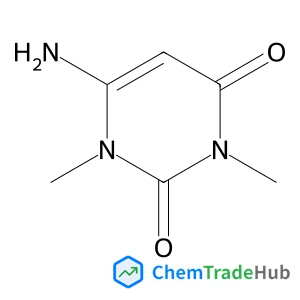
6-amino-1,3-dimethyl-1,2,3,4-tetrahydropyrimidine-2,4-dione
CAS Number:
6642-31-5
Molecular Formula:
C6H9N3O2
Recommended Suppliers






Disclaimer
This page provides academic journal information for reference and research purposes only. We are not affiliated with any journal publishers and do not handle publication submissions. For publication-related inquiries, please contact the respective journal publishers directly.
If you notice any inaccuracies in the information displayed, please contact us at support@chemtradehub.com. We will promptly review and address your concerns.