












Activation of carbon dioxide by a terminal uranium–nitrogen bond in the gas-phase: a demonstration of the principle of microscopic reversibility
Literature Information
Publication Date
2016-02-15
DOI
10.1039/C6CP00494F
Impact Factor
3.676
Authors
Phuong D. Dau, P. B. Armentrout, Maria C. Michelini, John K. Gibson
View Original
Abstract
Activation of CO2 is demonstrated by its spontaneous dissociative reaction with the gas-phase anion complex NUOCl2−, which can be considered as NUO+ coordinated by two chloride anion ligands. This reaction was previously predicted by density functional theory to occur exothermically, without barriers above the reactant energy. The present results demonstrate the validity of the prediction of microscopic reversibility, and provide a rare case of spontaneous dissociative addition of CO2 to a gas-phase complex. The activation of CO2 by NUOCl2− proceeds by conversion of a UN bond to a UO bond and creation of an isocyanate ligand to yield the complex UO2(NCO)Cl2−, in which uranyl, UO22+, is coordinated by one isocyanate and two chloride anion ligands. This activation of CO2 by a uranium(VI) nitride complex is distinctive from previous reports of oxidative insertion of CO2 into lower oxidation state U(III) or U(IV) solid complexes, during which both C–O bonds remain intact. This unusual observation of spontaneous addition and activation of CO2 by NUOCl2− is a result of the high oxophilicity of uranium. If the computed Gibbs free energy of the reaction pathway, rather than the energy, is considered, there are barriers above the reactant asymptotes such that the observed reaction should not proceed under thermal conditions. This result provides a demonstration that energy rather than Gibbs free energy determines reactivity under low-pressure bimolecular conditions.
Related Literature
New insights into radical and cationic polymerizations upon visible light exposure: role of novel photoinitiator systems based on the pyrene chromophore
Mohamad-Ali Tehfe, Frédéric Dumur, Emmanuel Contal, Bernadette Graff, Fabrice Morlet-Savary, Didier Gigmes, Jean-Pierre Fouassier, Jacques Lalevée
2012-12-07
Paper
DOI: 10.1039/C2PY20950K
A novel polytriazole-based organogel formed by the effects of copper ions
Yujing Li, Liqiang Wan, Hao Zhou, Farong Huang, Lei Du
2013-04-10
Communication
DOI: 10.1039/C3PY00227F
Pillar[5]arene–neutral guest recognition based supramolecular alternating copolymer containing [c2]daisy chain and bis-pillar[5]arene units
Xiaoyang Wang, Kang Han, Jian Li, Xueshun Jia
2013-05-01
Paper
DOI: 10.1039/C3PY00462G
Functional oligo(vinyl acetate) bearing bipyridine moieties by RAFT polymerization and extraction of metal ions in supercritical carbon dioxide
Shoucun Zhang, Yali Luo, Hongwei Yang, Hai-Jian Yang, Bien Tan
2013-04-02
Paper
DOI: 10.1039/C3PY00212H
Synthesis of linear amphiphilic tetrablock quaterpolymers with dual stimulus response through the combination of ATRP and RAFT by a click chemistry site transformation approach
Jiucun Chen, Mingzhu Liu, Honghong Gong, Guangjun Cui, Shaoyu Lü, Chunmei Gao, Feng Huang, Tongtong Chen, Xinyu Zhang, Zhen Liu
2012-12-17
Paper
DOI: 10.1039/C2PY20946B
A controlled and versatile NCA polymerization method for the synthesis of polypeptides‡
Inmaculada Conejos-Sánchez, Aroa Duro-Castano, Alexander Birke, Matthias Barz, María J. Vicent
2013-04-08
Communication
DOI: 10.1039/C3PY00347G
Thermo-responsive “hairy-rod” polypeptides for smart antitumor drug delivery
Jianxun Ding, Di Li, Chunsheng Xiao, Xiuli Zhuang, Xuesi Chen
2013-03-14
Paper
DOI: 10.1039/C3PY00144J
Chemical modification of graphene with a thermotropic liquid crystalline polymer and its reinforcement effect in the polymer matrix
Ying Jing, Hui Tang, Guijun Yu, Peiyi Wu
2013-02-14
Paper
DOI: 10.1039/C3PY00126A
You might also like
Compound Q&A
What is 1-(2,4,6-Trifluorophenyl)ethanol (CAS: 1250113-83-7)?
1-(2,4,6-Trifluorophenyl)ethanol is an organic compound with the CAS number 1250...
1250113-83-71-(2,4,6-Trifluoroph...
Compound Q&A
Is 1-(2,4-Dimethoxybenzyl)-4-(hydroxymethyl)-2-pyrrolidinone (CAS: 919111-34-5) safe?
1-(2,4-Dimethoxybenzyl)-4-(hydroxymethyl)-2-pyrrolidinone (CAS: 919111-34-5) is ...
919111-34-51-(2,4-Dimethoxybenz...
Compound Q&A
What are the physical and chemical properties of (7S,15R)-6β,15-Diacetoxy-7α,20-epoxy-7-hydroxykaura-2,16-dien-1-one (CAS: 51419-51-3)?
(7S,15R)-6β,15-Diacetoxy-7α,20-epoxy-7-hydroxykaura-2,16-dien-1-one is a crystal...
51419-51-3(7S,15R)-6β,15-Diace...
Compound Q&A
What regulatory guidelines apply to rac-ethyl (1r,4r)-4-hydroxycyclohexane-1-carboxylate, trans (CAS: 3618-04-0)?
The compound rac-ethyl (1r,4r)-4-hydroxycyclohexane-1-carboxylate, trans (CAS: 3...
3618-04-0rac-ethyl (1r,4r)-4-...
Compound Q&A
What is the market or research trend for 2-(2,4-Difluorophenoxy)-3-nitropyridine (CAS: 175135-62-3)?
The market for 2-(2,4-Difluorophenoxy)-3-nitropyridine (CAS: 175135-62-3) is cur...
175135-62-32-(2,4-Difluoropheno...
Compound Q&A
What are the main uses of 6-Diazo-5-oxo-L-norleucine (CAS: 157-03-9)?
The main uses of 6-Diazo-5-oxo-L-norleucine (CAS: 157-03-9) include research in ...
157-03-96-Diazo-5-oxo-L-norl...
Compound Q&A
What precautions should be taken when handling 2-Aminoethyl-mono-amide-DOTA-tris(tBu ester) (CAS: 173308-19-5)?
When handling 2-Aminoethyl-mono-amide-DOTA-tris(tBu ester) (CAS: 173308-19-5), i...
173308-19-52-Aminoethyl-mono-am...
Compound Q&A
How is 5-Methylimidazo[1,2-a]pyridine-3-carbaldehyde (CAS: 178488-37-4) typically synthesized?
5-Methylimidazo[1,2-a]pyridine-3-carbaldehyde (CAS: 178488-37-4) can be synthesi...
178488-37-45-Methylimidazo[1,2-...
Compound Q&A
Are there alternatives to 2,4,6-Trihydroxyisophthalaldehyde (CAS: 4396-13-8) in synthesis?
There are alternative reagents that can be used in the synthesis of 2,4,6-Trihyd...
4396-13-82,4,6-Trihydroxyisop...
Compound Q&A
What is (2Z)-3-(5-Fluoro-1H-indol-3-yl)-2-sulfanylacrylic acid (CAS: 179461-52-0)?
(2Z)-3-(5-Fluoro-1H-indol-3-yl)-2-sulfanylacrylic acid is a chemical compound wi...
179461-52-0(2Z)-3-(5-Fluoro-1H-...
Source Journal
Physical Chemistry Chemical Physics

CiteScore:
5.5
Self-citation Rate:
10.3%
Articles per Year:
3036
Physical Chemistry Chemical Physics (PCCP) is an international journal co-owned by 19 physical chemistry and physics societies from around the world. This journal publishes original, cutting-edge research in physical chemistry, chemical physics and biophysical chemistry. To be suitable for publication in PCCP, articles must include significant innovation and/or insight into physical chemistry; this is the most important criterion that reviewers and Editors will judge against when evaluating submissions. The journal has a broad scope and welcomes contributions spanning experiment, theory, computation and data science. Topical coverage includes spectroscopy, dynamics, kinetics, statistical mechanics, thermodynamics, electrochemistry, catalysis, surface science, quantum mechanics, quantum computing and machine learning. Interdisciplinary research areas such as polymers and soft matter, materials, nanoscience, energy, surfaces/interfaces, and biophysical chemistry are welcomed if they demonstrate significant innovation and/or insight into physical chemistry. Joined experimental/theoretical studies are particularly appreciated when complementary and based on up-to-date approaches.
Recommended Compounds

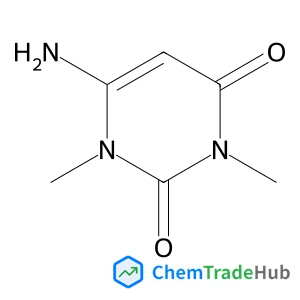
6-amino-1,3-dimethyl-1,2,3,4-tetrahydropyrimidine-2,4-dione
CAS Number:
6642-31-5
Molecular Formula:
C6H9N3O2
Recommended Suppliers




Disclaimer
This page provides academic journal information for reference and research purposes only. We are not affiliated with any journal publishers and do not handle publication submissions. For publication-related inquiries, please contact the respective journal publishers directly.
If you notice any inaccuracies in the information displayed, please contact us at support@chemtradehub.com. We will promptly review and address your concerns.