












Inside front cover
Literature Information
Publication Date
DOI
10.1039/C9CP90137J
Impact Factor
3.676
Authors
View Original
Abstract
A graphical abstract is available for this content
Related Literature
High quality CdSeS nanocrystals synthesized by facile single injection process and their electroluminescence
Eunjoo Jang, Shinae Jun, Lyongsun Pu
2003-11-07
Communication
DOI: 10.1039/B310853H
Novel cofacial oxidative coupling reaction of phosphinine in the presence of Cu(i) and ClO4−
Takahiko Kojima, Yoshitaka Ishioka, Yoshihisa Matsuda
2004-01-16
Communication
DOI: 10.1039/B308892H
Template-free synthesis of single-crystalline cadmium nanotubes
Pingàn Hu, Yunqi Liu, Lei Fu, Lingchao Cao, Daoben Zhu
2004-02-04
Communication
DOI: 10.1039/B312708G
Room-temperature one-step immobilization of rod-like helical polymer onto hydrophilic substrates
Guangqing Guo, Masanobu Naito, Michiya Fujiki, Anubhav Saxena, Kento Okoshi, Yonggang Yang, Masaaki Ishikawa, Takahiro Hagihara
2004-01-07
Communication
DOI: 10.1039/B310985B
A concise stereocontrolled formal total synthesis of (±)-podophyllotoxin using sulfoxide chemistry
Mike Casey, Claire M. Keaveney
2003-12-05
Communication
DOI: 10.1039/B312245J
Multiple active oxidants in competitive epoxidations catalyzed by porphyrins and corroles
James P. Collman, Li Zeng, Richard A. Decréau
2003-11-03
Communication
DOI: 10.1039/B310763A
Fluorescence detection of guanine–adenine transition by a hydrogen bond forming small compound
Keitaro Yoshimoto, Chun-Yan Xu, Seiichi Nishizawa, Takanobu Haga, Hiroyuki Satake, Norio Teramae
2003-10-31
Communication
DOI: 10.1039/B309229A
Rational design of porous titanophosphates
Christian Serre, Francis Taulelle, Gérard Ferey
2003-08-28
Feature Article
DOI: 10.1039/B304703B
Time dependent size and shape control of germanium nanocrystals
2003-11-04
Communication
DOI: 10.1039/B310770A
Preparation of chiral triarylphosphines by Pd-catalysed asymmetric P–C cross-coupling
Christian Korff, Günter Helmchen
2004-02-03
Communication
DOI: 10.1039/B315009G
You might also like
Compound Q&A
What are the main uses of 1H-Indazole-6-carbonitrile (CAS: 141290-59-7)?
1H-Indazole-6-carbonitrile finds applications in pharmaceuticals, where it serve...
141290-59-71H-Indazole-6-carbon...
Compound Q&A
How should waste containing Dioctyl (2E)-2-butenedioate (CAS: 2997-85-5) be handled?
Waste containing Dioctyl (2E)-2-butenedioate (CAS: 2997-85-5) should be collecte...
2997-85-5Dioctyl (2E)-2-buten...
Compound Q&A
What industries use Sodium [(1,2-benzoxazol-3-ylmethyl)sulfonyl]azanide (CAS: 68291-98-5)?
Sodium [(1,2-benzoxazol-3-ylmethyl)sulfonyl]azanide is primarily used in pharmac...
68291-98-5Sodium [(1,2-benzoxa...
Compound Q&A
Are there alternatives to Dimethyl 4-(4,4,5,5-tetramethyl-1,3,2-dioxaborolan-2-yl)-2,6-pyridinedicarboxylate (CAS: 741709-66-0) in synthesis?
Dimethyl 4-(4,4,5,5-tetramethyl-1,3,2-dioxaborolan-2-yl)-2,6-pyridinedicarboxyla...
741709-66-0Dimethyl 4-(4,4,5,5-...
Compound Q&A
How should waste containing 2-Fluoro-6-hydrazinopyridine (CAS: 80714-39-2) be handled?
Waste containing 2-Fluoro-6-hydrazinopyridine (CAS: 80714-39-2) should be manage...
80714-39-22-Fluoro-6-hydrazino...
Compound Q&A
What is 6-Formyl-2-pyridinecarboxylic acid (CAS: 499214-11-8)?
6-Formyl-2-pyridinecarboxylic acid is an organic compound with the molecular for...
499214-11-86-Formyl-2-pyridinec...
Compound Q&A
What is the market or research trend for 3-(3,4-dimethoxyphenyl)-2,5-dimethyl-N-(2-morpholin-4-ylethyl)pyrazolo[1,5-a]pyrimidin-7-amine (CAS: 900874-91-1)?
Research trends for this compound indicate a focus on its potential applications...
900874-91-13-(3,4-dimethoxyphen...
Compound Q&A
How is 9H-Tribenzo[b,d,f]azepine (CAS: 29875-73-8) typically synthesized?
9H-Tribenzo[b,d,f]azepine is typically synthesized via a multi-step process invo...
29875-73-89H-Tribenzo[b,d,f]az...
Compound Q&A
How is 1-Cyclopropyl-7-ethoxy-6-fluoro-8-methoxy-4-oxo-1,4-dihydro-3-quinolinecarboxylic acid (CAS: 1797982-51-4) typically synthesized?
1-Cyclopropyl-7-ethoxy-6-fluoro-8-methoxy-4-oxo-1,4-dihydro-3-quinolinecarboxyli...
1797982-51-41-Cyclopropyl-7-etho...
Compound Q&A
How should waste containing Methyl 3-oxo-1,2,3,4-tetrahydro-6-quinoxalinecarboxylate (CAS: 671820-52-3) be handled?
Waste containing Methyl 3-oxo-1,2,3,4-tetrahydro-6-quinoxalinecarboxylate (CAS: ...
671820-52-3Methyl 3-oxo-1,2,3,4...
Source Journal
Physical Chemistry Chemical Physics

CiteScore:
5.5
Self-citation Rate:
10.3%
Articles per Year:
3036
Physical Chemistry Chemical Physics (PCCP) is an international journal co-owned by 19 physical chemistry and physics societies from around the world. This journal publishes original, cutting-edge research in physical chemistry, chemical physics and biophysical chemistry. To be suitable for publication in PCCP, articles must include significant innovation and/or insight into physical chemistry; this is the most important criterion that reviewers and Editors will judge against when evaluating submissions. The journal has a broad scope and welcomes contributions spanning experiment, theory, computation and data science. Topical coverage includes spectroscopy, dynamics, kinetics, statistical mechanics, thermodynamics, electrochemistry, catalysis, surface science, quantum mechanics, quantum computing and machine learning. Interdisciplinary research areas such as polymers and soft matter, materials, nanoscience, energy, surfaces/interfaces, and biophysical chemistry are welcomed if they demonstrate significant innovation and/or insight into physical chemistry. Joined experimental/theoretical studies are particularly appreciated when complementary and based on up-to-date approaches.
Recommended Compounds
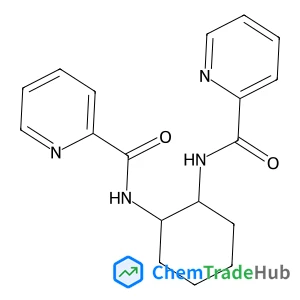
N,N'-(1R,2R)-1,2-Cyclohexanediyldi(2-pyridinecarboxamide)
CAS Number:
218290-24-5
Molecular Formula:
C18H20N4O2


Recommended Suppliers






Disclaimer
This page provides academic journal information for reference and research purposes only. We are not affiliated with any journal publishers and do not handle publication submissions. For publication-related inquiries, please contact the respective journal publishers directly.
If you notice any inaccuracies in the information displayed, please contact us at support@chemtradehub.com. We will promptly review and address your concerns.