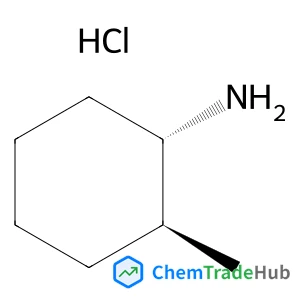
(1R,2R)-2-Methylcyclohexanamine hydrochloride (1:1)
CAS Number:
39558-31-1
Molecular Formula:
C7H16ClN
Karolina Anna Haupa, Wei-Siong Ong
Acetamide (CH3CONH2) is the largest molecule containing an amide bond that has been detected in an interstellar medium; it is considered to be a precursor for complex organic molecules (COM). We utilized the advantages of a para-hydrogen (p-H2) quantum-solid matrix host to perform efficient reactions of hydrogen atoms with CH3CONH2. The H-abstraction reaction from the methyl group of CH3CONH2 to produce the 2-amino-2-oxoethyl radical, ˙CH2CONH2, was observed as the sole reaction channel in solid p-H2 at 3.3 K, consistent with theoretical predictions that this reaction has the smallest barrier among all possible channels. Our results show that the amide bond of acetamide is unaffected by hydrogen exposure, but the hydrogen abstraction activates this molecule to react with other species on its methyl site to extend its size or to include other functional groups as a first step to form COM under prebiotic or abiotic conditions. This previously neglected path should be considered in the astrochemical modeling. The photolysis of ˙CH2CONH2 at wavelengths 380–450 nm produces ketene; this step might provide a plausible mechanism to explain the anti-correlated abundance of ketene and acetamide in some astronomical observations.
Yaogeng Ma, Min Li, Huilin Sun, Jing-Yuan Ge, Yang Bai, Lin Qiu, Xuan Wu, Jiuxi Chen, Zhongyan Chen
DOI: 10.1039/D3CC04041K
Elisa N. Stephens, Xiao-Nan Zhang, Albert T. Lam, Jiawei Li, Hua Pei
DOI: 10.1039/D3CC04343F
Lin Guo, Jinyu Zheng
DOI: 10.1039/D3CC03990K
Junyi Chen, Parisa Fasihianifard, Alexie Andrea P. Raz, Briana L. Hickey, Jose L. Moreno, Jr., Chia-En A. Chang
DOI: 10.1039/D3SC06087J
Tim Schrader, Jamoliddin Khanifaev, Eva Perlt
DOI: 10.1039/D3CC04304E
Pol Salles, Pamela Machado, Pengmei Yu, Mariona Coll
DOI: 10.1039/D3CC03030J
Ping Wang, Yu-Qiao Tong, Shi-Qing Yin, Qian-Jun Gu, Bo Huang, Ai-Xin Zhu
DOI: 10.1039/D3CC04186G
Kyla J. Woelk, Kushal Dhake, Nathan D. Schley, David C. Leitch
DOI: 10.1039/D3CC04234K
DOI: 10.1039/D3CC04160C
Elena S. Osipova, Sergey A. Kovalenko, Oleg A. Filippov, Natalia V. Belkova, Laure Vendier, Yves Canac, Elena S. Shubina, Dmitry A. Valyaev
DOI: 10.1039/D3SC05356C
(5-Sulfamoyl-3-pyridinyl)boronic acid is primarily used in chemical synthesis, p...
Benzyl 2-methyl-2-(methylsulfonyl)-4-pentenoate is typically synthesized via est...
When handling 8-Fluoroquinolin-6-ol (CAS: 209353-22-0), it is important to use p...
1,3-Dibromo-5-(2-methyl-2-propanyl)benzene (CAS: 129316-09-2) is a crystalline c...
Ethyl 7-chloro-4-oxo-1-(1,3-thiazol-2-yl)-1,4-dihydro-1,8-naphthyridine-3-carbox...
When handling Delta-7-Avenasterol (CAS: 23290-26-8), it is important to wear app...
Proper handling involves the use of personal protective equipment such as gloves...
When handling 2-Methyl-2-proanyl 4-[(2-aminophenyl)amino]-1-piperidinecarboxylat...
N-Methyl-4-chlorobenzylamine hydrochloride (CAS: 65542-24-7) is a organic compou...
[2-(Dodecyloxy)ethoxy]acetic acid (CAS: 27306-90-7) is generally considered safe...

Physical Chemistry Chemical Physics (PCCP) is an international journal co-owned by 19 physical chemistry and physics societies from around the world. This journal publishes original, cutting-edge research in physical chemistry, chemical physics and biophysical chemistry. To be suitable for publication in PCCP, articles must include significant innovation and/or insight into physical chemistry; this is the most important criterion that reviewers and Editors will judge against when evaluating submissions. The journal has a broad scope and welcomes contributions spanning experiment, theory, computation and data science. Topical coverage includes spectroscopy, dynamics, kinetics, statistical mechanics, thermodynamics, electrochemistry, catalysis, surface science, quantum mechanics, quantum computing and machine learning. Interdisciplinary research areas such as polymers and soft matter, materials, nanoscience, energy, surfaces/interfaces, and biophysical chemistry are welcomed if they demonstrate significant innovation and/or insight into physical chemistry. Joined experimental/theoretical studies are particularly appreciated when complementary and based on up-to-date approaches.
![2-(5-Bromo-1H-pyrrolo[2,3-B]pyridin-3-YL)acetic acid structure](https://static.chemtradehub.com/structs/106/1060795-03-0-0589.webp "2-(5-Bromo-1H-pyrrolo[2,3-B]pyridin-3-YL)acetic acid structure")