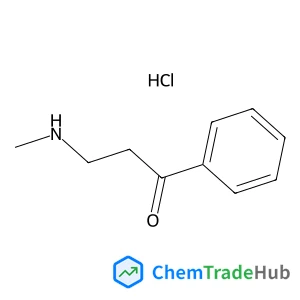
3-(Methylamino)-1-phenyl-1-propanone hydrochloride (1:1)
CAS Number:
2538-50-3
Molecular Formula:
C10H14ClNO
Jakub Dąbrowski, Wiesław Nowak, Arkadiusz Ptak
Detailed knowledge of intramolecular hydrogen bonds, including their nanomechanics, in a peptide secondary structure is crucial for understanding mechanisms of numerous biochemical processes. Single-molecule force spectroscopy has become a powerful tool to study directly the mechanical properties of single biopolymers and monitoring the hydrogen bonds. However, the interpretation of such experiments, due to their poor temporal resolution relative to the rate of intramolecular dynamics, requires the support of molecular simulations. In this work, we provide a methodology for determining the kinetic and energetic characteristics of hydrogen bonds in a template model of the protein secondary structure. Our approach, based on the steered molecular dynamics method, employs dynamic force spectroscopy calculations and uses two advanced theoretical models of force-induced unbinding. A systematic analysis of the simulated data with these models allowed for quantitative characterization of a single hydrogen bond in the α-helix of the AAKA(AEAAKA)5AC peptide model and detailed explanation of the mechanism of the α-helix unfolding. The methodology proposed here may be extended to other molecular structures stabilized by internal hydrogen bonds.
P. Modak, Ashok K. Verma
DOI: 10.1039/C6CP07805B
Hui Li, Wei Chen, Xiaopeng Shen, Jingwei Liu, Xuri Huang, Guangtao Yu
DOI: 10.1039/C6CP06717D
Matías E. Aguirre, S. Municoy, M. A. Grela, A. J. Colussi
DOI: 10.1039/C6CP06829D
Xiaoli Sun
DOI: 10.1039/C6CP07690D
A. R. Alian, S. A. Meguid
DOI: 10.1039/C6CP07464B
Hua-Bin Sun, Ying-Xian Zhou, Lu-Lu Zhang, Xue-Lin Yang, Xing-Zhong Cao, Hanu Arave, Hui Fang, Gan Liang
DOI: 10.1039/C6CP07760A
Bason Clancy, Joshua Salafsky
DOI: 10.1039/C6CP07708K
Dannie J. G. P. van Osch, Laura J. B. M. Kollau, Sari Asikainen, Marisa A. A. Rocha
DOI: 10.1039/C6CP07499E
Han-Shi Hu, Nikolas Kaltsoyannis
DOI: 10.1039/C7CP00113D
Rocío Domínguez, Núria F. Montcada, Pilar de la Cruz, Fernando Langa
DOI: 10.1039/C6CP08166E
When handling 4-(2-Furylmethyl)thiomorpholine 1,1-dioxide (CAS: 79206-94-3), it ...
When handling 4-Chloro-N-[2-(4-morpholinyl)ethyl]benzamide (CAS: 71320-77-9), it...
Waste containing this compound (CAS: 62921-74-8) should be handled according to ...
Waste containing (S)-Methyl 2-amino-3-cyclohexylpropanoate should be collected i...
This compound can be synthesized using a multi-step process involving the conjug...
There are several alternatives to (2E)-3-(3,4-Dichlorophenyl)acrylic acid in syn...
Ethyl 6-(2-nitrophenyl)imidazo[2,1-b][1,3]thiazole-3-carboxylate (CAS: 925437-84...
Waste containing 2-(1,3-Thiazol-2-yl)ethanamine (CAS: 18453-07-1) should be coll...
Methyl 5-iodo-2-methylbenzoate can be synthesized through the iodination of meth...
5-Chloro[1,2,4]triazolo[1,5-a]pyridine is commonly synthesized via the condensat...

Physical Chemistry Chemical Physics (PCCP) is an international journal co-owned by 19 physical chemistry and physics societies from around the world. This journal publishes original, cutting-edge research in physical chemistry, chemical physics and biophysical chemistry. To be suitable for publication in PCCP, articles must include significant innovation and/or insight into physical chemistry; this is the most important criterion that reviewers and Editors will judge against when evaluating submissions. The journal has a broad scope and welcomes contributions spanning experiment, theory, computation and data science. Topical coverage includes spectroscopy, dynamics, kinetics, statistical mechanics, thermodynamics, electrochemistry, catalysis, surface science, quantum mechanics, quantum computing and machine learning. Interdisciplinary research areas such as polymers and soft matter, materials, nanoscience, energy, surfaces/interfaces, and biophysical chemistry are welcomed if they demonstrate significant innovation and/or insight into physical chemistry. Joined experimental/theoretical studies are particularly appreciated when complementary and based on up-to-date approaches.