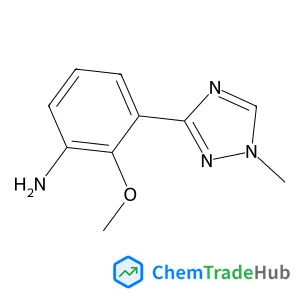
2-Methoxy-3-(1-methyl-1H-1,2,4-triazol-3-yl)aniline
CAS Number:
1609394-10-6
Molecular Formula:
C10H12N4O
Gustavo J. R. Aroeira, Adam S. Abbott, Sarah N. Elliott, Justin M. Turney, Henry F. Schaefer, III
Bimolecular reactions involving stabilized Criegee intermediates (SCI) have been the target of many studies due to the role these molecules play in atmospheric chemistry. Recently, kinetic rates for the addition reaction of the simplest SCI (formaldehyde oxide) and its methylated analogue (acetone oxide) with methanol were reported both experimentally and theoretically. We re-examine the energy profile of these reactions by employing rigorous ab initio methods. Optimized CCSD(T)/ANO1 geometries are reported for the stationary points along the reaction path. Energies are obtained at the CCSD(T)/CBS level of theory. Contributions of full triple and quadruple excitations are computed to assess the convergence of this method. Rate constants are obtained using conventional canonical transition state theory under the rigid rotor harmonic oscillator approximation and with the inclusion of a one-dimensional hindered rotor treatment. These corrections for internal rotations have a significant impact on computed kinetic rate constants. With this approach, we compute rate constants for the addition of methanol to formaldehyde oxide (H2COO) and acetone oxide [(CH3)2COO] at 298.15 K as (1.2 ± 0.8) × 10−13 and (2.8 ± 1.3) × 10−15 cm3 s−1, respectively. Additionally, we investigate the temperature dependence of the rate constant, concluding that the transition state barrier height and tunneling contributions shape the qualitative behaviour of these reactions.
Herman H. Y. Sung, Ian D. Williams, Matthew M. F. Yuen
DOI: 10.1039/C2PY20485A
Florian Herbst, Wolfgang H. Binder
DOI: 10.1039/C2PY20265D
Bryan T. Tuten, Christopher K. Lyon
DOI: 10.1039/C2PY20308A
Ribhu Gautam, R. Vinu
DOI: 10.1039/C8RE00227D
DOI: 10.1039/C8RE00323H
Yasmine Piette, Antoine Debuigne, Christine Jérôme, Vincent Bodart, Christophe Detrembleur
DOI: 10.1039/C2PY20413D
Massimo Benaglia, Angelo Alberti, Loris Giorgini, Francesco Magnoni, Silvia Tozzi
DOI: 10.1039/C2PY20646C
Fahed Javed, Zufishan Shamair, Shahzad Ali, Ainy Hafeez, Tahir Fazal, William B. Zimmerman, Fahad Rehman
DOI: 10.1039/C8RE00328A
Lejiao Jia, Zhenyu Li, Dianrui Zhang, Qiang Zhang, Jingyi Shen, Hejian Guo, Xiaona Tian, Guangpu Liu, Dandan Zheng, Lisi Qi
DOI: 10.1039/C2PY20781H
Abhijeet P. Bapat, Jacob G. Ray, Daniel A. Savin, Emily A. Hoff, Derek L. Patton
DOI: 10.1039/C2PY20351K
6-Bromo-2-methylimidazo[1,2-a]pyrimidine (CAS: 1111638-05-1) falls under various...
While there are no direct alternatives, similar compounds like 1-Pyrrolidineetha...
4-Methyl-2,6-bis(2-methyl-2-propanyl)phenyl methylcarbamate (CAS: 1918-11-2) is ...
2-(3-Bromo-4-fluorophenyl)-1,3-dioxolane (CAS: 77771-04-1) should be stored in a...
4,5,6,7-Tetrahydro-1H-indazole hydrochloride is a white crystalline solid with a...
(2R)-1-Methoxy-3-phenyl-2-propanamine is a chiral organic compound with the CAS ...
Ethyl 1-(1-phenylethyl)-1H-imidazole-5-carboxylate is used in various industries...
4-[(1E,3S)-1-(4-Hydroxyphenyl)-1,4-pentadien-3-yl]phenol (CAS: 17676-24-3) falls...
(S)-3-Amino-5-phenylpentanoic acid hydrochloride is primarily used in the pharma...
7-Methoxy-1-benzothiophene-2-carboxylic acid is typically synthesized by reactin...

Physical Chemistry Chemical Physics (PCCP) is an international journal co-owned by 19 physical chemistry and physics societies from around the world. This journal publishes original, cutting-edge research in physical chemistry, chemical physics and biophysical chemistry. To be suitable for publication in PCCP, articles must include significant innovation and/or insight into physical chemistry; this is the most important criterion that reviewers and Editors will judge against when evaluating submissions. The journal has a broad scope and welcomes contributions spanning experiment, theory, computation and data science. Topical coverage includes spectroscopy, dynamics, kinetics, statistical mechanics, thermodynamics, electrochemistry, catalysis, surface science, quantum mechanics, quantum computing and machine learning. Interdisciplinary research areas such as polymers and soft matter, materials, nanoscience, energy, surfaces/interfaces, and biophysical chemistry are welcomed if they demonstrate significant innovation and/or insight into physical chemistry. Joined experimental/theoretical studies are particularly appreciated when complementary and based on up-to-date approaches.