












Rational magnetic modification of N,N-dioxidized pyrazine ring expanded adenine and thymine: a diradical character induced by base pairing and double protonation
Literature Information
Publication Date
2019-08-15
DOI
10.1039/C9CP03234G
Impact Factor
3.676
Authors
Dongxiao Chen, Yuxiang Bu
View Original
Abstract
Rational modification of biomolecules especially DNA base pairs for the theoretical design of molecular magnets has attracted extensive interest. In this work, we report a modification strategy for adenine/thymine-based magnets through introducing a N,N-dioxidized pyrazine ring to either adenine or thymine to form ring-expanded bases (noA/noT) based on their experimentally synthesized derivatives. Further functionalization is conducted by double protonation and pairing with a normal complementary base (nohA-T/nohT-A), respectively. The diversity of protonation sites in noA generates totally six nohA-Ts, together with nohT-A forming seven two-step modified topic base pairs. DFT calculations are performed to characterize the magnetic properties and the diradical character, which indicate three diamagnetic (DM) nohA-Ts and three antiferromagnetic (AFM) nohA-Ts with extremely large magnetic coupling constants J ranging from −1279.7 to −2807.4 cm−1, while a relatively mild AFM nohT-A with a J of −194.6 cm−1. The electron separation effect induced by attraction of positive charges originating from protonation is proposed to explain the diradicalization, which is different from the traditional radical–coupler–radical coupling mode. In addition, atomic natural charges and spin densities, and H-bond and molecular orbital analyses are further discussed for verification and deep understanding of the observed unique phenomena. It should be noted that our designed seven topic base pairs have excellent characters including a good synthetic basis, a large scope of the |J| values, and the AFM–DM magnetic conversion or AFM strength modulation controlled by protonation/deprotonation, prototropic tautomerization, base pairing/dissociation, single proton transfer, and even the applied electric field. All these indicate the promising applications in the field of magnetic information storage or switch control. This work highlights the magnetic modification schemes and possible modulation methods of double positive charge doped DNA base pairs by utilizing their potential spin coupling modes.
Related Literature
Synthesis of thermo-responsive glycopolymersviacopper catalysed azide–alkyne ‘click’ chemistry for inhibition of ricin: the effect of spacer between polymer backbone and galactose
Gaojian Chen, Martina H. Stenzel
2011-06-08
Paper
DOI: 10.1039/C1PY00048A
Highly water repellent aerogels based on cellulose stearoyl esters
Mari Granström, Marjo Kettunen née Pääkkö, Hua Jin, Erkki Kolehmainen, Ilkka Kilpeläinen, Olli Ikkala
2011-05-03
Paper
DOI: 10.1039/C0PY00309C
Tunable geometry and wettability of organosilane nanostructured surfaces by water content
Meihua Jin, Jing Wang, Yan Hao, Mingyi Liao, Yong Zhao
2011-06-22
Communication
DOI: 10.1039/C1PY00246E
Synthesis and photovoltaic properties of narrow band gap copolymers of dithieno[3,2-b:2′,3′-d]thiophene and diketopyrrolopyrrole
Abasaheb V. Patil, Woo-Hyung Lee, Kyuri Kim, Hanok Park, In Nam Kang, Soo-Hyoung Lee
2011-10-14
Paper
DOI: 10.1039/C1PY00274K
Nylon 3 synthesized by ring opening polymerization with a metal-free catalyst
Hongjun Yang, Junpeng Zhao, Manqing Yan, Stergios Pispas
2011-10-19
Paper
DOI: 10.1039/C1PY00334H
Red light-emitting hyperbranched fluorene-alt-carbazolecopolymers with an iridium complex as the core
Ting Guo, Rong Guan, Jianhua Zou, Jie Liu, Lei Ying, Wei Yang, Hongbin Wu, Yong Cao
2011-07-08
Paper
DOI: 10.1039/C1PY00075F
Organic-metalloblock copolymersvia photocontrolled living anionic ring-opening polymerization
Laurent Chabanne, Inmaculada Matas, Sanjib K. Patra, Ian Manners
2011-09-12
Paper
DOI: 10.1039/C1PY00298H
Menthol-based chiral copolymers for polymer optical fibres (POF)
Eun Hee Min, Kok Hou Wong, Eki Setijadi, François Ladouceur, Mark Straton, Alexander Argyros
2011-07-05
Paper
DOI: 10.1039/C1PY00056J
Facile immobilization of enzymes on electrospun poly(styrene-alt-maleic anhydride) nanofibres
William J. Cloete, Craig Adriaanse, Pieter Swart, Bert Klumperman
2011-03-26
Communication
DOI: 10.1039/C1PY00069A
You might also like
Compound Q&A
What precautions should be taken when handling 2-Methyl-2-propanyl 5-amino-2-thiophenecarboxylate (CAS: 1498311-57-1)?
When handling 2-Methyl-2-propanyl 5-amino-2-thiophenecarboxylate (CAS: 1498311-5...
1498311-57-12-Methyl-2-propanyl ...
Compound Q&A
What are the physical and chemical properties of 5-Bromo-1,2-dichloro-3-fluorobenzene (CAS: 1000572-93-9)?
5-Bromo-1,2-dichloro-3-fluorobenzene (CAS: 1000572-93-9) is a crystalline solid ...
1000572-93-95-Bromo-1,2-dichloro...
Compound Q&A
How should (2R)-2-Amino-2-(4-bromophenyl)ethanol (CAS: 354153-64-3) be stored?
(2R)-2-Amino-2-(4-bromophenyl)ethanol (CAS: 354153-64-3) should be stored in a c...
354153-64-3(2R)-2-Amino-2-(4-br...
Compound Q&A
What regulatory guidelines apply to Methyl 4-(aminomethyl)tetrahydro-2H-pyran-4-carboxylate hydrochloride (CAS: 362707-24-2)?
Methyl 4-(aminomethyl)tetrahydro-2H-pyran-4-carboxylate hydrochloride (CAS: 3627...
362707-24-2Methyl 4-(aminomethy...
Compound Q&A
What are the main uses of 1,4-dimethyl-1H-pyrazole-5-sulfonyl chloride (CAS: 1174834-52-6)?
1,4-Dimethyl-1H-pyrazole-5-sulfonyl chloride is primarily used as an intermediat...
1174834-52-61,4-dimethyl-1H-pyra...
Compound Q&A
Is Dinaphtho[1,2-b:2',1'-d]furan (CAS: 239-69-0) safe?
Dinaphtho[1,2-b:2',1'-d]furan is generally safe when handled with appropriate pe...
239-69-0Dinaphtho[1,2-b:2',1...
Compound Q&A
What is the market or research trend for 7-Methyl-7,9-dihydro-1H-purine-2,6,8(3H)-trione (CAS: 612-37-3)?
The market for 7-Methyl-7,9-dihydro-1H-purine-2,6,8(3H)-trione (CAS: 612-37-3) i...
612-37-37-Methyl-7,9-dihydro...
Compound Q&A
What are the physical and chemical properties of 2-(4-Chlorophenyl)malonaldehyde (CAS: 205676-17-1)?
2-(4-Chlorophenyl)malonaldehyde (CAS: 205676-17-1) is a colorless or light yello...
205676-17-12-(4-Chlorophenyl)ma...
Compound Q&A
How is 2-Methylchrysene (CAS: 3351-32-4) typically synthesized?
2-Methylchrysene (CAS: 3351-32-4) is typically synthesized via the reaction of c...
3351-32-42-Methylchrysene
Compound Q&A
Is N-(6-aminopyrimidin-4-yl)acetamide (CAS: 89533-23-3) safe?
N-(6-aminopyrimidin-4-yl)acetamide (CAS: 89533-23-3) is generally considered saf...
89533-23-3N-(6-aminopyrimidin-...
Source Journal
Physical Chemistry Chemical Physics

CiteScore:
5.5
Self-citation Rate:
10.3%
Articles per Year:
3036
Physical Chemistry Chemical Physics (PCCP) is an international journal co-owned by 19 physical chemistry and physics societies from around the world. This journal publishes original, cutting-edge research in physical chemistry, chemical physics and biophysical chemistry. To be suitable for publication in PCCP, articles must include significant innovation and/or insight into physical chemistry; this is the most important criterion that reviewers and Editors will judge against when evaluating submissions. The journal has a broad scope and welcomes contributions spanning experiment, theory, computation and data science. Topical coverage includes spectroscopy, dynamics, kinetics, statistical mechanics, thermodynamics, electrochemistry, catalysis, surface science, quantum mechanics, quantum computing and machine learning. Interdisciplinary research areas such as polymers and soft matter, materials, nanoscience, energy, surfaces/interfaces, and biophysical chemistry are welcomed if they demonstrate significant innovation and/or insight into physical chemistry. Joined experimental/theoretical studies are particularly appreciated when complementary and based on up-to-date approaches.
Recommended Compounds
![2-[2-(2-Methoxyethoxy)ethoxy]-2-methylpropane structure](https://static.chemtradehub.com/structs/527/52788-79-1-71c1.webp "2-[2-(2-Methoxyethoxy)ethoxy]-2-methylpropane structure")
![2-Bromo-7-chloro-4H-pyrrolo[2,3-b]pyrazine structure](https://static.chemtradehub.com/structs/115/1150617-58-5-0b0a.webp "2-Bromo-7-chloro-4H-pyrrolo[2,3-b]pyrazine structure")
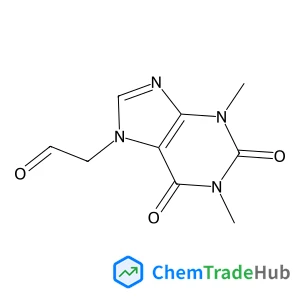
(1,3-Dimethyl-2,6-dioxo-1,2,3,6-tetrahydro-7H-purin-7-yl)acetaldehyde
CAS Number:
5614-53-9
Molecular Formula:
C9H10N4O3
Recommended Suppliers



Disclaimer
This page provides academic journal information for reference and research purposes only. We are not affiliated with any journal publishers and do not handle publication submissions. For publication-related inquiries, please contact the respective journal publishers directly.
If you notice any inaccuracies in the information displayed, please contact us at support@chemtradehub.com. We will promptly review and address your concerns.