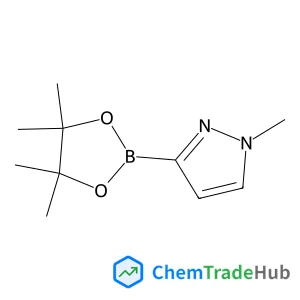
1-Methyl-3-(4,4,5,5-tetramethyl-1,3,2-dioxaborolan-2-yl)-1H-pyrazole
CAS Number:
1020174-04-2
Molecular Formula:
C10H17BN2O2
Carlos Cabezas, Yasuki Endo
The atmospheric reaction of the simplest Criegee intermediate, CH2OO, with formic acid has been investigated in the gas phase by pulsed Fourier-transform microwave spectroscopy. The dominant nascent product from this reaction was identified as hydroperoxymethyl formate (HOOCH2OCHO), for which two different conformations, formed through independent insertion mechanisms, were observed in the discharged plasma of a CH2I2/O2/formic acid gas mixture. The conformational identifications are supported by the observation of 13C species in natural abundance together with the chemically mono substituted deuterium isotopologues. These isotopic observations further suggest that hydroperoxymethyl formate slightly decomposes, producing formic anhydride (OHCOCHO) in a dehydration reaction.
Michelle C. Fairhurst, Michael J. Ezell, Carla Kidd, Pascale S. J. Lakey, Manabu Shiraiwa, Barbara J. Finlayson-Pitts
DOI: 10.1039/C6CP08663B
Paulo R. Bueno, David A. Miranda
DOI: 10.1039/C6CP02504H
Prasant Kumar Nayak, Judith Grinblat, Elena Levi, Mikhael Levi, Boris Markovsky, Doron Aurbach
DOI: 10.1039/C6CP07383B
Kaiqi Wu, Wenfei Li, Lu Yu, Wei Tong, Yue Feng, Shenglong Ling, Longhua Zhang, Xiao Zheng, Maojun Yang
DOI: 10.1039/C6CP08107J
Stefan Vuckovic, Tom J. P. Irons, Lucas O. Wagner, Andrew M. Teale, Paola Gori-Giorgi
DOI: 10.1039/C6CP08704C
Guohai Deng, Xuelin Dong, Qifan Liu, Dingqing Li, Hongmin Li, Qiao Sun, Xiaoqing Zeng
DOI: 10.1039/C6CP08125H
Teng Fang, Shuqi Zheng, Tian Zhou, Lei Yan, Peng Zhang
DOI: 10.1039/C6CP07897D
Tao Cheng, William A Goddard, III, Qi An, Hai Xiao, Boris Merinov, Sergey Morozov
DOI: 10.1039/C6CP08055C
P. Modak, Ashok K. Verma
DOI: 10.1039/C6CP07805B
When handling 4-(2-Furylmethyl)thiomorpholine 1,1-dioxide (CAS: 79206-94-3), it ...
When handling 4-Chloro-N-[2-(4-morpholinyl)ethyl]benzamide (CAS: 71320-77-9), it...
Waste containing this compound (CAS: 62921-74-8) should be handled according to ...
Waste containing (S)-Methyl 2-amino-3-cyclohexylpropanoate should be collected i...
This compound can be synthesized using a multi-step process involving the conjug...
There are several alternatives to (2E)-3-(3,4-Dichlorophenyl)acrylic acid in syn...
Ethyl 6-(2-nitrophenyl)imidazo[2,1-b][1,3]thiazole-3-carboxylate (CAS: 925437-84...
Waste containing 2-(1,3-Thiazol-2-yl)ethanamine (CAS: 18453-07-1) should be coll...
Methyl 5-iodo-2-methylbenzoate can be synthesized through the iodination of meth...
5-Chloro[1,2,4]triazolo[1,5-a]pyridine is commonly synthesized via the condensat...

Physical Chemistry Chemical Physics (PCCP) is an international journal co-owned by 19 physical chemistry and physics societies from around the world. This journal publishes original, cutting-edge research in physical chemistry, chemical physics and biophysical chemistry. To be suitable for publication in PCCP, articles must include significant innovation and/or insight into physical chemistry; this is the most important criterion that reviewers and Editors will judge against when evaluating submissions. The journal has a broad scope and welcomes contributions spanning experiment, theory, computation and data science. Topical coverage includes spectroscopy, dynamics, kinetics, statistical mechanics, thermodynamics, electrochemistry, catalysis, surface science, quantum mechanics, quantum computing and machine learning. Interdisciplinary research areas such as polymers and soft matter, materials, nanoscience, energy, surfaces/interfaces, and biophysical chemistry are welcomed if they demonstrate significant innovation and/or insight into physical chemistry. Joined experimental/theoretical studies are particularly appreciated when complementary and based on up-to-date approaches.