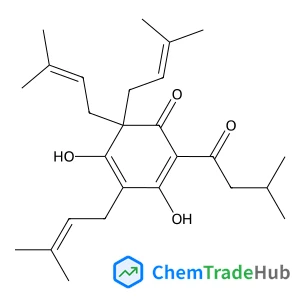
3,5-Dihydroxy-4-(3-methylbutanoyl)-2,6,6-tris(3-methyl-2-buten-1-yl)-2,4-cyclohexadien-1-one
CAS Number:
468-28-0
Molecular Formula:
C26H38O4
Song-Nam Hong, Yun-Hyok Kye, Chol-Jun Yu, Un-Gi Jong, Gum-Chol Ri, Chang-Song Choe, Kwang-Hui Kim, Ju-Myong Han
For the purpose of elucidating the gas sensing mechanism of SnO2 for NO and NO2 gases, we determine the phase diagram of the SnO2(110) surface in contact with an O2 and NO gas environment by means of an ab initio thermodynamic method. Firstly we build a range of surface slab models of oxygen pre-adsorbed SnO2(110) surfaces using (1 × 1) and (2 × 1) surface unit cells and calculate their Gibbs free energies considering only oxygen chemical potential. The fully reduced surface containing the bridging and in-plane oxygen vacancies under oxygen-poor conditions, while the fully oxidized surface containing the bridging oxygen atom and the oxygen dimer under oxygen-rich conditions, and the stoichiometric surface in between, was proved to be most stable. Using the selected plausible NO-adsorbed surfaces, we then determine the surface phase diagram of SnO2(110) surfaces in (ΔμO, ΔμNO) space. Under NO-rich conditions, the most stable surfaces were those formed by NO adsorption on the most stable surfaces in contact with only oxygen gas. Through the analysis of electronic charge transfer and density of states during NOx adsorption on the surface, we provide a meaningful understanding about the gas sensing mechanism.

Herald of the Russian Academy of Sciences

Main Group Chemistry

Journal of Asian Natural Products Research

Acta Metallurgica Sinica-English Letters

Chinese Journal of Chemistry

Critical Reviews in Solid State and Materials Sciences

Journal of the Indian Institute of Science

Atomization and Sprays

Heteroatom Chemistry

Polycyclic Aromatic Compounds
(3.beta.)-3-Hydroxy-N,N-dimethyl-chol-5-en-24-amide (CAS: 79066-03-8) is primari...
5-(Aminomethyl)-2-methoxyphenol (CAS: 89702-89-6) is classified under GHS as a s...
Thieno[2,3-c]pyridin-7(6H)-one (CAS: 28981-13-7) is a heterocyclic organic compo...
1-[(6-Methoxy-3-pyridinyl)methyl]-4-piperidinamine dihydrochloride is generally ...
[(2E)-3-Phenyl-2-propen-1-yl]phosphonic acid (CAS: 146404-58-2) is regulated und...
6-Bromo-7-methoxyquinoline (CAS: 1620515-86-7) falls under the scope of the Glob...
This compound is primarily used in the pharmaceutical industry for the developme...
1-Ethyl-7-[2-methyl-6-(4H-1,2,4-triazol-3-yl)-3-pyridinyl]-3,5-dihydropyrazino[2...
Alternative reagents such as 2-[(dimethylamino)methyl]phenylboronic acid or rela...
3-(Piperidin-4-yloxy)pyridine (CAS: 310881-48-2) is an organic compound with the...

Physical Chemistry Chemical Physics (PCCP) is an international journal co-owned by 19 physical chemistry and physics societies from around the world. This journal publishes original, cutting-edge research in physical chemistry, chemical physics and biophysical chemistry. To be suitable for publication in PCCP, articles must include significant innovation and/or insight into physical chemistry; this is the most important criterion that reviewers and Editors will judge against when evaluating submissions. The journal has a broad scope and welcomes contributions spanning experiment, theory, computation and data science. Topical coverage includes spectroscopy, dynamics, kinetics, statistical mechanics, thermodynamics, electrochemistry, catalysis, surface science, quantum mechanics, quantum computing and machine learning. Interdisciplinary research areas such as polymers and soft matter, materials, nanoscience, energy, surfaces/interfaces, and biophysical chemistry are welcomed if they demonstrate significant innovation and/or insight into physical chemistry. Joined experimental/theoretical studies are particularly appreciated when complementary and based on up-to-date approaches.