












Ionic liquids as modulators of physicochemical properties and nanostructures of sodium dodecyl sulfate in aqueous solutions and potential application in pesticide microemulsions
Literature Information
Publication Date
2016-10-11
DOI
10.1039/C6CP04722J
Impact Factor
3.676
Authors
Jing Li, Tengfei Fan, Yong Xu, Xuemin Wu
View Original
Abstract
Emulsifiers for pesticide microemulsions contain a part of volatile organic compounds (VOCs), and ionic liquids (ILs) are becoming potential substitutes. In order to apply ILs in pesticide microemulsions, the study of interaction between ILs and surfactants is necessary. Therefore, the surface properties and aggregation of anionic surfactant sodium dodecyl sulfate (SDS) in ILs, including N-hexyl-N-methylmorpholinyl bromide ([C6mm][Br]), N-hexyl-N-methylpiperidyl bromide ([C6mp][Br]), N-hexyl-N-methylpyrrolidyl bromide ([C6mpyr][Br]), N-octyl-N-methylpyrrolidyl bromide ([C8mpyr][Br]), N-dodecyl-N-methylpyrrolidyl bromide ([C12mpyr][Br]) and N-hexadecyl-N-methylpyrrolidyl bromide ([C16mpyr][Br]), were investigated in terms of surface tension, conductivity, dynamic light scattering (DLS), viscosity, fluorescence, pseudo-ternary phase diagram and 1H NMR measurements. Generally in agreement, the methods afforded the evaluation of various micellar parameters such as critical micelle concentration (CMC), degree of counterion ionization (α), the maximum surface excess concentration (Γmax), the minimum area per surfactant headgroup (Amin) as well as some thermodynamic parameters, including standard free energy of micellization (ΔG0m), standard enthalpy of micellization (ΔH0m) and standard entropy of micellization (ΔS0m). The results indicated a hydrophobic effect as the primary force of a spontaneous, exothermic, entropy driven micellization process. 1H NMR technique was applied to reveal the solubilization site and interaction of ILs in aqueous SDS micellar solutions. Fluorescence, DLS and viscosity measurements revealed considerable micellar morphologies and various phase behaviors. Furthermore, the 10% difenoconazole microemulsion was successfully prepared and showed good stability and spreadability in mixtures which indicated ILs' potential application in pesticide formulation.
Recommended Journals
Related Literature
You might also like
Compound Q&A
What are the main uses of (3.beta.)-3-Hydroxy-N,N-dimethyl-chol-5-en-24-amide (CAS: 79066-03-8)?
(3.beta.)-3-Hydroxy-N,N-dimethyl-chol-5-en-24-amide (CAS: 79066-03-8) is primari...
79066-03-8(3.beta.)-3-Hydroxy-...
Compound Q&A
What regulatory guidelines apply to 5-(aminomethyl)-2-methoxyphenol (CAS: 89702-89-6)?
5-(Aminomethyl)-2-methoxyphenol (CAS: 89702-89-6) is classified under GHS as a s...
89702-89-65-(aminomethyl)-2-me...
Compound Q&A
What is Thieno[2,3-c]pyridin-7(6H)-one (CAS: 28981-13-7)?
Thieno[2,3-c]pyridin-7(6H)-one (CAS: 28981-13-7) is a heterocyclic organic compo...
28981-13-7Thieno[2,3-c]pyridin...
Compound Q&A
Is 1-[(6-Methoxy-3-pyridinyl)methyl]-4-piperidinamine dihydrochloride (CAS: 1185311-28-7) safe?
1-[(6-Methoxy-3-pyridinyl)methyl]-4-piperidinamine dihydrochloride is generally ...
1185311-28-71-[(6-Methoxy-3-pyri...
Compound Q&A
What regulatory guidelines apply to [(2E)-3-Phenyl-2-propen-1-yl]phosphonic acid (CAS: 146404-58-2)?
[(2E)-3-Phenyl-2-propen-1-yl]phosphonic acid (CAS: 146404-58-2) is regulated und...
146404-58-2[(2E)-3-Phenyl-2-pro...
Compound Q&A
What regulatory guidelines apply to 6-Bromo-7-methoxyquinoline (CAS: 1620515-86-7)?
6-Bromo-7-methoxyquinoline (CAS: 1620515-86-7) falls under the scope of the Glob...
1620515-86-76-Bromo-7-methoxyqui...
Compound Q&A
What industries use (2R)-1-(1-Benzofuran-2-yl)-N-propyl-2-pentanamine (CAS: 260550-89-8)?
This compound is primarily used in the pharmaceutical industry for the developme...
260550-89-8(2R)-1-(1-Benzofuran...
Compound Q&A
What are the main uses of 1-Ethyl-7-[2-methyl-6-(4H-1,2,4-triazol-3-yl)-3-pyridinyl]-3,5-dihydropyrazino[2,3-b]pyrazin-2(1H)-one (CAS: 1228013-15-7)?
1-Ethyl-7-[2-methyl-6-(4H-1,2,4-triazol-3-yl)-3-pyridinyl]-3,5-dihydropyrazino[2...
1228013-15-71-Ethyl-7-[2-methyl-...
Compound Q&A
Are there alternatives to {5-(Acryloylamino)-2-[(dimethylamino)methyl]phenyl}boronic acid (CAS: 1217500-78-1) in synthesis?
Alternative reagents such as 2-[(dimethylamino)methyl]phenylboronic acid or rela...
1217500-78-1{5-(Acryloylamino)-2...
Compound Q&A
What is 3-(Piperidin-4-yloxy)pyridine (CAS: 310881-48-2)?
3-(Piperidin-4-yloxy)pyridine (CAS: 310881-48-2) is an organic compound with the...
310881-48-23-(Piperidin-4-yloxy...
Source Journal
Physical Chemistry Chemical Physics

CiteScore:
5.5
Self-citation Rate:
10.3%
Articles per Year:
3036
Physical Chemistry Chemical Physics (PCCP) is an international journal co-owned by 19 physical chemistry and physics societies from around the world. This journal publishes original, cutting-edge research in physical chemistry, chemical physics and biophysical chemistry. To be suitable for publication in PCCP, articles must include significant innovation and/or insight into physical chemistry; this is the most important criterion that reviewers and Editors will judge against when evaluating submissions. The journal has a broad scope and welcomes contributions spanning experiment, theory, computation and data science. Topical coverage includes spectroscopy, dynamics, kinetics, statistical mechanics, thermodynamics, electrochemistry, catalysis, surface science, quantum mechanics, quantum computing and machine learning. Interdisciplinary research areas such as polymers and soft matter, materials, nanoscience, energy, surfaces/interfaces, and biophysical chemistry are welcomed if they demonstrate significant innovation and/or insight into physical chemistry. Joined experimental/theoretical studies are particularly appreciated when complementary and based on up-to-date approaches.
Recommended Compounds
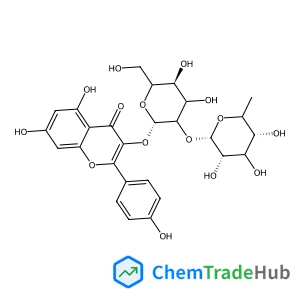
5,7-Dihydroxy-2-(4-hydroxyphenyl)-4-oxo-4H-chromen-3-yl 2-O-(6-deoxy-alpha-L-mannopyranosyl)-beta-D-glucopyranoside
CAS Number:
32602-81-6
Molecular Formula:
C27H30O15
Recommended Suppliers







Disclaimer
This page provides academic journal information for reference and research purposes only. We are not affiliated with any journal publishers and do not handle publication submissions. For publication-related inquiries, please contact the respective journal publishers directly.
If you notice any inaccuracies in the information displayed, please contact us at support@chemtradehub.com. We will promptly review and address your concerns.