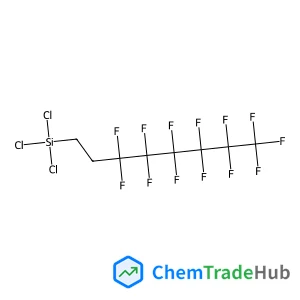
Trichloro(3,3,4,4,5,5,6,6,7,7,8,8,8-tridecafluorooctyl)silane
CAS Number:
78560-45-9
Molecular Formula:
C8H4Cl3F13Si
Jesse Lentz, Stephen H. Garofalini
Using a highly robust and reactive all-atom potential, molecular dynamics computer simulations have been used to provide detailed analysis of the behavior of water and protons at a large-scale amorphous silica surface that offers the heterogeneity of surface sites and water/silica interactions. Structural data of the H–O distances as a function of distance from the glass surface showed variation in hydrogen bond (H-bond) lengths to second and third nearest oxygen neighbors that play an important role in H-bond lifetimes, rotations, and proton transfer, especially at the glass surface. The higher density and inherently closer average spacing between oxygens in the glass surface (2.6 Å) in comparison to that in water (2.8 Å) create a significantly different environment for H-bond lifetimes and proton transfers. Continuous H-bond lifetime autocorrelation functions for water H-bonded to the surface are considerably shorter than those of bulk water, whereas the intermittent lifetime autocorrelation functions are longer. Such results affect proton transfers that are over an order of magnitude higher at the surface than farther from the surface or in bulk water. However, most of these transfers are rattling events between the participating oxygens, one of which is the newly formed H3O+ ion adjacent to the interface. Such a H3O+ ion has an extremely low barrier to proton transfer back to the surface site in comparison to a H3O+ ion in bulk water. Nonetheless, the simulations showed that rotation of the H3O+ ion away from the initial transfer site allowed for structural diffusion of an excess proton away from the surface. Proton conduction from such rotations could be enhanced by external forces.
Saburo Kobayashi, Kaiyu Fujiwara, Takuya Yamamoto, Kenji Tajima, Yasunori Yamamoto, Takuya Isono, Toshifumi Satoh
DOI: 10.1039/D0PY01127D
Tianyu Yuan, Lisha Zhang, Tony Li, Ruowen Tu
DOI: 10.1039/D0PY00819B
Charalampos Pronoitis, Minna Hakkarainen, Karin Odelius
DOI: 10.1039/D0PY01089H
Seishi Ohashi, Eric Rachita, Sean Baxley, Jessica Zhou, Adam Erlichman, Hatsuo Ishida
DOI: 10.1039/D0PY01521K
Ralf Schweins, Hartmut Komber
DOI: 10.1039/D0PY01045F
Sameer F. Hamad, Euan Gray, Christopher M. Magazzeni, Fodio Longman, David E. J. Armstrong, Joel P. Foreman, Frederik Claeyssens, Cornelia Rodenburg
DOI: 10.1039/D0PY01220C
Mayu Yamada, Yu Shinke, Shoichi Kutsumizu
DOI: 10.1039/D0PY01034K
Guillaume Noirbent, Damien Brunel, Didier Gigmes, Pu Xiao, Frédéric Dumur
DOI: 10.1039/D0PY01197E
William D. Walker, Michael J. Sandoz, Samuel Roland, Tony M. Buster, John K. Newman, Derek L. Patton
DOI: 10.1039/D0PY01006E
1H-Indazole-6-carbonitrile finds applications in pharmaceuticals, where it serve...
Waste containing Dioctyl (2E)-2-butenedioate (CAS: 2997-85-5) should be collecte...
Sodium [(1,2-benzoxazol-3-ylmethyl)sulfonyl]azanide is primarily used in pharmac...
Dimethyl 4-(4,4,5,5-tetramethyl-1,3,2-dioxaborolan-2-yl)-2,6-pyridinedicarboxyla...
Waste containing 2-Fluoro-6-hydrazinopyridine (CAS: 80714-39-2) should be manage...
6-Formyl-2-pyridinecarboxylic acid is an organic compound with the molecular for...
Research trends for this compound indicate a focus on its potential applications...
9H-Tribenzo[b,d,f]azepine is typically synthesized via a multi-step process invo...
1-Cyclopropyl-7-ethoxy-6-fluoro-8-methoxy-4-oxo-1,4-dihydro-3-quinolinecarboxyli...
Waste containing Methyl 3-oxo-1,2,3,4-tetrahydro-6-quinoxalinecarboxylate (CAS: ...

Physical Chemistry Chemical Physics (PCCP) is an international journal co-owned by 19 physical chemistry and physics societies from around the world. This journal publishes original, cutting-edge research in physical chemistry, chemical physics and biophysical chemistry. To be suitable for publication in PCCP, articles must include significant innovation and/or insight into physical chemistry; this is the most important criterion that reviewers and Editors will judge against when evaluating submissions. The journal has a broad scope and welcomes contributions spanning experiment, theory, computation and data science. Topical coverage includes spectroscopy, dynamics, kinetics, statistical mechanics, thermodynamics, electrochemistry, catalysis, surface science, quantum mechanics, quantum computing and machine learning. Interdisciplinary research areas such as polymers and soft matter, materials, nanoscience, energy, surfaces/interfaces, and biophysical chemistry are welcomed if they demonstrate significant innovation and/or insight into physical chemistry. Joined experimental/theoretical studies are particularly appreciated when complementary and based on up-to-date approaches.