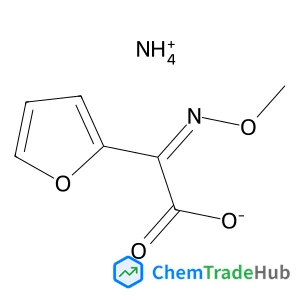
Ammonium (Z)-2-(furan-2-yl)-2-(methoxyimino)acetate
CAS Number:
97148-39-5
Molecular Formula:
C7H10N2O4
A. Serrano-Jiménez, L. Bañares, A. García-Vela
A coherent control scheme is suggested to modify the output of photodissociation in a polyatomic system. The performance of the scheme is illustrated by applying it to the ultrafast photodissociation of CH3I in the A-band. The control scheme uses a pump laser weak field that combines two pulses of a few femtoseconds delayed in time. By varying the time delay between the pulses, the shape of the laser field spectral profile is modulated, which causes a change in the initial relative populations excited by the pump laser to the different electronic states involved in the photodissociation. Such a change in the relative populations produces different photodissociation outputs, which is the basis of the control achieved. The degree of control obtained over different photodissociation observables, like the branching ratio between the two dissociation channels of CH3I yielding I(2P3/2) and I*(2P1/2) and the fragment angular distributions associated with each channel, is investigated. These magnitudes are found to oscillate strongly with the time delay, with the branching ratio changing by factors between two and three. Substantial variations of the angular distributions also indicate that the scheme provides a high degree of control. Experimental application of the scheme to general polyatomic photodissociation processes should be straightforward.
Muhamad Z. Mokhtar, Mu Chen, Eric Whittaker, Bruce Hamilton, Nicholas Aristidou, Ali Gholinia, Saif A. Haque, Brian R. Saunders
DOI: 10.1039/C7CP00471K
Jamie C. Wang, Kyle Violette, Omotola O. Ogunsolu
DOI: 10.1039/C6CP07939C
Zhen Liu, Vinh Son Nguyen, Jeremy Harvey, Jean-François Müller, Jozef Peeters
DOI: 10.1039/C7CP00288B
J. Xu, T. F. He, L. Q. Chai, L. Qiao, X. Q. Zhang, P. Wang, W. M. Liu
DOI: 10.1039/C6CP08356K
Tim Kohlmann, Robert Naumann, Christoph Kerzig, Martin Goez
DOI: 10.1039/C6CP08491E
L. Pavasaryte, A. Katelnikovas, V. Klimavicius, V. Balevicius, A. Krajnc, G. Mali, J. Plavec, A. Kareiva
DOI: 10.1039/C6CP07723D
Chao Yuan, Mengyu Huang, Yanhua Cheng, Xiaobing Luo
DOI: 10.1039/C7CP00209B
Markus Schütz, Yoshiteru Matsumoto, Aude Bouchet, Murat Öztürk, Otto Dopfer
DOI: 10.1039/C6CP07251H
Alexandre Barras, Ahmed Addad, Brigitte Sieber, Mokhtar Férid, Sabine Szunerits, Rabah Boukherroub
DOI: 10.1039/C6CP08576H
1H-Indazole-6-carbonitrile finds applications in pharmaceuticals, where it serve...
Waste containing Dioctyl (2E)-2-butenedioate (CAS: 2997-85-5) should be collecte...
Sodium [(1,2-benzoxazol-3-ylmethyl)sulfonyl]azanide is primarily used in pharmac...
Dimethyl 4-(4,4,5,5-tetramethyl-1,3,2-dioxaborolan-2-yl)-2,6-pyridinedicarboxyla...
Waste containing 2-Fluoro-6-hydrazinopyridine (CAS: 80714-39-2) should be manage...
6-Formyl-2-pyridinecarboxylic acid is an organic compound with the molecular for...
Research trends for this compound indicate a focus on its potential applications...
9H-Tribenzo[b,d,f]azepine is typically synthesized via a multi-step process invo...
1-Cyclopropyl-7-ethoxy-6-fluoro-8-methoxy-4-oxo-1,4-dihydro-3-quinolinecarboxyli...
Waste containing Methyl 3-oxo-1,2,3,4-tetrahydro-6-quinoxalinecarboxylate (CAS: ...

Physical Chemistry Chemical Physics (PCCP) is an international journal co-owned by 19 physical chemistry and physics societies from around the world. This journal publishes original, cutting-edge research in physical chemistry, chemical physics and biophysical chemistry. To be suitable for publication in PCCP, articles must include significant innovation and/or insight into physical chemistry; this is the most important criterion that reviewers and Editors will judge against when evaluating submissions. The journal has a broad scope and welcomes contributions spanning experiment, theory, computation and data science. Topical coverage includes spectroscopy, dynamics, kinetics, statistical mechanics, thermodynamics, electrochemistry, catalysis, surface science, quantum mechanics, quantum computing and machine learning. Interdisciplinary research areas such as polymers and soft matter, materials, nanoscience, energy, surfaces/interfaces, and biophysical chemistry are welcomed if they demonstrate significant innovation and/or insight into physical chemistry. Joined experimental/theoretical studies are particularly appreciated when complementary and based on up-to-date approaches.