












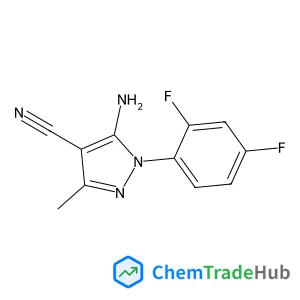
5-Amino-1-(2,4-difluorophenyl)-3-methyl-1H-pyrazole-4-carbonitrile
CAS Number:
1020057-92-4
Molecular Formula:
C11H8F2N4
Miles A. Taylor, Cheng Chen
Green fluorescent protein (GFP) has revolutionized bioimaging and life sciences. Its successes have inspired modification of the chromophore structure and environment to tune emission properties, but outside the protein cage, the chromophore is essentially non-fluorescent. In this study, we employ the tunable femtosecond stimulated Raman spectroscopy (FSRS) and transient absorption (TA) to map the energy dissipation pathways of GFP model chromophore (HBDI) in basic aqueous solution. Strategic tuning of the Raman pump to 550 nm exploits the stimulated emission band to enhance excited state vibrational motions as HBDI navigates the non-equilibrium potential energy landscape to pass through a conical intersection. The time-resolved FSRS uncovers prominent anharmonic couplings between a global out-of-plane bending mode of ∼227 cm−1 and two modes at ∼866 and 1572 cm−1 before HBDI reaches the twisted intramolecular charge transfer (TICT) state on the ∼3 ps time scale. Remarkably, the wavelet transform analysis reveals a ∼500 fs delayed onset of the coupling peaks, in correlation with the emergence of an intermediate charge-separated state en route to the TICT state. This mechanism is corroborated by the altered coupling matrix for the HBDI Raman modes in the 50% (v/v) water–glycerol mixture, and a notable lengthening of the picosecond time constant. The real-time molecular “movie” of the general rotor-like HBDI isomerization reaction following photoexcitation represents a significant advance in comprehending the photochemical reaction pathways of the solvated GFP chromophore, therefore providing a crucial foundation to enable rational design of diverse nanomachines from efficient molecular rotors to bright fluorescent probes.
Raul Villamil-Ramos, Anatoly K. Yatsimirsky
DOI: 10.1039/C0CC05346E
Sarah Di Nonno, Roland Ulber
DOI: 10.1039/D1AN00025J
Mingrui Jiang, Ting Shu, Chao Ye, Jing Ren, Shengjie Ling
DOI: 10.1039/D1AN00290B
Xin Zhang, Xiaowei Feng, Leon Lee Zhou, Bin Liu, Zhengbo Chen, Xia Zuo
DOI: 10.1039/D1AN02109E
Minghui Bi, Guanghua Li, Jia Hua, Xiaomin Liu, Yawei Hu, Zhan Shi, Shouhua Feng
DOI: 10.1039/B709852A
Jing-San Xu, Ying-Jie Zhu
DOI: 10.1039/C2CE06619J
Navaneetha K. Subbaiyan, Francis D’Souza, Yongshu Xie, Satyajit Sahu, Noelia M. Sanchez-Ballester, Toshiyuki Mori
DOI: 10.1039/C2CC30712J
Chao Hou, Qing Liu, Taka-aki Okamura, Peng Wang, Wei-Yin Sun
DOI: 10.1039/C2CE26533H
Yue Zhao, Juan Bai, Xin-Ru Wu, Pei Chen, Pu-Jun Jin, Hong-Chang Yao, Yu Chen
DOI: 10.1039/C9TA05334D
Ethyl 4-chlorothieno[2,3-b]pyridine-5-carboxylate (CAS: 59713-58-5) can be synth...
5-Methyl-1H-indole-3-carbaldehyde (CAS: 52562-50-2) is subject to various regula...
(1,3-Dimethyl-2,4-dioxo-1,2,3,4-tetrahydro-5-pyrimidinyl)boronic acid is a white...
Waste containing Sulfocostunolide A (CAS: 1016983-51-9) should be handled with c...
When handling Murraxocin (CAS: 88478-44-8), ensure proper personal protective eq...
Formvar (CAS: 63148-64-1) is an alkyd resin characterized by a high molecular we...
(S)-4-benzyl-2-((benzyloxy)methyl)morpholine is generally safe when handled with...
Methyl 1-(5-bromo-2-pyrimidinyl)cyclopropanecarboxylate (CAS: 1447607-69-3) is p...
2-Methyl-1-phenyl-1-propanamine hydrochloride (CAS: 24290-47-9) is generally con...
3-(4-Bromophenyl)-2-methylpropanoic acid is synthesized through a multi-step pro...

Physical Chemistry Chemical Physics (PCCP) is an international journal co-owned by 19 physical chemistry and physics societies from around the world. This journal publishes original, cutting-edge research in physical chemistry, chemical physics and biophysical chemistry. To be suitable for publication in PCCP, articles must include significant innovation and/or insight into physical chemistry; this is the most important criterion that reviewers and Editors will judge against when evaluating submissions. The journal has a broad scope and welcomes contributions spanning experiment, theory, computation and data science. Topical coverage includes spectroscopy, dynamics, kinetics, statistical mechanics, thermodynamics, electrochemistry, catalysis, surface science, quantum mechanics, quantum computing and machine learning. Interdisciplinary research areas such as polymers and soft matter, materials, nanoscience, energy, surfaces/interfaces, and biophysical chemistry are welcomed if they demonstrate significant innovation and/or insight into physical chemistry. Joined experimental/theoretical studies are particularly appreciated when complementary and based on up-to-date approaches.
![4-[(1-Methyl-1H-pyrrol-2-yl)methylene]-1,3(2H,4H)-isoquinolinedione structure](https://static.chemtradehub.com/structs/110/1104546-89-5-a600.webp "4-[(1-Methyl-1H-pyrrol-2-yl)methylene]-1,3(2H,4H)-isoquinolinedione structure")






