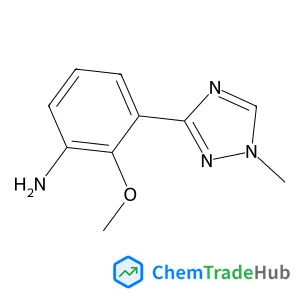
2-Methoxy-3-(1-methyl-1H-1,2,4-triazol-3-yl)aniline
CAS Number:
1609394-10-6
Molecular Formula:
C10H12N4O
Advanced electrolytes for supercapacitors with high electrochemical stability are necessary to improve the suitability of supercapacitors for many applications. In this work we investigated electrolytes based on the solvent propylene carbonate (PC) and butylene carbonate (BC). A comparison of different solvent–salt combinations shows that 1 M N-butyl-N-methylpyrrolidinium bis(trifluoromethanesulfonyl)imide (Pyr14TFSI) in BC is superior to conventionally used PC-based electrolytes examined in this work in terms of voltage window and capacitance. In order to gain a better understanding of the influence of the ions and the solvent on the formation of the electrochemical double layer, the self-discharge mechanism and its temperature dependence have been investigated in detail. By coupling thermogravimetry (TGA), infrared spectroscopy (IR), gas chromatography and mass spectrometry (GC-MS), also decomposition and temperature stability have been assessed.
M. A. Ulla, E. Miro, R. Mallada, J. Coronas, J. Santamaría
DOI: 10.1039/B315386J
Michelle K. Kidder, Phillip F. Britt, Zongtao Zhang, Sheng Dai, A. C. Buchanan, III
DOI: 10.1039/B310405B
Robert D. Hancock, Libero J. Bartolotti
DOI: 10.1039/B312518C
Christian Korff, Günter Helmchen
DOI: 10.1039/B315009G
Barbara Becker, Katarzyna Baranowska, Jarosław Chojnacki, Wiesław Wojnowski
DOI: 10.1039/B313576D
Ken Sasaki, Hiroki Nakagawa, Xiaoyong Zhang, Shinichi Sakurai, Koji Kano, Yasuhisa Kuroda
DOI: 10.1039/B311079F
Ibon Odriozola, Nathalie Kyritsakas, Jean-Marie Lehn
DOI: 10.1039/B311045A
Qing Wen Shi, Françoise Sauriol, Alain Lesimple, Lolita O. Zamir
DOI: 10.1039/B316051C
Junhui He, Toyoki Kunitake, Aiko Nakao
DOI: 10.1039/B314407K
James G. Worden, Andrew W. Shaffer, Qun Huo
DOI: 10.1039/B312819A
1H-Indazole-6-carbonitrile finds applications in pharmaceuticals, where it serve...
Waste containing Dioctyl (2E)-2-butenedioate (CAS: 2997-85-5) should be collecte...
Sodium [(1,2-benzoxazol-3-ylmethyl)sulfonyl]azanide is primarily used in pharmac...
Dimethyl 4-(4,4,5,5-tetramethyl-1,3,2-dioxaborolan-2-yl)-2,6-pyridinedicarboxyla...
Waste containing 2-Fluoro-6-hydrazinopyridine (CAS: 80714-39-2) should be manage...
6-Formyl-2-pyridinecarboxylic acid is an organic compound with the molecular for...
Research trends for this compound indicate a focus on its potential applications...
9H-Tribenzo[b,d,f]azepine is typically synthesized via a multi-step process invo...
1-Cyclopropyl-7-ethoxy-6-fluoro-8-methoxy-4-oxo-1,4-dihydro-3-quinolinecarboxyli...
Waste containing Methyl 3-oxo-1,2,3,4-tetrahydro-6-quinoxalinecarboxylate (CAS: ...

Physical Chemistry Chemical Physics (PCCP) is an international journal co-owned by 19 physical chemistry and physics societies from around the world. This journal publishes original, cutting-edge research in physical chemistry, chemical physics and biophysical chemistry. To be suitable for publication in PCCP, articles must include significant innovation and/or insight into physical chemistry; this is the most important criterion that reviewers and Editors will judge against when evaluating submissions. The journal has a broad scope and welcomes contributions spanning experiment, theory, computation and data science. Topical coverage includes spectroscopy, dynamics, kinetics, statistical mechanics, thermodynamics, electrochemistry, catalysis, surface science, quantum mechanics, quantum computing and machine learning. Interdisciplinary research areas such as polymers and soft matter, materials, nanoscience, energy, surfaces/interfaces, and biophysical chemistry are welcomed if they demonstrate significant innovation and/or insight into physical chemistry. Joined experimental/theoretical studies are particularly appreciated when complementary and based on up-to-date approaches.