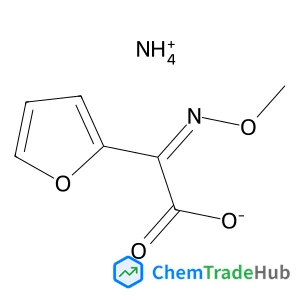
Ammonium (Z)-2-(furan-2-yl)-2-(methoxyimino)acetate
CAS Number:
97148-39-5
Molecular Formula:
C7H10N2O4
Hien Q. Nguyen, Lorena S. Grundy, Kevin R. Olson, Sue J. Mecham
The performance of binary electrolytes is governed by three transport properties: conductivity, salt diffusion coefficient, and transference number. Rigorous methods for measuring conductivity and the salt diffusion coefficient are well established and used routinely in the literature. The commonly used methods for measuring transference number are the steady-state current method, t+,id, and pulsed field gradient NMR, t+,NMR. These methods yield the transference number only if the electrolyte is ideal, i.e., the salt dissociates completely into non-interacting anions and cations. In this work, we present a complete set of ion transport properties for mixtures of a functionalized perfluoroether, dimethyl carbonate terminated perfluorinated tetraethylene ether, and lithium bis(fluorosulfonyl)imide (LiFSI). The equations used to determine these properties from experimental data are based on Newman's concentrated solution theory. The concentrated-solution-theory-based transference number, t0+, is negative across all salt concentrations, and it increases with increasing salt concentration. In contrast, the ideal transference number, t+,id, is positive across all salt concentrations and it decreases with salt concentration. The NMR-based transference number, t+,NMR, is approximately 0.5, independent of salt concentration. The disparity between the three transference numbers, which indicates the dominance of ion clustering, is resolved by the use of Newman's concentrated solution theory.
Avijit Mondal, Kaushik Hatua, Ria Sinha Roy, Prasanta K. Nandi
DOI: 10.1039/C6CP07845A
Eugene Heifets, Joachim Maier
DOI: 10.1039/C6CP07986E
Shaun G. Ard, Oscar Martinez, Jr., Steven A. Brown, Jordan C. Sawyer, P. B. Armentrout, Albert A. Viggiano, Nicholas S. Shuman
DOI: 10.1039/C6CP08703E
J. Xu, T. F. He, L. Q. Chai, L. Qiao, X. Q. Zhang, P. Wang, W. M. Liu
DOI: 10.1039/C6CP08356K
Jamie C. Wang, Kyle Violette, Omotola O. Ogunsolu
DOI: 10.1039/C6CP07939C
Isaac W. Boateng, Richard Tia, Evans Adei, Nelson Y. Dzade
DOI: 10.1039/C6CP08698E
Dmitry A. Pasko, Oleg N. Kalugin
DOI: 10.1039/C6CP05562A
Yang-Jin Cho, So-Yoen Kim, Ho-Jin Son, Sang Ook Kang
DOI: 10.1039/C7CP00500H
P. Florian, C. Thieuleux
DOI: 10.1039/C6CP08583K
Jian Liu, Ian D. Tevis, Richard S. Andino, Christina M. Miller, Lawrence D. Ziegler, Xin Chen
DOI: 10.1039/C6CP07580K
1H-Indazole-6-carbonitrile finds applications in pharmaceuticals, where it serve...
Waste containing Dioctyl (2E)-2-butenedioate (CAS: 2997-85-5) should be collecte...
Sodium [(1,2-benzoxazol-3-ylmethyl)sulfonyl]azanide is primarily used in pharmac...
Dimethyl 4-(4,4,5,5-tetramethyl-1,3,2-dioxaborolan-2-yl)-2,6-pyridinedicarboxyla...
Waste containing 2-Fluoro-6-hydrazinopyridine (CAS: 80714-39-2) should be manage...
6-Formyl-2-pyridinecarboxylic acid is an organic compound with the molecular for...
Research trends for this compound indicate a focus on its potential applications...
9H-Tribenzo[b,d,f]azepine is typically synthesized via a multi-step process invo...
1-Cyclopropyl-7-ethoxy-6-fluoro-8-methoxy-4-oxo-1,4-dihydro-3-quinolinecarboxyli...
Waste containing Methyl 3-oxo-1,2,3,4-tetrahydro-6-quinoxalinecarboxylate (CAS: ...

Physical Chemistry Chemical Physics (PCCP) is an international journal co-owned by 19 physical chemistry and physics societies from around the world. This journal publishes original, cutting-edge research in physical chemistry, chemical physics and biophysical chemistry. To be suitable for publication in PCCP, articles must include significant innovation and/or insight into physical chemistry; this is the most important criterion that reviewers and Editors will judge against when evaluating submissions. The journal has a broad scope and welcomes contributions spanning experiment, theory, computation and data science. Topical coverage includes spectroscopy, dynamics, kinetics, statistical mechanics, thermodynamics, electrochemistry, catalysis, surface science, quantum mechanics, quantum computing and machine learning. Interdisciplinary research areas such as polymers and soft matter, materials, nanoscience, energy, surfaces/interfaces, and biophysical chemistry are welcomed if they demonstrate significant innovation and/or insight into physical chemistry. Joined experimental/theoretical studies are particularly appreciated when complementary and based on up-to-date approaches.
![Sodium 3-[(E)-(4-anilinophenyl)diazenyl]benzenesulfonate structure](https://static.chemtradehub.com/structs/587/587-98-4-035f.webp "Sodium 3-[(E)-(4-anilinophenyl)diazenyl]benzenesulfonate structure")
![(1S)-1,5-Anhydro-1-[3-(1-benzothiophen-2-ylmethyl)-4-fluorophenyl]-D-glucitol structure](https://static.chemtradehub.com/structs/761/761423-87-4-dbeb.webp "(1S)-1,5-Anhydro-1-[3-(1-benzothiophen-2-ylmethyl)-4-fluorophenyl]-D-glucitol structure")