













Cognitive spectroscopy for wood species identification: near infrared hyperspectral imaging combined with convolutional neural networks
Literature Information
Publication Date
2019-10-02
DOI
10.1039/C9AN01180C
Impact Factor
4.616
Authors
Hideaki Kanayama, Te Ma, Satoru Tsuchikawa, Tetsuya Inagaki
View Original
Abstract
From the viewpoint of combating illegal logging and examining wood properties, there is a contemporary demand for a wood species identification system. Several nondestructive automatic identification systems have been developed, but there is room for improvement to construct a highly reliable model. The present study proposes cognitive spectroscopy that combines near infrared hyperspectral imaging (NIR-HSI) with a deep convolutional neural network approach. We defined “cognitive spectroscopy” as a protocol that extracts features from complex spectroscopic data and presents the best results without human intervention. Overall, 120 samples representing 38 hardwood species were scanned using an NIR-HSI camera. A deep learning prediction model was built based on the principal component (PC) images obtained from the PC scores of hyperspectral images (wavelength range: 1000–2200 nm at approximately 6.2 nm interval). The results showed that the accuracy of wood species identification based on 6PC (PC1–PC6) images was 90.5%, which was considerably higher than the accuracy of 56.0% obtained with conventional visible images.
Related Literature
Photocatalytic, modular difunctionalization of alkenes enabled by ligand-to-metal charge transfer and radical ligand transfer
Kang-Jie Bian, David Nemoto, Jr, Xiao-Wei Chen, Shih-Chieh Kao, James Hooson, Julian G. West
2023-11-24
Edge Article
DOI: 10.1039/D3SC05231A
Using waste to treat waste: facile synthesis of hollow carbon nanospheres from lignin for water decontamination
Xiang Liu, Zixuan Hao, Chen Fang, Kun Pang, Jiaying Yan, Yingping Huang, Di Huang
2023-11-27
Edge Article
DOI: 10.1039/D3SC05275C
Photocatalytic (3 + 2) dipolar cycloadditions of aziridines driven by visible-light
Daniele Mazzarella, Tommaso Bortolato, Giorgio Pelosi, Luca Dell'Amico
2023-11-29
Edge Article
DOI: 10.1039/D3SC05997A
Native mass spectrometry of proteoliposomes containing integral and peripheral membrane proteins
Yun Zhu, Sangho D. Yun, Tianqi Zhang, Jing-Yuan Chang, Lauren Stover, Arthur Laganowsky
2023-11-21
Edge Article
DOI: 10.1039/D3SC04938H
Computationally guided bioengineering of the active site, substrate access pathway, and water channels of thermostable cytochrome P450, CYP175A1, for catalyzing the alkane hydroxylation reaction
Mohd Taher, Kshatresh Dutta Dubey, Shyamalava Mazumdar
2023-12-04
Edge Article
DOI: 10.1039/D3SC02857G
Photoredox-catalyzed stereo- and regioselective vicinal fluorosulfonyl-borylation of unsaturated hydrocarbons
Heyin Li, Mengjun Huang, Zhenlei Zou, Zhen Wang, Yifan Li, Chao Sun, Wangzhe Chen, Yi Pan, Weigang Zhang, Yi Wang
2023-11-13
Edge Article
DOI: 10.1039/D3SC03101B
Facile synthesis of 1,2-aminoalcohols via α-C–H aminoalkylation of alcohols by photoinduced hydrogen-atom transfer catalysis
Joaquim Caner, Akira Matsumoto
2023-11-16
Edge Article
DOI: 10.1039/D3SC05305A
Crystallographic evidence for global aromaticity in the di-anion and tetra-anion of a cyclophane hydrocarbon
Yikun Zhu, Zheng Wei, Marina A. Petrukhina, Harry L. Anderson
2023-09-20
Edge Article
DOI: 10.1039/D3SC04251K
You might also like
Compound Q&A
What precautions should be taken when handling 4-(2-Furylmethyl)thiomorpholine 1,1-dioxide (CAS: 79206-94-3)?
When handling 4-(2-Furylmethyl)thiomorpholine 1,1-dioxide (CAS: 79206-94-3), it ...
79206-94-34-(2-Furylmethyl)thi...
Compound Q&A
What precautions should be taken when handling 4-Chloro-N-[2-(4-morpholinyl)ethyl]benzamide (CAS: 71320-77-9)?
When handling 4-Chloro-N-[2-(4-morpholinyl)ethyl]benzamide (CAS: 71320-77-9), it...
71320-77-94-Chloro-N-[2-(4-mor...
Compound Q&A
How should waste containing 2-[2-(2-Methoxyethoxy)ethoxy]ethyl 4-methylbenzenesulfonate (CAS: 62921-74-8) be handled?
Waste containing this compound (CAS: 62921-74-8) should be handled according to ...
62921-74-82-[2-(2-Methoxyethox...
Compound Q&A
How should waste containing (S)-Methyl 2-amino-3-cyclohexylpropanoate be handled?
Waste containing (S)-Methyl 2-amino-3-cyclohexylpropanoate should be collected i...
40056-18-6(S)-Methyl 2-amino-3...
Compound Q&A
How is 5-({4-[(2S,4R)-4-Hydroxy-2-methyltetrahydro-2H-pyran-4-yl]-2-thienyl}sulfanyl)-1-methyl-1,3-dihydro-2H-indol-2-one (CAS: 166882-70-8) typically synthesized?
This compound can be synthesized using a multi-step process involving the conjug...
166882-70-85-({4-[(2S,4R)-4-Hyd...
Compound Q&A
Are there alternatives to (2E)-3-(3,4-Dichlorophenyl)acrylic acid (CAS: 7312-27-8) in synthesis?
There are several alternatives to (2E)-3-(3,4-Dichlorophenyl)acrylic acid in syn...
7312-27-8(2E)-3-(3,4-Dichloro...
Compound Q&A
How should Ethyl 6-(2-nitrophenyl)imidazo[2,1-b][1,3]thiazole-3-carboxylate (CAS: 925437-84-9) be stored?
Ethyl 6-(2-nitrophenyl)imidazo[2,1-b][1,3]thiazole-3-carboxylate (CAS: 925437-84...
925437-84-9Ethyl 6-(2-nitrophen...
Compound Q&A
How should waste containing 2-(1,3-Thiazol-2-yl)ethanamine (CAS: 18453-07-1) be handled?
Waste containing 2-(1,3-Thiazol-2-yl)ethanamine (CAS: 18453-07-1) should be coll...
18453-07-12-(1,3-Thiazol-2-yl)...
Compound Q&A
How is Methyl 5-iodo-2-methylbenzoate (CAS: 103440-54-6) typically synthesized?
Methyl 5-iodo-2-methylbenzoate can be synthesized through the iodination of meth...
103440-54-6Methyl 5-iodo-2-meth...
Compound Q&A
How is 5-Chloro[1,2,4]triazolo[1,5-a]pyridine (CAS: 1427399-34-5) typically synthesized?
5-Chloro[1,2,4]triazolo[1,5-a]pyridine is commonly synthesized via the condensat...
1427399-34-55-Chloro[1,2,4]triaz...
Source Journal
Analyst

CiteScore:
7.8
Self-citation Rate:
5.6%
Articles per Year:
653
Analyst publishes analytical and bioanalytical research that reports premier fundamental discoveries and inventions, and the applications of those discoveries, unconfined by traditional discipline barriers.
Recommended Compounds


![1-[3-(4-Morpholinylsulfonyl)phenyl]methanamine structure](https://static.chemtradehub.com/structs/933/933989-32-3-51af.webp "1-[3-(4-Morpholinylsulfonyl)phenyl]methanamine structure")
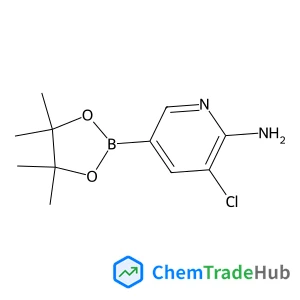
3-Chloro-5-(4,4,5,5-tetramethyl-1,3,2-dioxaborolan-2-yl)-2-pyridinamine
CAS Number:
1032758-99-8
Molecular Formula:
C11H16BClN2O2
Recommended Suppliers





Disclaimer
This page provides academic journal information for reference and research purposes only. We are not affiliated with any journal publishers and do not handle publication submissions. For publication-related inquiries, please contact the respective journal publishers directly.
If you notice any inaccuracies in the information displayed, please contact us at support@chemtradehub.com. We will promptly review and address your concerns.