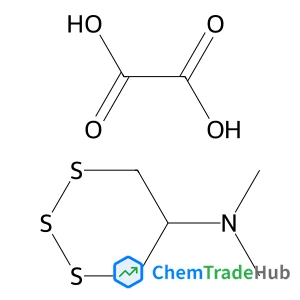
Oxalic acid compound with cyclohexylsulfamothioic O-acid (11)
CAS Number:
31895-22-4
Molecular Formula:
C7H13NO4S3
Yingying Xiong, Yunlong Chen, Lin Ding, Xiaoqiang Liu, Huangxian Ju
Sialic acid (SA), usually located at the termini of glycan chains, is one of the most important monosaccharide blocks for glycosylation of proteins. The expression level of sialoglycoconjugates (SiaGCs) in cellular secretome is of great significance in diagnosis of tumor malignancy. This work developed a fluorescent visual method for the detection of SiaGCs secreted from living cells by a boronic acid modified chip based chemoselective recognition and hybridization chain reaction. The cell-secreted SiaGCs, which were labeled with the azide group through a metabolic labeling technique during cell culture, were captured by the chip through chemoselective recognition of boronic acid toward SA. After further conjugating the azide group with an alkyne modified DNA probe, the captured SiaGCs could be conveniently endowed with the amplified fluorescent signal through a hybridization chain reaction of a pair of dye-labeled DNA hairpins, which led to a quantitative imaging method for detection of SiaGCs. The average amount of metabolically labeled SiaGCs secreted from a single HeLa cell and MCF-7 cell was 2.18 × 10⁻¹⁷ and 3.98 × 10⁻¹⁷ mol, respectively. The proposed method could be utilized to monitor the variation of the secreted SiaGCs during drug treatment, providing a useful tool for investigating the glycosylation and glycan-related biological processes.
Robert A. Hill, Marie Claire Parker
DOI: 10.1039/B301871G
Waste containing (6-Bromo-2-naphthyl)oxy](dimethyl)(2-methyl-2-propanyl)silane (...
7-Fluoro-4-isoquinolinecarboxylic acid can be synthesized via a multi-step proce...
2,3,5,6-Tetrabromothieno[3,2-b]thiophene is a crystalline compound with a high m...
1-[4-(Benzylamino)-7,8-dihydro-5H-pyrano[4,3-d]pyrimidin-2-yl]-2-methyl-1H-indol...
The market for imidazo[5,1-d]-1,2,3,5-tetrazine-8-carboxylic acid, 3,4-dihydro-3...
3-(Triisopropylsilyl)propiolaldehyde is a synthetic organic compound with the CA...
6-Nitro-2H-1,4-benzoxazin-3(4H)-one (CAS: 81721-87-1) is subject to various regu...
Waste containing (3-Fluorophenyl)(4-{[(2-methyl-2-propanyl)oxy]carbonyl}-1-piper...
N,N'-4,4'-Biphenyldiyldiisonicotinamide is a white crystalline solid with a mole...
6-Bromo-8-fluoro-2-quinazolinol is primarily used in the pharmaceutical industry...

Analyst publishes analytical and bioanalytical research that reports premier fundamental discoveries and inventions, and the applications of those discoveries, unconfined by traditional discipline barriers.
![(2S)-2-({[(2-Methyl-2-propanyl)oxy]carbonyl}amino)-4-pentynoic acid structure](https://static.chemtradehub.com/structs/630/63039-48-5-b66d.webp "(2S)-2-({[(2-Methyl-2-propanyl)oxy]carbonyl}amino)-4-pentynoic acid structure")