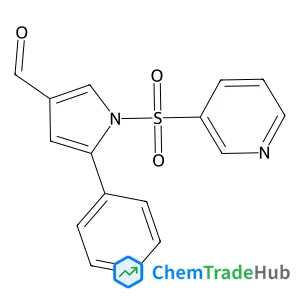
5-Phenyl-1-(pyridin-3-ylsulfonyl)-1H-pyrrole-3-carbaldehyde
CAS Number:
881676-90-0
Molecular Formula:
C16H12N2O3S
Jiangjun Liu, Meng Yu, Guobo Zeng, Jie Cao, Yuanhe Wang, Tao Ding, Xu Yang, Kang Sun, Javad Parvizi, Shaoqi Tian
A periprosthetic joint infection (PJI) with methicillin-resistant Staphylococcus aureus (MRSA) is a catastrophic deep joint infection for patients who have had joint replacement surgery. To efficiently eradicate the MRSA, curcumin–upconversion nanoparticles (curcumin–UCNPs) were synthesized by binding the curcumin onto UCNPs, which could produce singlet oxygen under near infrared (NIR) irradiation. Dual antibacterial behavior induced by the curcumin–UCNP itself and induced by photodynamic therapy were demonstrated. Nearly 100% MRSA was eradicated using curcumin–UCNPs under the NIR irradiation because of the dual antibacterial behavior in vitro. Furthermore, a MRSA-induced PJI model was constructed using Sprague Dawley rats. The NIR could penetrate the rats’ knee joint tissue well and activated the curcumin–UCNPs to perform photodynamic therapy, which exhibited a good antibacterial effect in the deep joint tissue (1 cm) and about 80% of MRSA was eradicated in vivo. Blood tests and histopathological examinations revealed that the inflammation was also significantly relieved because of the eradication of MRSA in the curcumin–UCNPs-NIR group. Compared with traditional treatments, this research may provide a new therapy for PJI.
Anand Babu Velappan, Subhashini Kogatam, Dhrubajyoti Datta, Rakshantha Srithar, Gunasekaran Nanjappan, Joy Debnath
DOI: 10.1039/C9QO00293F
Guang-Shou Feng, Zi-Biao Zhao, Lei Shi
DOI: 10.1039/C9QO00443B
Iryna Vashchenko, Andrii Gerasov, Mykhaylo Vovk, Eduard Rusanov, Volodymyr Fetyukhin, Oleg Lukin
DOI: 10.1039/C9QO00377K
Yun-Xia Qu, Rui-Lian Lin, Yun-Qian Zhang, Kai-Zhi Zhou, Qing-Di Zhou, Qian-Jiang Zhu, Zhu Tao, Pei-Hua Ma, Jing-Xin Liu, Gang Wei
DOI: 10.1039/C7QO00376E
Wei Shi, Yunfan Yang, Yu Zhao, Yongqing Li
DOI: 10.1039/C9QO00230H
Meng Yan, Xu-Bo Liu, Zhong-Zheng Gao, Yi-Peng Wu, Jun-Li Hou, Hui Wang, Dan-Wei Zhang, Yi Liu, Zhan-Ting Li
DOI: 10.1039/C9QO00382G
Huicai Huang, Xue Lu, Yukang Mao, Jinxing Ye
DOI: 10.1039/C8QO01132J
Yong You, Jian-Qiang Zhao
DOI: 10.1039/C9QO00347A
Chao-Xian Yan, Rui-Zhi Wu, Ka Lu, Fang-Ling Yang, Xiao-Shan Yang, Rui Wang, Xing Yang, Pan-Pan Zhou, Xiangfeng Shao
DOI: 10.1039/C9QO00251K
Jia-Hui Zhao, Xue-Ya Gou, Xi-Meng Chen, Yong-Min Liang
DOI: 10.1039/C9QO00240E
When considering alternatives to 1-(4-Chlorophenyl)-N-hydroxymethanimine (CAS: 3...
This compound should be stored in a cool, dry place away from direct sunlight. I...
3-(4-Bromophenyl)-5-(2-fluorophenyl)-1,2,4-oxadiazole is synthesized through a m...
5-Chloro-2-(4-chlorophenyl)-4-methyl-6-[3-(1-piperidinyl)propoxy]pyrimidine (CAS...
2-Chloro-4-(difluoromethoxy)pyridine is used in the pharmaceutical industry for ...
3-Chloro-6-methylpyridazine (CAS: 1121-79-5) is classified under the Globally Ha...
Several alternatives can be used in the synthesis of Methyl 4,5-dimethyl-2-nitro...
Alternatives to (2E,2'E)-3,3'-(1,4-Phenylene)bisacrylaldehyde include other acry...
3-Amino-5-chloropyridin-2-ol hydrochloride is an organic compound with the CAS n...
When handling 6,7-Difluoro-2,3-dihydro-4H-chromen-4-one, it is essential to wear...
Journal of Materials Chemistry A, B & C cover high quality studies across all fields of materials chemistry. The journals focus on those theoretical or experimental studies that report new understanding, applications, properties and synthesis of materials. The journals have a strong history of publishing quality reports of interest to interdisciplinary communities and providing an efficient and rigorous service through peer review and publication. The journals are led by an international team of Editors-in-Chief and Associate Editors who are all active researchers in their fields. Journal of Materials Chemistry A, B & C are separated by the intended application of the material studied. Broadly, applications in energy and sustainability are of interest to Journal of Materials Chemistry A, applications in biology and medicine are of interest to Journal of Materials Chemistry B, and applications in optical, magnetic and electronic devices are of interest to Journal of Materials Chemistry C. More than one Journal of Materials Chemistry journal may be suitable for certain fields and researchers are encouraged to submit their paper to the journal that they feel best fits for their particular article. Example topic areas within the scope of Journal of Materials Chemistry B are listed below. This list is neither exhaustive nor exclusive. Antifouling coatings Biocompatible materials Bioelectronics Bioimaging Biomimetics Biomineralisation Bionics Biosensors Diagnostics Drug delivery Gene delivery Immunobiology Nanomedicine Regenerative medicine & Tissue engineering Scaffolds Soft robotics Stem cells Therapeutic devices image block All articles published in Journal of Materials Chemistry B from 2019 onwards will be indexed in MEDLINE®. Articles that primarily focus on providing insight into the underlying science and performance of biomaterials within a biological environment are more suited to our companion journal, Biomaterials Science.