



![Benzo[b]naphtho[2,1-d]thiophene structure](https://static.chemtradehub.com/structs/239/239-35-0-ff90.webp "Benzo[b]naphtho[2,1-d]thiophene structure")
Beyond band bending in the WO3/BiVO4 heterojunction: insight from DFT and experiment
Literature Information
Publication Date
2018-11-09
DOI
10.1039/C8SE00420J
Impact Factor
6.367
Authors
Carles Ràfols i Bellés, Shababa Selim, Nicholas M. Harrison, Ehsan A. Ahmad
View Original
Abstract
Heterojunction photocatalysts can significantly enhance the efficiency of photocatalytic water splitting. It is well known that the key to such improvements lies at the interfacial region where charge separation occurs. Understanding the origins of this interfacial enhancement can enable the design of better performing water splitting devices. Therefore, in this work, a novel theoretical–experimental approach is developed for the study of photocatalytic heterojunctions using the model system – WO3/BiVO4, where it has been shown that the quantum efficiency of water splitting can approach unity at certain wavelengths. Our photoelectrochemical measurements of this heterojunction show a significantly enhanced performance over its separate components when illuminated through the BiVO4 side but not the WO3 side. This is indicative of more efficient electron transfer (i.e. from BiVO4 to WO3) than hole transfer (i.e. from WO3 to BiVO4) across the junction. Our classical band bending model of this junction predicts noticeable interfacial barriers, but could not explain the reduced performance under back illumination. Our atomistic model was used to investigate the effect of interfacial reconstructions and chemical interactions on the electronic structure of the system. The model reveals a non-staggered valence band, in contrast to the staggered conduction band, due to strong hybridization of valence band orbitals in both materials across the interface. This non-staggered valence band does not provide an energetic driving force for charge separation for hole transfer (i.e. from WO3 to BiVO4 under back illumination). Hence, a significant improvement in performance is only observed under front illumination. This combined approach, using both experiment and theory, results in a more complete understanding of a heterojunction photocatalyst system and provides unique insight into the interfacial effects that arise when two semiconductor materials are brought together, going beyond traditional band bending models.
Recommended Journals

Russian Journal of Applied Chemistry

Journal of Saudi Chemical Society

Drug Discovery Today

Organic Process Research & Development

Russian Journal of Bioorganic Chemistry

Journal of Natural Medicines

Acta Materialia

Current Opinion in Colloid & Interface Science

New Journal of Chemistry

Saudi Pharmaceutical Journal
Related Literature
A new strategy to enhance low-temperature capacitance: combination of two charge-storage mechanisms
Linghao Su, Liangyu Gong, Yang Zhao
2013-10-25
Communication
DOI: 10.1039/C3CP53747A
Probing the stability of neutral and anionic transition-metal-doped golden cage nanoclusters: M@Au16 (M = Sc, Ti, V)
Hui-Fang Li, Huai-Qian Wang
2013-10-17
Paper
DOI: 10.1039/C3CP53292E
On the correlation between dye coverage and photoelectrochemical performance in dye-sensitized solar cells
Viktor Johansson, Lilian Ellis-Gibbings, Trevor Clarke, Mikhail Gorlov, Gunther G. Andersson, Lars Kloo
2013-10-21
Paper
DOI: 10.1039/C3CP52486H
Combining ionic liquids and polyethylene glycols to boost the hydrophobic–hydrophilic range of aqueous biphasic systems
Jorge F. B. Pereira, Luís Paulo N. Rebelo, Robin D. Rogers, João A. P. Coutinho
2013-10-04
Communication
DOI: 10.1039/C3CP53701C
Copper(ii) binding to flexible triethanolamine-core PAMAM dendrimers: a combined experimental/in silico approach
Maria Francesca Ottaviani, Michela Cangiotti, Alberto Fattori, Concetta Coppola, Erik Laurini, Xiaoxuan Liu, Cheng Liu, Ling Peng
2013-11-04
Paper
DOI: 10.1039/C3CP54005G
A liquid CO2-compatible hydrocarbon surfactant: experiment and modelling
Soumi Banerjee, J. Mieke Kleijn, Martien A. Cohen Stuart, Frans A. M. Leermakers
2013-10-03
Paper
DOI: 10.1039/C3CP52571F
An ammonia-stabilized mixed-cation borohydride: synthesis, structure and thermal decomposition behavior
Yanjing Yang, Yongfeng Liu, Mingxia Gao, Hongge Pan
2013-11-14
Paper
DOI: 10.1039/C3CP54099E
NaYF4 nanocrystals with TOPO ligands: synthesis-dependent structural and luminescent properties
Mateusz Banski, Artur Podhorodecki, Jan Misiewicz
2013-09-18
Paper
DOI: 10.1039/C3CP52865K
Predicted organic compounds derived from rare gas atoms and formic acid
Min Zhang, Li Sheng
2013-10-15
Paper
DOI: 10.1039/C3CP52175C
Dynamical aspects of the unzipping of multiwalled boron nitride nanotubes
E. Perim, P. A. S. Autreto, R. Paupitz, D. S. Galvao
2013-08-09
Paper
DOI: 10.1039/C3CP52701H
You might also like
Compound Q&A
How should waste containing 6-Chloro-5-(2'-hydroxy-3'-methoxy-4-biphenylyl)-3-(3-methoxyphenyl)-1H-pyrrolo[3,2-d]pyrimidine-2,4(3H,5H)-dione (CAS: 1346607-05-3) be handled?
Waste containing 6-Chloro-5-(2'-hydroxy-3'-methoxy-4-biphenylyl)-3-(3-methoxyphe...
1346607-05-36-Chloro-5-(2'-hydro...
Compound Q&A
What are the main uses of (3alpha,5alpha)-3-Hydroxypregnane-11,20-dione (CAS: 23930-19-0)?
(3alpha,5alpha)-3-Hydroxypregnane-11,20-dione is primarily used in the pharmaceu...
23930-19-0(3alpha,5alpha)-3-Hy...
Compound Q&A
What is the market or research trend for 4-Amino-6-chloro-2-pyridinecarboxylic acid (CAS: 546141-56-4)?
The market for 4-Amino-6-chloro-2-pyridinecarboxylic acid (CAS: 546141-56-4) is ...
546141-56-44-Amino-6-chloro-2-p...
Compound Q&A
Are there alternatives to (2-Benzoylethyl)trimethylammonium chloride (CAS: 24472-88-6) in synthesis?
Alternatives to (2-Benzoylethyl)trimethylammonium chloride (CAS: 24472-88-6) in ...
24472-88-6(2-Benzoylethyl)trim...
Compound Q&A
Is N-[4-Nitro-3-(trifluoromethyl)phenyl]acetamide (CAS: 393-12-4) safe?
N-[4-Nitro-3-(trifluoromethyl)phenyl]acetamide (CAS: 393-12-4) is generally safe...
393-12-4N-[4-Nitro-3-(triflu...
Compound Q&A
Are there alternatives to [(4R,5R,6S)-5-hydroxy-10-imino-3,7-dioxa-1,9-diazatricyclo[6.4.0.02,6]dodeca-8,11-dien-4-yl]methyl dihydrogen phosphate (CAS: 39679-56-6) in synthesis?
Alternative reagents such as other phosphates or similar functional groups can b...
39679-56-6[(4R,5R,6S)-5-hydrox...
Compound Q&A
Are there alternatives to N,N'-Bis(3-aminopropyl)-1,3-propanediamine (CAS: 4605-14-5) in synthesis?
There are alternatives to N,N'-Bis(3-aminopropyl)-1,3-propanediamine (CAS: 4605-...
4605-14-5N,N'-Bis(3-aminoprop...
Compound Q&A
What precautions should be taken when handling Aluminium trihexadecanoate (CAS: 555-35-1)?
When handling Aluminium trihexadecanoate, it is important to use appropriate per...
555-35-1Aluminium trihexadec...
Compound Q&A
What is (1,1-Dioxido-3-oxo-1,2-benzothiazol-2(3H)-yl)acetic acid (CAS: 52188-11-1)?
(1,1-Dioxido-3-oxo-1,2-benzothiazol-2(3H)-yl)acetic acid is a chemical compound ...
52188-11-1(1,1-Dioxido-3-oxo-1...
Compound Q&A
Are there alternatives to 5,5-dimethyloxolan-2-one (CAS: 3123-97-5) in synthesis?
Several alternatives to 5,5-dimethyloxolan-2-one (CAS: 3123-97-5) can be used in...
3123-97-55,5-dimethyloxolan-2...
Source Journal
Recommended Compounds
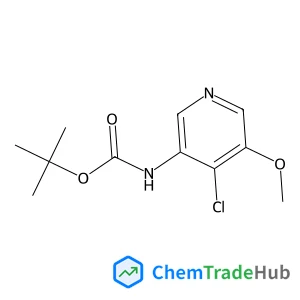
tert-Butyl 4-chloro-5-methoxypyridin-3-ylcarbamate
CAS Number:
1045858-17-0
Molecular Formula:
C11H15ClN2O3

2-Methyl-2-propanyl 4-(5-iodo-2-pyrimidinyl)-1-piperazinecarboxylate
CAS Number:
1027616-32-5
Molecular Formula:
C13H19IN4O2
![1-(2-Chlorophenyl)-6-[(2S)-3,3,3-trifluoro-2-methylpropyl]-1,7-dihydro-4H-pyrazolo[3,4-d]pyrimidin-4-one structure](https://static.chemtradehub.com/structs/794/794568-91-5-0c34.webp "1-(2-Chlorophenyl)-6-[(2S)-3,3,3-trifluoro-2-methylpropyl]-1,7-dihydro-4H-pyrazolo[3,4-d]pyrimidin-4-one structure")
1-(2-Chlorophenyl)-6-[(2S)-3,3,3-trifluoro-2-methylpropyl]-1,7-dihydro-4H-pyrazolo[3,4-d]pyrimidin-4-one
CAS Number:
794568-91-5
Molecular Formula:
C15H12ClF3N4O
![4-{[4-(Trifluoromethoxy)benzyl]oxy}benzonitrile structure](https://static.chemtradehub.com/structs/103/1036629-63-6-2172.webp "4-{[4-(Trifluoromethoxy)benzyl]oxy}benzonitrile structure")
4-{[4-(Trifluoromethoxy)benzyl]oxy}benzonitrile
CAS Number:
1036629-63-6
Molecular Formula:
C15H10F3NO2
Recommended Suppliers






Disclaimer
This page provides academic journal information for reference and research purposes only. We are not affiliated with any journal publishers and do not handle publication submissions. For publication-related inquiries, please contact the respective journal publishers directly.
If you notice any inaccuracies in the information displayed, please contact us at support@chemtradehub.com. We will promptly review and address your concerns.