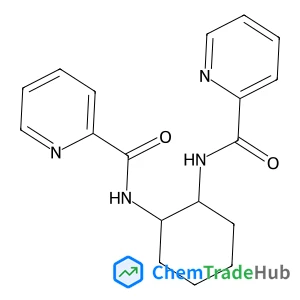
N,N'-(1R,2R)-1,2-Cyclohexanediyldi(2-pyridinecarboxamide)
CAS Number:
218290-24-5
Molecular Formula:
C18H20N4O2
Ana María López Fernández, Abdul Rehman, Adam P. Harvey
The development of a limonene epoxidation process using environment-friendly H2O2, with high H2O2 conversion (∼95%) and selectivity to the epoxide (100%), is reported in this paper. Parametric studies of temperature, oxidant, solvent, acid concentration and sodium sulphate amounts were performed with the focus on establishing a rapid and highly selective process. Approximately 95% conversion of H2O2 at 100% selectivity to limonene-1,2-epoxide was achieved in 15 minutes with a single-step addition of oxidant. The operating conditions included a 323 K temperature in a solvent-free environment, with a limonene/H2O2/catalyst molar ratio of 4 : 1 : 0.005, using a tungsten-based polyoxometalates. To prevent the hydrolysis of the epoxide, the reaction mixture was saturated with sodium sulphate. An acid concentration of lower than 0.04 M was used and found to have significant effect on the selectivity. Kinetic studies were performed to allow modelling of the reaction scheme. The activation energy was determined to be ∼36 kJ mol−1.
Weijia Mao, Jit Sarkar, Bo Peng, Atsushi Goto
DOI: 10.1039/D1PY01087E
J. Jamnik, J. Maier
DOI: 10.1039/B100180I
Simon D. Elliott, Simon P. Bates
DOI: 10.1039/B101804N
Wulf Hofbauer
DOI: 10.1039/B100764P
M. E. Tucceri, M. P. Badenes, A. E. Croce, C. J. Cobos
DOI: 10.1039/B100348H
Barbara D'Anna, Sarka Langer, Evert Ljungström, Claus J. Nielsen, Maria Ullerstam
DOI: 10.1039/B100855M
DOI: 10.1039/D1PY01073E
Kristine Pierloot, Annelies Delabie, Marijke H. Groothaert, Robert A. Schoonheydt
DOI: 10.1039/B100531F
Yuko Kato, Ken-ichi Shimizu, Norimitsu Matsushita, Tomoko Yoshida, Hisao Yoshida, Atsushi Satsuma, Tadashi Hattori
DOI: 10.1039/B100610J
6-Bromo-2-methylimidazo[1,2-a]pyrimidine (CAS: 1111638-05-1) falls under various...
While there are no direct alternatives, similar compounds like 1-Pyrrolidineetha...
4-Methyl-2,6-bis(2-methyl-2-propanyl)phenyl methylcarbamate (CAS: 1918-11-2) is ...
2-(3-Bromo-4-fluorophenyl)-1,3-dioxolane (CAS: 77771-04-1) should be stored in a...
4,5,6,7-Tetrahydro-1H-indazole hydrochloride is a white crystalline solid with a...
(2R)-1-Methoxy-3-phenyl-2-propanamine is a chiral organic compound with the CAS ...
Ethyl 1-(1-phenylethyl)-1H-imidazole-5-carboxylate is used in various industries...
4-[(1E,3S)-1-(4-Hydroxyphenyl)-1,4-pentadien-3-yl]phenol (CAS: 17676-24-3) falls...
(S)-3-Amino-5-phenylpentanoic acid hydrochloride is primarily used in the pharma...
7-Methoxy-1-benzothiophene-2-carboxylic acid is typically synthesized by reactin...

Reaction Chemistry & Engineering is an interdisciplinary journal reporting cutting-edge research focused on enhancing the understanding and efficiency of reactions. Reaction engineering leverages the interface where fundamental molecular chemistry meets chemical engineering and technology. Challenges in chemistry can be overcome by the application of new technologies, while engineers may find improved solutions for process development from the latest developments in reaction chemistry. Reaction Chemistry & Engineering is a unique forum for researchers whose interests span the broad areas of chemical engineering and chemical sciences to come together in solving problems of importance to wider society. All papers should be written to be approachable by readers across the engineering and chemical sciences. Papers that consider multiple scales, from the laboratory up to and including plant scale, are particularly encouraged.
![(3aS,6aS)-1-Methyloctahydropyrrolo[3,4-b]pyrrole structure](https://static.chemtradehub.com/structs/877/877212-98-1-9157.webp "(3aS,6aS)-1-Methyloctahydropyrrolo[3,4-b]pyrrole structure")
![9H-Fluoren-9-ylmethyl {15-[(2,5-dioxo-1-pyrrolidinyl)oxy]-15-oxo-3,6,9,12-tetraoxapentadec-1-yl}carbamate structure](https://static.chemtradehub.com/structs/131/1314378-14-7-4316.webp "9H-Fluoren-9-ylmethyl {15-[(2,5-dioxo-1-pyrrolidinyl)oxy]-15-oxo-3,6,9,12-tetraoxapentadec-1-yl}carbamate structure")